Mixed signals · A public show
They invited you to their show. Is it a date?
Ask what the invitation means
A public show invitation may mean a seat in the audience, time together, or both. It does not tell you which. Ask kindly: 'Will you be working the whole evening, or would you like to spend time together too?' Check the event's own ticket details before buying. You may go because you want to enjoy the show, suggest a separate date, or decline. A musician's work time is not proof of romantic interest or disinterest.
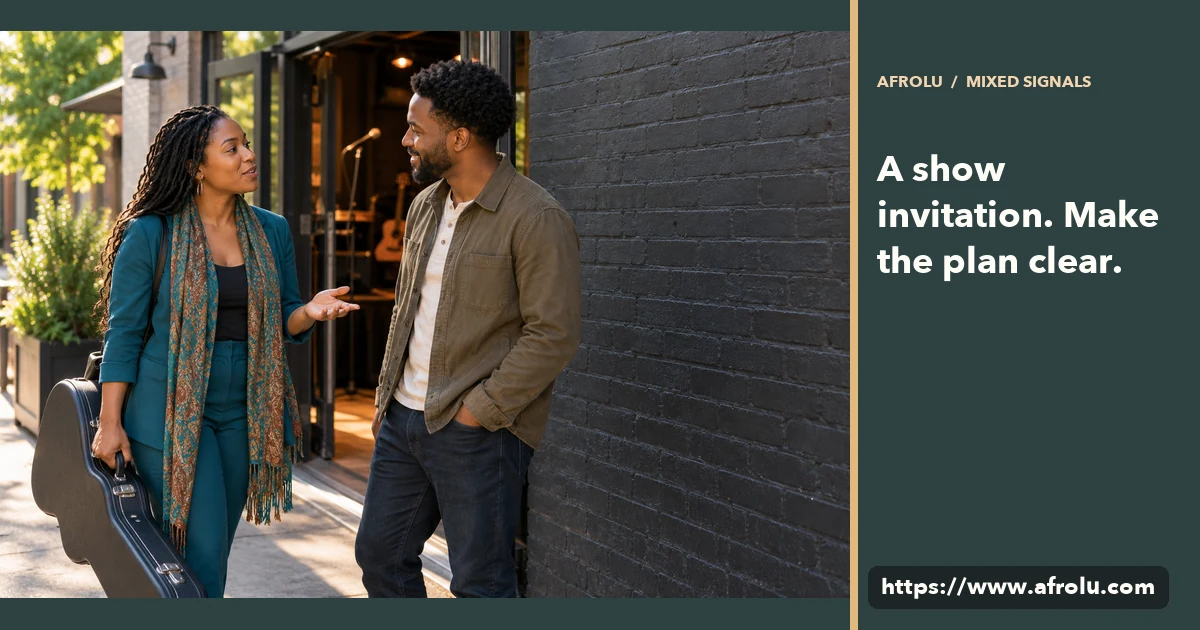
After two dates, Nkosana receives a warm invitation from Ohemaa, a musician playing a public show on Saturday. He likes her and hopes for a serious relationship. He would enjoy hearing her music, but he does not know if they will spend any time together. Ohemaa will be working during the show. Nkosana can ask before choosing how to spend his evening.
Ask about the part you cannot see
Nkosana can say, 'Thank you for inviting me. Will you be free to spend time together, or would you like me to come as an audience member?' Both answers are useful. Ohemaa may be performing, preparing or talking with the team before and after the show.
An invitation to watch someone's work can be kind without being a date. Asking for clarity is not asking the performer to stop working or prove their feelings.
A clear question
A question before Saturday
Invented messages between adult daters Nkosana and Ohemaa.
- Nkosana
- “I'd enjoy hearing you play. Will we have time together, or is this an invitation to the show?”
- Ohemaa
- “I'll be working all evening. I'd love to see you there, and we could have coffee on Sunday if you like.”
- Nkosana
- “Thanks for explaining. I'll check the show details and let you know about both plans.”
The adults separate audience time from a possible date; neither is a promise of a relationship.
Treat a ticket and a date as separate choices
If the event needs a ticket, Nkosana can check the current price, access and terms through the venue or its official seller before buying. A ticket can give him a place at the show; it does not promise personal time with Ohemaa.
He can decide whether the event is worth the cost to him even if they cannot meet afterward. He need not send money to a date to prove support. Event rules and costs differ, so check the actual organiser's information.
Three parts of the invitation
The showWould I enjoy attending even if we do not meet?
Time togetherHave we agreed on a separate time and place?
The costWhat does the official event information say?
A different date can fit their work
If Ohemaa cannot talk during the show, she may suggest another public meeting. Nkosana may offer one too if he wants. Neither adult must promise more time than they have or attend a show they do not enjoy.
If he wants a serious relationship, that hope can guide what he asks next. One invitation cannot establish exclusivity or predict whether their goals fit. Those are conversations both adults can choose to have.
Choose your evening
Which plan works for you?
- The show itself appeals to you
Check the event details and attend if you choose.
- You want time to talk
Agree on a separate time if both adults want one.
- Neither plan works for you
Decline and use your evening as you wish.
Use the answer, not a guess about intent
If Ohemaa says she can meet before the show, they can agree on a time and place. If she is working all evening, Nkosana can still attend for the music, make a separate plan, or stay home. If the answer stays unclear, he may choose the evening that works for him.
Respect includes listening and allowing a no. A disappointed response is human; repeated pressure to buy a ticket or give up your plans is a reason to reconsider. You do not need to label the other person to protect your choice.
Keep reading
Make the next plan clear
Sources and what they can tell us
Nkosana, Ohemaa and the show are invented Afrolu examples. Event access and ticket terms vary; the sources support respectful communication and public meeting choices, not a reading of anyone's feelings.
- Love is respect: Boundaries and expectations
It explains discussing expectations and respecting another person's boundaries.
Limit: It does not decide whether a show invitation is a date or set the venue's ticket terms. - Love is respect: What is respect in a healthy relationship?
It describes listening and valuing each person's needs and choices.
Limit: It cannot tell Nkosana whether Ohemaa wants a serious relationship. - eSafety Commissioner: Online dating
It encourages adults to keep control of their choices and meet in public when meeting someone new.
Limit: It does not verify this invented event or require anyone to buy a ticket.
Questions about the invitation
Does inviting me to a show prove romantic interest?
No. You can enjoy the invitation and ask what kind of time is available without guessing their feelings.
Must I buy a ticket to support them?
No. You decide whether the event and its cost work for you.
Is it rude to ask if we will meet?
A kind question helps both adults understand the plan. Accept their answer, including a work commitment.
What if they offer a separate date?
Agree only if you both want to and the time and place work for you.