Career-heavy dating · serious intent · clear plans
When words and plans disagree, ask about the plan
Dating around a demanding career can blur intent. Compare promises with actual plans, ask one direct question and decide whether the rhythm fits your hopes.

The repair after a changed plan matters more than a job title or a flattering future statement.
Written and edited by Liya Bekele · Horn of Africa Editor
You cannot read commitment from a job title, a warm message or one cancelled dinner. Compare the specific invitation with what happened: Was there early notice, a workable alternative and a kept follow-up? State what you need in the present month, then ask whether the other adult can offer it. Some demanding careers make scheduling hard without making a person dishonest. If every concrete plan slips into an unspecified future, you may decide the available relationship does not fit your serious aim, even without knowing why the other person acts this way.
Dating behaviour · Professionals
They say they want a serious relationship but keep changing plans. Is this normal busyness or a mismatch I should stop explaining away?
Mixed signals are statements and actions that seem to point in different directions, such as speaking about a future relationship while repeatedly avoiding an agreed present plan. They describe a confusing pattern, not a diagnosis of motive or attachment style.
Illustrative scenario: A person says they want a committed relationship and proposes Thursday dinner. On Wednesday they cancel for work, apologise and offer a specific Saturday breakfast, which they keep. A different pattern would be three cancellations followed by 'soon, when things settle' and no new date. Both include a cancellation; only the sequence tells the reader what relationship is actually available.
The month in front of you
Move from an appealing promise to an available plan
This is not a scorecard for how busy someone is. It is a way to see whether two adults can make and repair the smallest agreement needed to keep dating.
Put words, a dated invitation, any change and the offered repair in sequence. Then ask whether the result is enough for you.
What was said?
Keep the serious aim separate from a promised timetable.
What was booked?
A date and place are different from 'we should meet'.
What followed change?
Notice early notice and a workable alternative.
Is this enough now?
You may want more even when the explanation is genuine.
Read the sequence
A cancellation means less than the next action
Work can interrupt a dinner without erasing interest. What happens next gives the event meaning: early notice, acknowledgement of the cost, an alternative that both can accept, and follow-through. A person who says 'Thursday is impossible; could Saturday morning work?' has made a different offer from someone who disappears until the next affectionate message. The point is not to reward perfect attendance, but to see whether plans can survive ordinary life.
Keep the sequence small enough to remember accurately. Note the proposed date, the change, the next offer and whether it happened. Avoid collecting screenshots to prosecute a stranger over every delayed reply. If a repeated pattern emerges, you need not decide whether ambition, uncertainty or competing dates caused it. You can decide whether the rhythm itself is enough for the relationship you want.
Words are information
Future talk and a present invitation do different jobs
Someone may sincerely want a serious partner one day and have little room for dating today. That is not a deception by itself. It becomes confusing when a future story is offered every time you ask about a next meeting. Say what a workable present connection means to you: perhaps a planned outing this month and a call if work changes it. The other adult can say yes, suggest a different rhythm or admit they cannot offer that now.
love is respect distinguishes expectations from boundaries and advises people to discuss an unspoken standard. Its guidance supports a direct conversation but does not create a required number of dates. Your standard is a personal choice. If you need more than the other adult can give, that is a compatibility question even if each person's intentions are good and career demands are real.
Be careful with digital clues. A late-night affectionate text may be genuine, yet it does not book time. A quiet workday may feel cold, yet it does not prove disinterest. Digital-boundary guidance asks people to discuss contact expectations rather than monitor devices. The more reliable question is whether the person can respond to a specific invitation and make a new plan when one falls through.

The reader's own needs matter after the sequence.
Four parts of a real plan
- Dated invitation
- An actual day is proposed, not only 'soon'.
- Change explained
- A changed plan is acknowledged in time.
- Repair offered
- A specific alternative follows if wanted.
- Next plan kept
- The new plan happens or another honest answer is given.
Keep in mind: Read the sequence of a plan and its repair, not a presumed hidden intention.
One clear ask
Give the other adult a question they can answer
Try one direct question rather than several hints. 'I am looking for a serious relationship. Could we choose a day this month that we can both keep?' leaves room for the person to describe a real constraint. Do not offer a schedule you cannot keep just to make the answer easy. Ask once in a calm moment, not during a work crisis or after a barrage of messages.
A helpful reply may be a date, an honest counteroffer or an admission that they cannot date in the way you need right now. A vague 'soon' may also be an answer if it repeats after you have asked for specifics. You are not obliged to keep reformulating the question until the other adult gives the response you hoped to hear.

No invented app chat or work schedule is shown.
One answerable question
An optional way to say it
I have enjoyed our conversations, and I am looking for something serious. Could we choose a day we can both keep this month? If that is not possible now, I would rather know.
What the line does
- Name serious aim
- Ask for this month
- Allow counteroffer
- Accept honest no
Keep in mind: Ask whether one meeting this month is actually possible and let the answer be real.
What research can say
Responsive acts matter, but a study cannot read this date
A daily-life study of 102 young heterosexual dating couples found that enacted responsive acts related to how responsive partners felt, and perceived responsiveness related to intimacy. That one-week research concerns established couples, not this varied professional dating audience; it cannot infer commitment from two cancelled dates or set a reply-time threshold. Its useful lesson is narrower: actions inside a relationship can matter alongside people's descriptions of themselves.
A larger analysis across 43 longitudinal couple datasets found that relationship-specific perceptions, including perceived partner commitment, were among the stronger predictors of relationship quality. That result does not tell you that a busy new date is committed or uncommitted. It does reinforce why your own lived experience of a relationship matters. If the available arrangement repeatedly leaves you unsure, your need for clarity is part of the decision, not a flaw to argue away.
Research cannot replace a conversation about this month. Notice whether the other person recognises the cost of changed plans and whether an alternative materialises. Also notice your own role: are you asking for a rhythm you would actually enjoy, or one that only looks reassuring on paper? A smaller, reliable plan may be better than a grand future itinerary neither person can keep.
Decide from today
You may leave a sincere connection that cannot be lived
If a specific plan is made and kept, see how it feels and let the connection develop without turning one repaired cancellation into a permanent guarantee. If the answer remains future-only, say the present arrangement does not work for you. That decision does not accuse the other adult of lying. It says that the relationship available now does not meet a serious hope you are allowed to have.
Close any booked plans instead of fading while waiting for a final sign. A simple 'I have enjoyed talking, but I need a steadier way of meeting and will not continue dating' is enough when safe to send. If the other adult later offers a concrete change, you can assess it afresh; you are not required to stay on standby for a promised quieter quarter.

No one must stay on standby.
Decide from this month
- Separate words and planWrite the invitation and the change in sequence.
- Ask one direct questionAsk for one day this month that can be kept.
- Observe the answerNotice a specific counteroffer or honest limit.
- Choose from todayContinue for the available rhythm or part clearly.
Keep in mind: record a specific invitation and change, ask once for a present plan, observe repair and decide fit without diagnosing motive
Two cancelled dinners, two different sequences
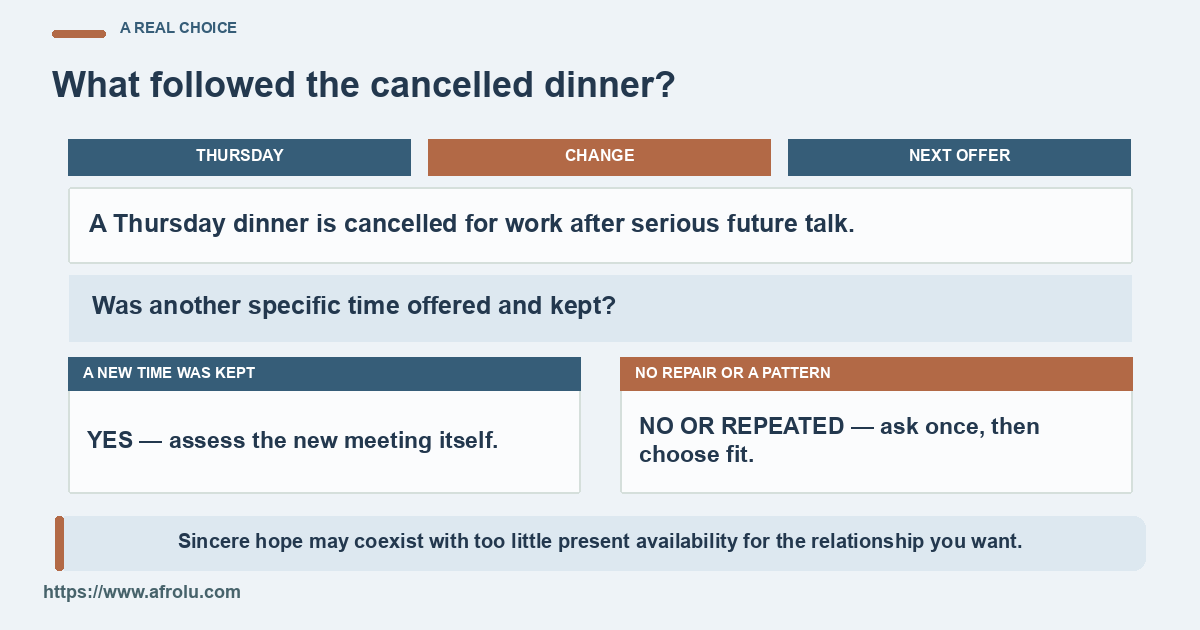
What followed the cancelled dinner?
- What happened
- A Thursday dinner is cancelled for work after serious future talk.
- Question to ask
- Was another specific time offered and kept?
- YESassess the new meeting itself.
- NO OR REPEATEDask once, then choose fit.
Keep in mind: Sincere hope may coexist with too little present availability for the relationship you want.
Work cancels dinner and a specific Saturday meeting follows
A disruption was noticed and repaired.
See whether the alternative is kept and enjoyable.Every invitation waits for an undefined quieter quarter
The present relationship has no available meeting rhythm.
Ask once what this month can hold.Affection arrives after another unbooked weekend
A message can be sincere without creating a plan.
Separate the words from the next invitation.Both adults like one another but need different contact
A sincere connection may still be insufficient for one person.
Name the mismatch without assigning a hidden motive.What a plan looks like in motion
An invitation contains an actual day both can choose.
A change arrives with enough notice to respect the other person's time.
The person who changes a plan can offer a workable alternative.
At least one agreed alternative is kept or honestly revised.
Both adults can say whether that rhythm meets their present needs.
Ask for a date this month
| Situation | What it may mean | What to do next |
|---|---|---|
| One work emergency | A cancellation can happen in a sincere connection. | Notice notice, acknowledgement and repair. |
| Three future promises | A serious aim has not become an available plan. | Ask for one real day this month. |
| The counteroffer is too rare | A plan can be genuine yet not meet your need. | State your minimum and decide fit. |
| A direct question gets 'soon' | The other adult may not be able to offer a date now. | Treat the present answer as information. |
| The plan is kept | Follow-through answers one concrete question. | Enjoy the meeting; keep future conclusions proportionate. |
A direct question without a cross-examination
“I like seeing you and I am dating for a serious relationship. Is there a day this month we can both protect?”
“I understand work changed Thursday. I need to know whether Saturday is a real alternative before holding the time.”
“I have enjoyed talking, but I need a steadier way of meeting than we can arrange now. I will not continue dating.”
Know the difference
A repaired plan versus a future-only promise
Thursday changed with notice; Saturday was offered and kept.
Every date moves to 'when work calms down' without a concrete opening.
Sincere hope may coexist with too little present availability for the relationship you want.

A sincere mismatch can still be a reason to part.
Repair versus future talk
Present repair
Thursday changed with notice; Saturday was offered and kept.
Future-only
Every date moves to 'when work calms down' without a concrete opening.
Questions that clarify the difference
- Specific invite?
- Early notice?
- New time offered?
- Enough for you?
Keep in mind: Sincere hope may coexist with too little present availability for the relationship you want.
Repaired Thursday versus permanent someday
| Type or dimension | What it describes | Best next question |
|---|---|---|
| Serious language | A hope or intention about the future. | Ask what it can mean this month. |
| Specific plan | A day and place both adults can accept. | Give it a fair chance to happen. |
| Repair | A changed plan gets notice and a usable alternative. | Observe whether the alternative holds. |
| Mismatch | The offered rhythm is too little for one person. | Leave clearly without a character verdict. |
Decide from today's offer
Busy is not a diagnosis
A career title cannot tell you whether someone will make or keep a plan.
Repair is information
A specific alternative says more about present capacity than a perfect apology.
Your need counts
Sincere interest need not be enough for the serious relationship you want.
Questions after the answer
Choose a few prompts that fit the moment. This is a reference library, not a list to complete.
After a changed plan
Read the whole sequence without scoring personality.
- When was I told?
- Was another day offered?
- Did it happen?
Before deciding to stay
Ask what the available connection gives you now.
- Is the pace enough for me?
- Have I asked directly?
- Am I waiting for an unnamed season?
What couple studies can and cannot tell you
Enacted care
A one-week study of 102 young heterosexual dating couples linked responsive acts with perceived responsiveness and intimacy.
Evidence limit: Established couples, not a diverse career-specific first-date sample or proof of commitment.
Relationship quality
An analysis of 43 couple datasets found relationship-specific perceptions among stronger predictors of reported quality.
Evidence limit: Population-level associations, not a test for this new date.
Expectations
love is respect recommends discussing an unspoken standard.
Evidence limit: It does not prescribe a number of meetings per month.
Digital clues
love is respect includes contact expectations in digital boundaries.
Evidence limit: A late reply or warm text alone cannot establish intent.
Disagreement
love is respect distinguishes respectful conflict from coercion.
Evidence limit: A genuine scheduling mismatch need not imply wrongdoing.
Mind reading from a busy calendar
Counting late texts as plans
Affectionate words do not reserve time together.
Diagnosing from a job
Work pressure alone says nothing certain about intent or attachment.
Waiting through indefinite quarters
A hoped-for future can postpone a present fit decision repeatedly.
Ask about one present plan
A specific meeting, changed plan and offered repair show what can be lived now, even when future hopes sound sincere.
Explore the guide library
Continue with Afrolu
Responsiveness, expectations and communication studies
Afrolu reviewed these health, research, safety, or public guidance resources while editing this page. They support the behaviour and safety guidance; they do not diagnose any individual described by a reader.
Questions about mixed signals around work
Does one cancellation mean mixed signals?
No. Notice whether the change is acknowledged and a workable alternative follows.
What if they say they want something serious?
Hear that aim, then ask what a present meeting rhythm could be. A future wish alone does not book time.
Are late-night texts proof of interest?
They can express interest, but they cannot by themselves answer whether plans are made and kept.
Could work genuinely be too busy right now?
Yes. The explanation can be true while the available relationship still does not fit what you need.
Do I need proof they are misleading me to leave?
No. A persistent difference between what is offered and what you want is enough reason to part kindly.
One thing to do now
Choose the relationship that is available
Ask for one concrete present plan, observe the response and decide whether the offered rhythm fits; you do not need to solve the other person's motive.