Two-calendar boundary room · parent clarity
Read Intense Attention Without Opening Family Life
A sourced Nairobi parent guide to love-bombing patterns: slow contact, protect child privacy, decline gifts, test boundaries safely and close access clearly.
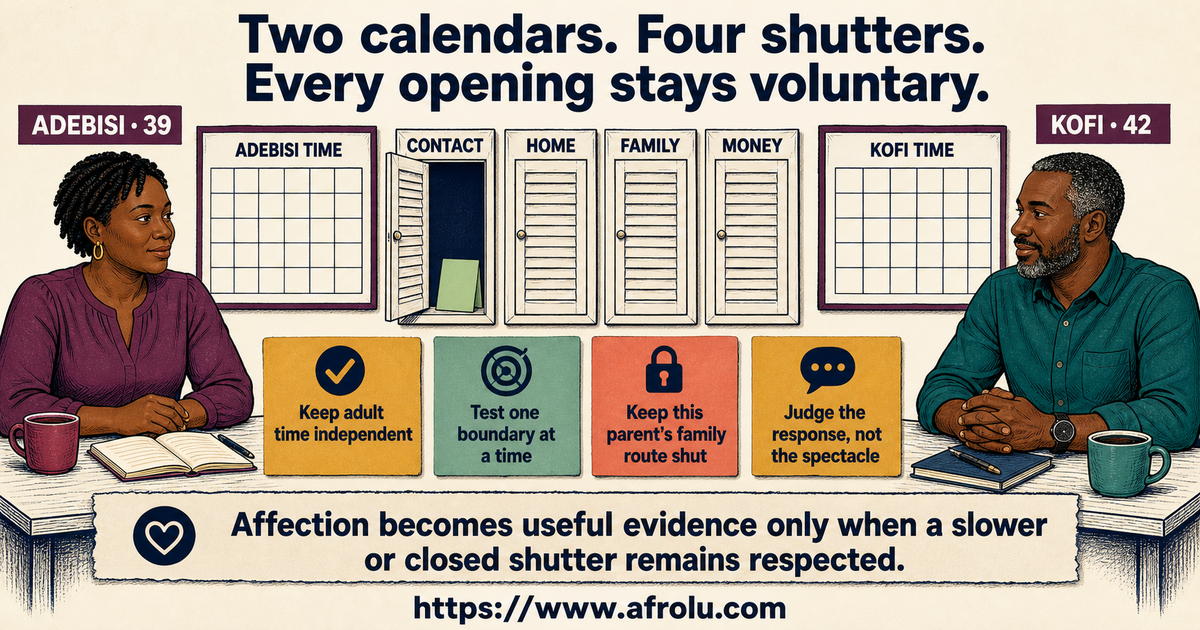
Warm attention can wait outside any boundary that is not open.
Written and edited by Adwoa Boateng · Dating Safety Editor
Keep two adult calendars separate and treat CONTACT, HOME, FAMILY and MONEY as four independent shutters. Describe the intensity, compare claims with elapsed knowledge, make one genuine pace or access boundary when safe, and observe the response. Then ENJOY SLOWLY, ASK DIRECTLY, RESET PACE, KEEP FAMILY PRIVATE, RETURN GIFT, CLOSE CONTACT, SECURE SYSTEMS or SEEK PROTECTION according to present evidence.
Emotional safety · Parents Returning To Dating
How can a parent assess intense attention without diagnosing a match, exposing family life, accepting gift debt or waiting for threats and blocked exit to become a clearer pattern?
Love bombing is a non-diagnostic behaviour label for intense attention, idealisation, gifts or future claims that press access or create leverage. Intensity alone does not prove motive, fraud or abuse. Clarity comes from observable conduct after a boundary, while parenthood remains private life context rather than a reason for family inspection.
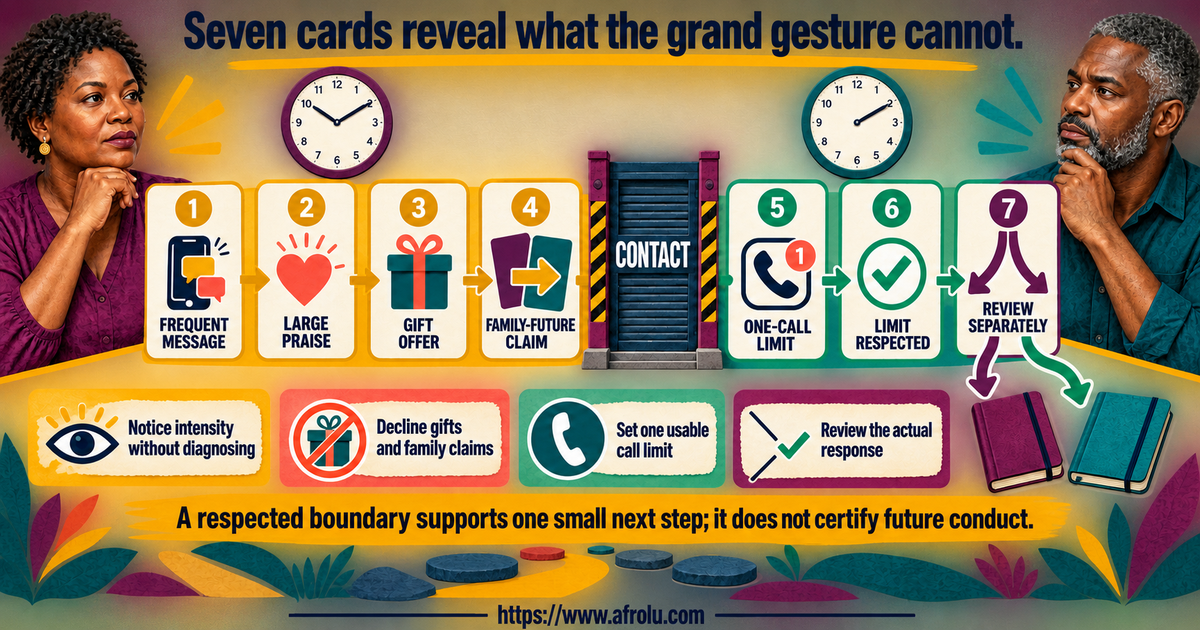
Adebisi, 39, and Kofi, 42, are fictional Black African adults and parents in Nairobi. Seven cards move from praise, a gift and family-future claims to one slower call boundary and two private reviews. No child, real contact, family detail or guaranteed interpretation appears.
The parent Nairobi two-calendar room
Read attention on one page and access on another
Adwoa keeps love bombing non-diagnostic, parenthood child-private and clarity anchored in what happens after a real adult boundary.
Separate calendars, close four access shutters, compare promises with elapsed evidence and route the boundary response proportionately.
Protect time
Offer a bounded adult window without disclosing the care system behind it.
Keep choice
Let each adult accept, counter, pause or close without punishment.
Separate access
Contact, home, family and money never open as one bundle.
Read response
Use respect for one next step and direct risk for immediate protection.
Start with two separate calendars
Separate welcome attention from access to a parent's time, home, family and money
Love bombing is used here as a behaviour label for intense attention, idealisation, gifts or future claims that press access or create leverage. It is not a mental-health diagnosis and does not prove a personality type. Enthusiasm, generous gestures and fast mutual interest can occur without manipulation. The practical question is narrower: what happens when either adult asks for less contact, slower timing or a closed route?
Being a parent identifies an adult's responsibilities; it does not score exposure, select a relationship aim or invite household scrutiny. Availability can be explained with times the adult chooses to offer. Names, photographs, voices, schools, schedules, carers, care logistics and whereabouts of children stay outside the dating exchange. Every fictional moment on this page contains adults only, and a complete dating boundary never requires opening the family system.
Picture two calendars that never merge automatically. Each adult controls when dating attention is welcome. Four shutters—CONTACT, HOME, FAMILY and MONEY—open through separate, specific permission. Opening CONTACT for one planned call does not open the home, introduce family, authorise gifts, close other romantic routes or create continuous availability. A previous opening can close again without an accusation or debt.
Begin with one small boundary that fits ordinary safe communication. Slow messages, decline a large gift, keep a future claim hypothetical or refuse a family question. Read what follows that limit. Respect supports one next step but cannot certify future conduct. Bargaining, punishment, new-channel pursuit or a direct threat changes the evidence. When danger is present, do not stage another test merely to make the label certain.
Read attention and access on different pages
Let elapsed time, mutual knowledge and boundary response carry more weight than spectacle
Attention can be pleasant and still exceed the access an adult wants. Frequent messages may fit two people who freely choose them, while a single unwanted call may cross a stated boundary. Count is less informative than consent, reversibility and response. Ask whether both calendars can say not now, whether the offer can be declined and whether warmth remains respectful when the answer is smaller than hoped.
Future language deserves its own page. Talking about travel, partnership or family may be exploratory, but it becomes misleading when the imagined future is presented as evidence about a person who is barely known. Keep statements in the conditional until time and conduct support more. A parent can enjoy hope while refusing family introductions, co-residence plans, caregiving assumptions or claims of instant belonging.
Gifts are also separate agreements. A modest freely offered item may be welcome; an expensive or unwanted gift can create pressure even if the giver denies intending it. The receiver may decline, return or donate according to safety and practicality. Payment creates no entitlement to reply speed, exclusivity, home access, sexual contact, forgiveness or family inclusion. A stipulation added later is evidence of leverage.
The University of Arkansas study often cited around love bombing examined correlations among self-reported tendencies in 484 college students aged 18 to 30 at one southern United States university. It cannot diagnose a Nairobi match, establish motive or represent parents. Use it only as evidence that the research base is narrow, not as permission to label a person from compliments, attachment language or a personality theory.
Follow one fictional boundary response
Adebisi and Kofi turn seven early-attention cards into a small, reviewable choice
Adebisi is 39 and has exchanged messages with Kofi, 42, for nine days. The conversation feels warm. Kofi sends frequent praise, offers a costly gift and speaks about a future in which their families already fit. Adebisi neither declares the conduct harmless nor assigns a diagnosis. She notes that elapsed knowledge is small and that three unopened shutters—HOME, FAMILY and MONEY—are being approached together.
She declines the gift and says she wants one planned call rather than continuous messages. She also states that family information and access remain outside the dating route. The boundary is not a trap designed to provoke Kofi; it describes what Adebisi genuinely wants. She does not provide a child's age, schedule, image or reason that would let the new contact reconstruct the household.
Kofi says he is disappointed but accepts the call window, stops the extra messages and makes no new future claim. During the call, he asks what pace feels workable and answers the same question himself. Adebisi enjoys the conversation. His response is supportive evidence for one small next step, not proof that every claim is accurate or that later boundaries will always be respected.
Each adult reviews the boundary alone. Adebisi wants another public date but no gift or family discussion. Kofi can accept that pace. Either adult could instead close because the desired rhythms differ. The useful result is not that intensity won; it is that a real boundary replaced speculation. If Kofi had punished, threatened or bypassed the limit, the next route would have been protection rather than a better explanation.
Sort sixteen signals before naming the route
Distinguish intensity, time, access and direct safety facts without a motive score
INTENSITY asks whether praise refers to something actually known, future language remains open, gifts can be declined and contact can slow. Large affection is not automatically abusive, and modest affection is not automatically safe. The strongest ordinary evidence is reversibility: can either adult reduce the volume or say no without warmth becoming contempt, disappearance becoming punishment or persuasion becoming relentless?
TIME asks whether calendars remain separate, plans have edges, missed commitments can receive proportionate repair and silence is not punished. Parenting does not require constant interruption or total unavailability; it means the adult defines what dating time exists. A free hour is not automatic access, and a care conflict never needs to be proved by exposing a household. Compatibility may still fail without anyone behaving abusively.
ACCESS asks whether home stays closed, family stays private, devices remain personal and money stays separate. These shutters do not open as a bundle. A public date creates no right to transport, residence entry, family contact, account passwords, live location, intimate content or financial help. Another person's urgency, expense or declaration of love cannot supply the missing consent.
SAFETY facts include threats, stalking, child approaches, image pressure, fraud and blocked exit. Kenya's Protection Against Domestic Violence Act includes harassment, stalking, intimidation, economic and psychological abuse within defined domestic relationships, but only a qualified adviser can apply law to specific facts. For immediate danger use current urgent help; for other exposure consider safe evidence preservation, account security and specialist support.

Praise does not excuse stalking, financial pressure, image abuse or an overridden exit.
Compare nine intensity patterns
Keep enthusiasm, idealisation, access pressure, mismatch, fraud and control distinct
WARM ENTHUSIASM leaves space for either adult to slow down. FAST MUTUAL PACE is chosen by both and remains revisable. IDEALISATION appears when the imagined person or family future exceeds elapsed evidence. Each may involve frequent contact, praise or hope, so message count alone cannot separate them. Preserve separate calendars and let ordinary conduct over time carry more weight than spectacle.
A LOVE-BOMBING PATTERN uses attention, gifts or future claims to press access or create leverage. PARENT-BOUNDARY MISMATCH may instead be an honest disagreement about family privacy or introductions, while GIFT LEVERAGE attaches an item to reply, access, forgiveness or sex. Set no dangerous test: keep every child detail closed, decline or return an unwanted gift when safe, and accept incompatibility without diagnosing a personality.
WIDER DISTRESS means serious changes continue across ordinary life beyond this contact; qualified local care can assess what a webpage cannot. That route differs from relationship redesign. A parent may pause dating and seek care while still keeping home, family and device access closed. Neither distress nor parenthood explains another adult's motive, and neither makes intrusive attention acceptable.
ROMANCE FRAUD turns affectionate contact into a path toward funds, credentials, records or system entry. COERCIVE CONTROL erodes choice by watching, isolating, intimidating or refusing an ending. Secure exposed accounts, contact each relevant provider and move threats or defeated exit to current safeguards instead of polishing either label. Kenya's law may cover defined close personal relationships, while ODPC and eSafety material clarify narrower privacy and technology contexts; none supplies case-specific certainty here.
Use twelve lines that do not expose the family
State pace, future, gifts, calendars, privacy, consent and closure completely
PACE can hold warmth and a limit: ‘I like you, and I am slowing contact to one planned call.’ CONTACT can define when messages are read. PRAISE can accept the kind part without accepting a total story: ‘Thank you; we are still learning each other.’ FUTURE can remain conditional. None of these lines diagnoses motive or promises that slowing will reveal a person perfectly.
GIFT should state the decision and remove debt: ‘I am not accepting this gift; it creates no future claim.’ CALENDAR names adult availability without the care system behind it. HOME stays closed until separately chosen. FAMILY needs an explicit privacy wall: no names, images, schedules, introductions or contact routes. A new match may decide that this pace does not fit; that is incompatibility, not a reason to open the shutter.
MONEY stays separate from affection, and CONSENT stays specific to each adult act. A gift, dinner, earlier yes, relationship label or declaration of love does not decide an image, sexual conversation, touch or private visit. PAUSE can suspend one channel or all contact without a return promise. Each line should be shorter than the argument it prevents, while still naming the route and its edge.
CLOSE can say, ‘I am ending contact; do not use new, work or family channels.’ No further explanation is required. If the person returns through alternate accounts, approaches a child, threatens, tracks, impersonates or shares material, the question is no longer how to phrase a boundary. Lock down exposed systems, retain useful records when doing so is safe, and choose current Kenyan provider, specialist, legal or emergency support that fits the incident.

A boundary is a statement of access, not a request to diagnose intent.
Choose one of eight equal routes
Let the boundary response lead to enjoyment, redesign, closure, security or protection
ENJOY SLOWLY when attention is welcome, knowledge is growing and limits are respected. ASK DIRECTLY when one statement about pace, intent or future would resolve an ordinary ambiguity. RESET PACE when both adults want contact but the volume does not fit. Test a specific rhythm and review conduct; do not use constant availability as a demonstration that the relationship is real.
KEEP FAMILY PRIVATE regardless of how promising adult contact feels. RETURN GIFT when an item is unwanted, disproportionate or becoming leverage, provided return itself is practical and safe. CLOSE CONTACT when the pattern, fit or person is not wanted. A parent owes no diagnostic case, family explanation, friendship offer or extra meeting to make that ending legitimate.
SECURE SYSTEMS when devices, passwords, accounts, documents, location, funds or intimate material may be exposed. Change access through channels under your control and contact relevant providers quickly. SEEK PROTECTION for threats, stalking, child approaches, image abuse, fraud or blocked exit. Consider whether confrontation or blocking could change risk and seek locally informed safety planning rather than another boundary test.
The label remains secondary to action. Warm enthusiasm may simply need time; incompatible pace may need release; wider serious distress may need qualified care; direct control or violence needs protection. Close the room with every shutter under the adult's control. The outcome is clearer when Adebisi, Kofi or any reader can choose the next step without paying for affection or exposing a family.

The safest next move may be slower, separate, closed or directly supported.
Eight moments when affection approaches time, family, money or exit
The instant complete portrait
A new match describes the parent as perfect before enough ordinary information exists to support the portrait.
Accept or decline the compliment while keeping the future and access unassigned.The all-day calendar
Frequent messages turn every gap in adult time into a demand for immediate availability.
Offer one bounded rhythm and observe whether the slower calendar is respected.The ready-made family
Early affection includes claims about joining a household or parenting role before trust develops.
Keep all family access and future roles closed; return to present adult dating.The generous debt
A large item is delivered after a decline and later invoked as a reason to reply, meet or forgive.
Refuse or return when safe and state that payment creates no access.The caring family questions
A match asks for names, images, school, routines or caregiver details to show serious interest.
Share only adult availability and close the family-information route.The surprise pickup
A public plan is replaced by an unrequested vehicle arrival or home approach framed as romance.
Do not enter; protect location and use support suited to the conduct.The urgent proof
Warm contact becomes a request for a fare, emergency, investment, code or account access.
Send nothing; if funds or credentials moved, lock the affected channel and notify its provider promptly.The family-channel bypass
After closure, messages arrive through new accounts, a workplace or a family contact route.
Preserve useful evidence when safe, secure access and seek fitting protection.Sixteen markers across intensity, time, access and safety
Praise is specific — appreciation refers to something actually known rather than a complete invented person.
Future stays open — travel, commitment, co-residence and family roles remain conditional adult choices.
Gifts can be declined — refusal creates no guilt, debt, punishment or surprise delivery.
Contact can slow — a smaller rhythm is accepted without bargaining through new channels.
Calendars stay separate — each adult offers time; an empty slot creates no automatic access.
Plans have edges — calls and meetings name a start, ending and independent departure.
Misses can repair — one change receives proportionate notice rather than a loyalty trial.
Silence is not punished — no accusation, withdrawal tactic or household inquiry follows an agreed gap.
Home stays closed — a public date or gift grants no residence, transport or routine access.
Family stays private — no name, image, school, schedule, caregiver or contact route is requested.
Devices stay personal — passwords, codes, recordings, location and remote access remain controlled.
Money stays separate — fares, emergencies, investments and fees never become proof of care.
No threats appear — fear, intimidation or threatened harm bypasses ordinary relationship review.
No tracking appears — surveillance, surprise arrival or unexplained location knowledge needs protection.
No image pressure appears — intimate content remains specific, voluntary and never used as leverage.
Exit holds — closure remains closed across personal, work and family channels.
Ten questions for one proportionate boundary-room decision
| Situation | What it may mean | What to do next |
|---|---|---|
| Can contact become slower? | Fits: The smaller rhythm is respected. Needs review: One counteroffer needs discussion. Stop: Pressure or bypass follows the limit. | Test one pace boundary or reduce access. |
| Does praise match actual knowledge? | Fits: Compliments stay specific. Needs review: Future language is running ahead. Stop: An invented perfect identity demands agreement. | Return to observed present facts. |
| Will refusal leave the gift obligation-free? | Fits: No debt or punishment follows. Needs review: Return logistics need planning. Stop: Payment becomes access or obedience. | Refuse leverage and protect the route. |
| Do calendars remain independent? | Fits: Each adult offers bounded time. Needs review: Their contact rhythm needs one adjustment. Stop: Every free moment is claimed. | Restore separate calendars or leave. |
| Is family access still closed? | Fits: The offered dating hours reveal no family particulars. Needs review: A household question is refused and not repeated. Stop: The match insists on child, carer or home evidence. | Share nothing further and secure access. |
| Are home and location controlled? | Fits: Meetings are public and independently reached. Needs review: One venue detail needs checking. Stop: Surprise arrival or tracking appears. | Do not meet privately; seek fitting help. |
| Are devices and money separate? | Fits: Codes, accounts and funds remain personal. Needs review: One request needs refusal. Stop: Access or payment proves trust. | Stop, protect the exposed account, contact its provider and choose a suitable reporting route. |
| Is consent newly asked at every step? | Fits: Current permission is asked for at each distinct step. Needs review: An earlier agreement is mistakenly carried into one new act. Stop: A gift or relationship claim is used to override a fresh answer. | Stop the step and reduce access. |
| Can the relationship route close? | Fits: Closure holds across every route. Needs review: Blocking or provider controls are now necessary. Stop: A new, workplace or family channel overrides the chosen exit. | Secure systems and use protection. |
| Has a direct protection fact appeared? | Fits: No danger indicator interrupts the optional relationship review. Needs review: Account, provider or specialist safeguards should begin. Stop: A threat, stalking, family approach, image misuse or financial deception is present. | Bypass the label debate and seek current help. |
Twelve lines for pace, family privacy, gifts, consent and closure
“I like you, and I am slowing contact to one planned call.”
“I read dating messages in my chosen window, not throughout the day.”
“Thank you; we are still learning each other, so I am keeping conclusions small.”
“Family, travel and commitment stay hypothetical until each is discussed separately.”
“I am not accepting this gift; it creates no future claim.”
“I will share adult availability, not the care reasons behind it.”
“I meet publicly and arrange my own arrival and departure.”
“My family details and access stay outside this dating route.”
“I do not send fares, fees, investments, emergencies or account codes in a dating contact.”
“No gift, relationship label or past consent chooses my next image, touch or sexual act.”
“I am pausing contact and will not promise a return date.”
“I am ending contact; do not use new, work or family channels.”
Know the difference
Love bombing is not a synonym for every enthusiastic beginning
Interest may be frequent or expressive, yet either adult can slow contact, decline a gift, keep family private and say no without punishment.
Praise, gifts, future claims or communication volume become leverage over time, home, family, money, intimacy or exit.
Fast mutual pace, idealisation, parent-boundary mismatch, gift leverage, wider distress, romance fraud and coercive control each require distinct evidence and action.

Describe the pattern, test a boundary and route the strongest fact.
Do not confuse enthusiasm, idealisation, leverage, fraud and control
| Type or dimension | What it describes | Best next question |
|---|---|---|
| Warm enthusiasm | Expressive interest leaves time, privacy, money, consent and no fully voluntary. | Enjoy slowly and keep ordinary boundaries visible. |
| Fast mutual pace | Both adults freely choose speed and can revise it without retaliation. | Review often; speed never opens every access route. |
| Idealisation | The imagined person or family future exceeds what elapsed knowledge supports. | Return to present facts and slow consequential access. |
| Love-bombing pattern | Attention, praise, gifts or future claims press access or create leverage. | Set one genuine boundary and route the response. |
| Parent-boundary mismatch | Adults disagree about family privacy, introductions or household access without direct abuse. | Keep the family closed and accept incompatibility if needed. |
| Gift leverage | An item is attached to reply, access, forgiveness, sex or obligation. | Decline or return when safe; payment creates no consent. |
| Wider distress | Serious changes persist across ordinary life beyond this dating contact. | Seek qualified local care; do not infer a diagnosis from a guide. |
| Romance fraud | A deceptive connection uses affection to obtain money, codes, documents or access. | End transfers, contain any account exposure, alert the service involved and make an appropriate report. |
| Coercive control | Monitoring, isolation, threats, economic pressure or defeated exit narrows autonomy. | Move threats or defeated exit to current Kenyan protection and emergency routes. |
Read two calendars before opening four access shutters
Two-calendar check
Write each adult's actual dating availability without disclosing the family system that produces it.
Four-shutter map
Treat contact, home, family and money as separate access decisions that never open as a bundle.
Elapsed-evidence note
Compare praise and future claims with what is actually known through time and ordinary conduct.
Boundary-response log
Record what happens after a slower pace, declined gift, private family detail or clear no.
Nairobi access plan
Use public meetings and independent movement while keeping home, routine and live location closed.
Proportionate route
Choose conversation, pace reset, closure, care, system security, fraud action or protection from the strongest fact.
Questions for attention, shutters, response and the next route
Choose a few prompts that fit the moment. This is a reference library, not a list to complete.
Read the attention
Describe what happened without guessing a personality.
- What is actually known?
- Which promise runs ahead?
- Could I refuse this particular gift?
- Is the contact wanted?
Close the shutters
Keep every access route independently voluntary.
- Which contact rhythm do I want?
- Does the private home route remain shut?
- Which family data stays private?
- Are funds and devices independently controlled?
Examine conduct after the boundary
Use one genuine boundary only when doing so is safe.
- Was the slower pace accepted?
- Did bargaining begin?
- Was a fresh contact channel used?
- Did fear or leverage increase?
Select the boundary-room route
Match action to the strongest present fact.
- Enjoy, ask or reset?
- Return, close or seek care?
- Do exposed accounts need securing?
- Is immediate protection needed?
What limited research, Kenyan law and official safety guidance can support
The first empirical love-bombing study used a narrow college sample
The University of Arkansas paper examined correlations among attachment, self-esteem, narcissism, media use and self-reported love-bombing tendencies in 484 students aged 18–30.
Evidence limit: One southern U.S. university, correlational self-report and a student-journal design cannot diagnose motive, represent Nairobi parents or establish causation.
The Hotline organises four signs around early relationship pressure
The U.S. domestic-violence organisation discusses early soulmate claims, exaggerated compliments, gifts that gain stipulations and communication overload.
Evidence limit: This practitioner resource does not measure prevalence or establish a diagnosis. Its contact services and emergency information are designed for the United States, not Kenya.
The Protection Against Domestic Violence Act defines covered relationships and conduct
Kenya Law's current text includes close personal relationships and addresses harassment, stalking, intimidation, economic and psychological abuse, plus protection orders.
Evidence limit: Only qualified advice and a court can apply the statute to facts; a new dating contact may or may not meet its relationship tests, and this page is not legal advice.
ODPC states data-subject rights and minimisation principles
The regulator explains rights to access, object, rectify or erase data, alongside the minimisation principle for personal and family details.
Evidence limit: It regulates controllers and processors rather than every interpersonal act and cannot guarantee that voluntarily shared dating data will remain private.
eSafety describes monitoring, cyberstalking and image abuse
The Australian regulator's page includes threats, controlling communication, account restriction, location knowledge, password pressure and technology-enabled financial abuse.
Evidence limit: Its services, evidence base and legal powers are Australian; Kenyan support and reporting routes must be checked currently.
FTC separates affectionate contact from requests for money
The U.S. consumer page describes romance-scam stories that move off-platform, build trust and request travel, emergency or investment funds.
Evidence limit: It is U.S. guidance; affection alone proves no fraud, and Kenyan reporting, provider response and recovery routes differ.
Six ways clarity can become diagnosis, exposure or another test
Turning intensity into a personality verdict
A personality label replaces evidence. Repair: describe conduct, access and boundary response.
Testing a dangerous person
Another boundary is staged after threats. Repair: protect first; certainty about motive is unnecessary.
Explaining with family proof
A parent's limit exposes a child or household. Repair: share only adult availability.
Ignoring the obligation attached to a gift
An unwanted item becomes debt. Repair: decline or return when safe and name no entitlement.
Merging every shutter
One call opens home, money or family access. Repair: request separate, current consent.
Refining closure after bypass
New routes are treated as misunderstanding. Repair: secure systems and seek fitting help.
Name the behaviour, write the boundary, or organise direct safety facts
Use the route that matches today's question. Keep behaviour labels, ordinary adult boundaries and urgent safety action distinct, and keep every child and household route closed.
Explore the guide library
Show more related guides
Continue with Afrolu
Show more Afrolu guides
Six bounded sources for intensity, privacy, law and protection
Afrolu reviewed these health, research, safety, or public guidance resources while editing this page. They support the behaviour and safety guidance; they do not diagnose any individual described by a reader.
Parent questions about intense attention, privacy, gifts and safety
Does the term love bombing identify a mental illness?
No. It is a behaviour label used for intense attention, idealisation, gifts or future claims that press access or create leverage. Do not diagnose narcissism, attachment style or intent from a guide. Describe observable conduct, set a genuine boundary when safe and route the response.
Can rapid mutual affection exist without love bombing?
Yes. Two adults may freely enjoy an expressive or fast beginning. Ask whether either can slow contact, decline a gift, keep family private and say no without punishment. Respect supports one next step but cannot guarantee later conduct; direct threats or control require protection regardless of the label.
How can a parent test the pace without exposing children?
Offer only adult availability and one smaller rhythm, such as a planned call. Share no names, images, voices, schools, routines, caregiver identities, care arrangements or family contact routes. The response to the adult boundary supplies evidence; a child's information is never needed for the test.
Should I accept an expensive early gift?
You may decline or return it when practical and safe. State that no gift creates reply, meeting, exclusivity, sexual or family-access obligations. If a gift arrives after refusal, contains tracking, or becomes part of threats or debt, preserve useful evidence when safe and seek suitable support.
What if the person talks about joining my family immediately?
Keep the claim hypothetical and every family shutter closed. Early future language is not evidence of caregiving suitability or household consent. Return to present adult dating: pace, public meetings, relevant intent and ordinary conduct. You can end the contact simply because the expectation does not fit.
How many messages are too many?
No fixed message total defines overload. The useful question is whether both adults chose the rhythm and can change it. Offer a bounded window or one planned call. Communication overload, accusations after silence or contact through alternate routes after a limit are different evidence from mutually wanted frequent messaging.
Can setting a boundary make the situation more dangerous?
It can in some circumstances, so do not stage a test when threats, stalking, surveillance or retaliation are already present. Consider device safety, whether blocking or confrontation could change risk, and use locally informed specialist or urgent help. Certainty about the love-bombing label is not required.
Does Kenyan law cover a person I recently started dating?
Possibly, but the answer depends on facts and legal interpretation. Kenya's Act includes certain close personal relationships and lists several forms of abuse, while courts consider relationship nature, intensity and duration. This page is not legal advice; use qualified current help for your situation.
What if I already shared money, passwords or family information?
Act without self-blame. Change credentials through devices and routes you control, contact the relevant financial or platform provider promptly, review connected accounts and preserve useful evidence when safe. Reduce further disclosure and use current Kenyan privacy, fraud, legal or survivor support appropriate to the exposure.
When should I stop discussing and seek protection?
Bypass ordinary pacing discussion for threats, stalking, tracking, child approaches, image abuse, fraud, physical or sexual harm, coercion or contact that defeats a clear ending. Protect immediate safety, secure systems and use current local specialist, legal or urgent routes. You do not need a motive confession or diagnosis.
One thing to do now
Close every shutter that has not received a current adult yes
Continue only while contact can slow, praise stays proportionate to knowledge, gifts can be declined, calendars remain separate, home and family access stay closed, money and devices remain personal, consent is specific and no works across every channel. Use qualified care for wider persistent distress and direct protection for threats, stalking, child approaches, image abuse, fraud or defeated exit.