New dating · affection and pressure · safety
When early affection starts asking for too much
New to dating and overwhelmed by intense attention? Distinguish affection from pressure, keep one safe boundary, protect your plans and find support if needed.
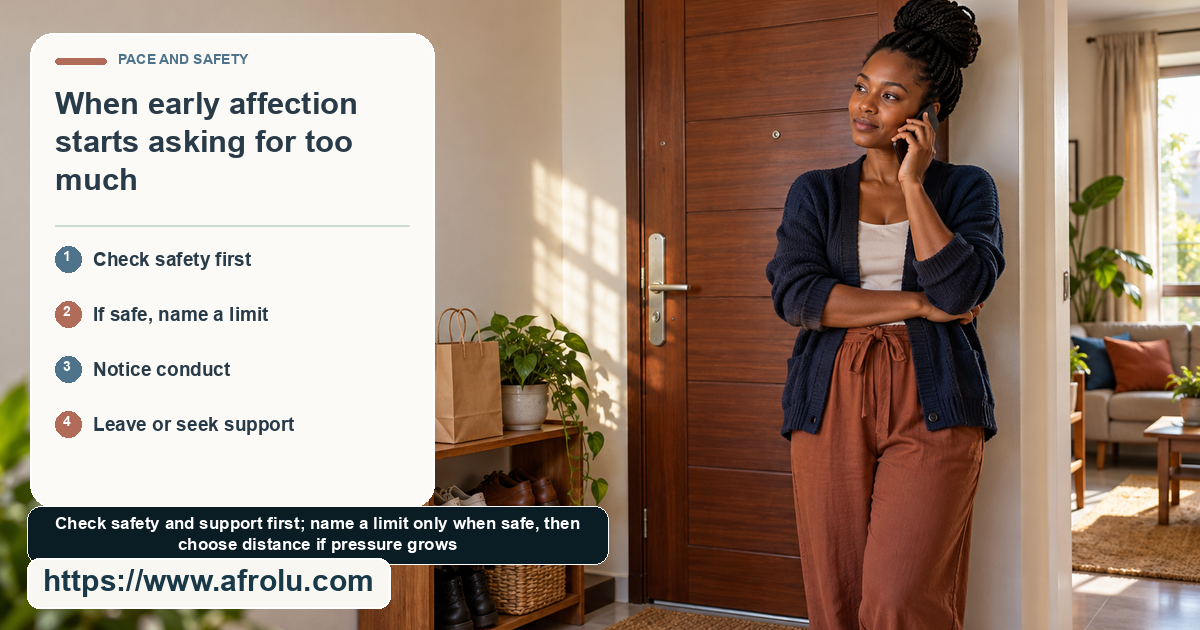
Your freedom to decline matters; fear or pressure can justify leaving before further contact.
Written and edited by Nala Okafor · Africa Dating Platforms Editor
A large gesture alone cannot tell you someone's motive. Notice what happens when you keep an existing plan, decline a gift, slow the messaging or say no to private contact. Affection leaves that choice intact; pressure turns the gesture into a claim on your time, body, money, location or loyalty. Do not stage a risky test if you already feel unsafe. Keep first meetings public and your transport independent, stay connected to trusted people, and use support if boundary violations repeat or escalate.
Emotional safety · New Relationship Starters
Is this a loving new connection, or am I being pushed past choices I have not made?
Love bombing describes excessive early attention or affection that may be used to accelerate a bond and influence the recipient. It is a warning pattern, not a clinical diagnosis or a conclusion drawn from one enthusiastic message.
Illustrative scenario: After two dates, one adult sends an expensive unasked-for gift and calls repeatedly during the other's Saturday family lunch. The recipient thanks them for the thought, declines the parcel, and says they are unavailable until Sunday. A respectful reply leaves those choices alone; anger, surveillance or a claim that the gift has purchased access changes the safety question.
The response is the evidence
A compliment is pleasant; a boundary reveals more
Early intensity can be mutual and welcome. The concern grows when one person's pace becomes a condition for the other's freedom.
Name the observable request, your own limit and the reaction. Do not use a checklist to diagnose motive or wait for a second violation when you feel unsafe.
What was offered?
Separate a compliment or gift from what is later demanded.
What did you want?
Notice whether you could keep friends, money and time.
What followed no?
Respect differs from guilt, repeated demands or monitoring.
What is the next safe move?
A trusted person and a public exit may matter more than a reply.
Look past the flourish
A grand weekend does not settle the question
Some people express interest exuberantly, and two adults may enjoy an early burst of conversation. The useful question is whether the pace is still chosen by both. An expensive parcel after two dates is not automatically coercion; a parcel that becomes a reason you must cancel friends, share your address or provide intimacy is a different event.
The National Domestic Violence Hotline describes early extravagant attention as a potential warning sign, especially when gifts later carry stipulations. Australia's eSafety Commissioner likewise describes love bombing as a possible part of a controlling pattern. These services do not claim that every enthusiastic new date is abusive. The pattern and the response to your choices matter.
Keep a small factual account for yourself if you are unsure: what was offered, what you said, and what actually happened afterward. Avoid scoring the number of texts or trying to infer a hidden plan. You are allowed to decide the pace does not fit even when no one has crossed an obvious safety line.
Use a real limit
Keep one plan that already belongs to you
Suppose Saturday lunch with family was arranged before this connection. Say you will be unavailable during it and suggest a later call only if you want one. Or decline a costly gift rather than storing it out of guilt. These are ordinary decisions, not artificial traps. The other adult can feel disappointed and still respect them.
A respectful person might ask once about another time, then let the limit stand. Repeated calls, an insistence on location sharing, threats to take a gift back, or a claim that you owe affection after they paid are different conduct. love is respect explicitly says accepting a gift, drink or date is not consent to physical activity.
Do not announce a boundary as an experiment if you fear retaliation. You may stop replying, leave a public setting or involve a trusted person without proving to the other adult that the phrase love bombing applies. Your safety does not depend on winning an argument about what they meant.

Avoid a red-flag score or villain portrait.
Four freedoms to check
- No is respectedA gift can be declined without trading access or affection.
- No location demandA new date has no claim on your whereabouts.
- Friends remain welcomeKeep ordinary family and friend plans in place.
- No gift debtNotice if generosity is later presented as a bill.
Look for repeated demands that shrink choice; do not diagnose motive from one message.
Keep an exit
A first weekend can remain public and independently navigable
If you met online and decide to meet, choose a busy public location and arrange your own journey where feasible. Tell a trusted person your plan, and do not share home or exact location simply to reassure a new match. RAINN's U.S. safer-dating advice includes public early meetings and independent transport; adapt the practical idea to your setting and resources.
Online pressure can precede a meeting. Australia's eSafety Commissioner warns about requests to move quickly off a dating app, share intimate images or disclose personal details. Platform controls vary, but you can keep contact where you feel able to manage it, review privacy settings and pause an exchange that has become intrusive.
If a person appears where you did not invite them, threatens you, persists after no, or asks for money tied to a romantic emergency, the issue is beyond awkward enthusiasm. Preserve relevant messages if safe, contact someone you trust, and use appropriate local safety or emergency support. Do not accept a private meeting to resolve the pressure.

The visual does not instruct a threatened reader to confront someone.
A short, safe boundary
Optional wording
I am not accepting a large gift, and I am keeping my Saturday plans. I can talk on Sunday if I still want to continue.
Adapt it in four moves
- Check safety first
- If safe, state limit
- Keep outside plans
- Seek support if pressured
If safe, decline the gift and keep the plan you already chose.
Read what repeats
An apology matters when the conduct changes
After you say that repeated evening calls interrupt your life, the other adult may apologise. The useful follow-up is simple: do they stop calling at that time, and can they hear another limit later? A lavish apology gift that restarts the same demand is not repair. You do not need to keep dating to collect more evidence.
eSafety describes coercive control as a pattern of pressure, monitoring and fear, often using technology. That is not a licence to label every awkward early interaction as coercive control. It is a reason to take a cluster of demands seriously: isolation from friends, required password sharing, checks on your location and anger when you decline intimacy.
Sometimes there is no abusive pattern and the two of you simply want different speeds. You can say the connection is not for you and close it. If there is intimidation, prioritise a safe exit and support over a tidy closing text; a perfectly worded message is not a prerequisite to leaving.
Return to your circle
Do not let one new person become the only interpreter
Tell a friend or trusted relative the plain sequence rather than asking them to diagnose a stranger: what happened, what you said and what followed. Someone outside the intense exchange may help you recover ordinary scale. You can also speak with a relationship support service about options if you feel isolated, monitored or afraid.
If you have shared intimate material or financial information under pressure, you may need specialist digital or financial help as well as emotional support. eSafety's guidance is Australian and cannot supply Kenya-specific reporting routes, but its privacy and evidence-preservation principles can inform your next question to a local service.
You can appreciate an early good moment and still stop. You do not need to negotiate an unasked-for gift as the price of ending contact or offer a longer explanation because someone was affectionate. If you made a separate repayment agreement beforehand, handle that practical question on its own terms. Your next relationship decision belongs to you, guided by what is observable and what helps you remain safe.

No one needs proof of a diagnostic label to stop dating.
Choose the safer next move
- Check safety and supportA trusted call or public exit can come before a reply.
- Keep a limit if safeA short no is optional when you can say it safely.
- Read actual conductJudge repeated requests and the response to your limits.
- Leave when neededDistance and support are valid without proving a label.
check safety and support first; name a limit only when safe, then choose distance if pressure grows
When a gesture changes shape
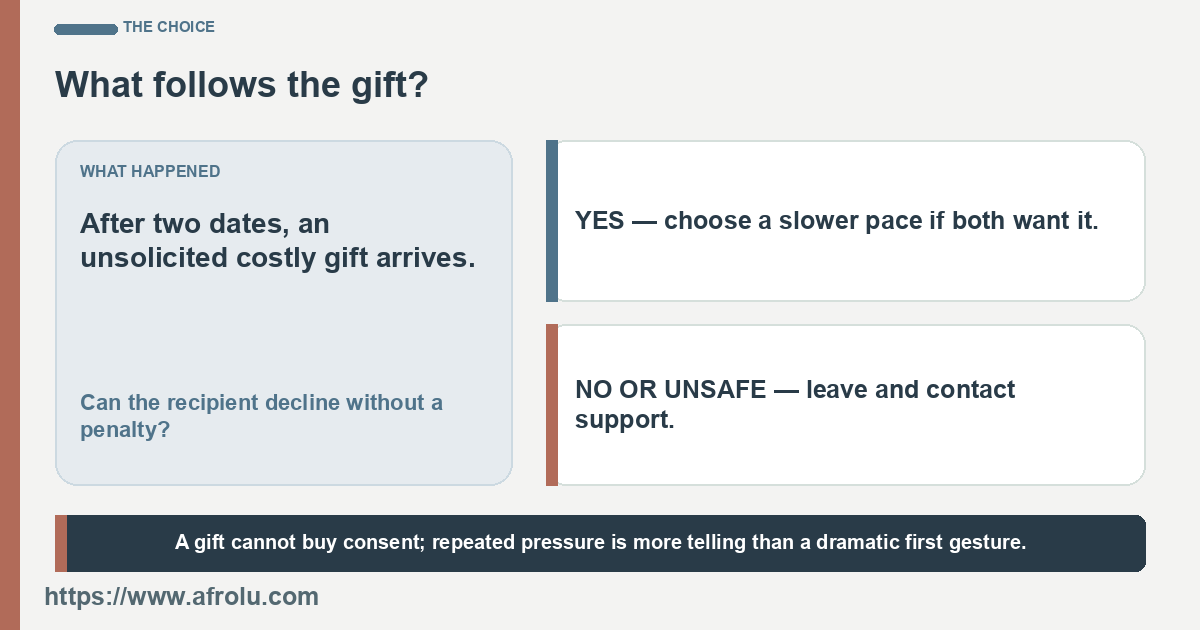
What follows the gift?
- Notice
- After two dates, an unsolicited costly gift arrives.
- Ask
- Can the recipient decline without a penalty?
- YESchoose a slower pace if both want it.
- NO OR UNSAFEleave and contact support.
A gift cannot buy consent; repeated pressure is more telling than a dramatic first gesture.
A costly parcel arrives after two dates
The gesture alone does not tell you why it was sent.
Decide whether you want it and say no if safe.A date rings repeatedly during a family lunch
Your existing plans are still yours.
State when, or whether, you want contact.The giver says you owe a private evening
Material spending is being made into a claim on you.
End the interaction and seek support if needed.They reject a public first meeting
The choice and exit have become safety questions.
Decline or change the meeting; do not travel under pressure.Freedoms to check, not a score
The other adult can hear no to a gift without punishment.
Friends and existing weekend plans remain possible.
Location, passwords and intimate images are not demanded as proof.
A changed contact rhythm is respected rather than flooded with calls.
Your route out remains your own when meeting in person.
Respond according to safety
| Situation | What it may mean | What to do next |
|---|---|---|
| The attention feels exciting | Enjoyment and caution can coexist. | Keep ordinary plans while you learn more. |
| The gift feels too large | You can decline without diagnosing the giver. | Use a brief no if safe; do not bargain over gratitude. |
| Calls continue after no | A stated limit is not being respected. | Reduce contact and involve a trusted person. |
| A threat or tracking appears | This is beyond a pacing mismatch. | Prioritise safety, preserve evidence if safe and seek local support. |
| You simply want a slower pace | A difference in desired speed may be enough to part. | Do not wait for misconduct to justify leaving. |
A boundary if it is safe to send
“Thank you for thinking of me, but I will not accept a costly gift. I am keeping my Saturday plans.”
“I will not be on my phone during family lunch. I can talk on Sunday if I choose to continue.”
“I do not want to continue dating. Please do not contact me again.”
Know the difference
Generous affection versus conditional access
A compliment or gift can be accepted or declined without punishment.
The giver later demands calls, location, intimacy or loyalty as repayment.
A gift cannot buy consent; repeated pressure is more telling than a dramatic first gesture.

Money and attention never purchase physical access.
Affection versus access claim
Freely offered
A compliment or gift can be accepted or declined without punishment.
A hidden invoice
The giver later demands calls, location, intimacy or loyalty as repayment.
Questions that separate them
- Was it asked for?
- Can it be declined?
- Are friends intact?
- Is leaving safe?
A gift cannot buy consent; repeated pressure is more telling than a dramatic first gesture.
No-strings care versus a hidden invoice
| Type or dimension | What it describes | Best next question |
|---|---|---|
| Welcome compliment | An expression both adults can enjoy. | Let it remain a compliment. |
| Fast pace | A desire for more contact than you want. | State your own pace if safe. |
| Conditional gift | Spending is later used to demand access. | Reject the debt and seek support. |
| Monitoring | Location or accounts are demanded or checked. | Treat it as a safety issue, not romance. |
Keep the decision in your hands
Conduct beats flourish
The reaction to no often matters more than the first display.
No diagnostic duty
You can leave without proving love bombing as a label.
Support before certainty
A trusted person can help when intensity narrows perspective.
Questions for a trusted person
Choose a few prompts that fit the moment. This is a reference library, not a list to complete.
After a large gesture
Tell a trusted person the actual sequence.
- What was offered?
- What did I choose?
- What happened after no?
Before another meeting
Choose the safer route rather than a diagnostic label.
- Is the place public?
- Can I leave independently?
- Has contact become threatening?
What safety organisations actually say
Early intensity
The National Domestic Violence Hotline describes excessive early attention and gifts as possible warning signs.
Evidence limit: A single enthusiastic gesture does not establish abuse or motive.
Online dating
Australia's eSafety Commissioner describes pressure for personal details, money and rapid off-platform contact.
Evidence limit: Australian safety advice; features and local support differ in Kenya.
Boundary response
love is respect describes repeated violations or guilt over a boundary as concerning.
Evidence limit: Do not require a confrontation if it may be unsafe.
Consent
love is respect says accepting a gift, drink or date is not consent.
Evidence limit: Material spending does not establish entitlement to intimacy.
Meeting safety
RAINN suggests public early meetings and independent transport.
Evidence limit: U.S. practical options, not a guarantee or a prescribed Kenyan route.
Mistakes that keep pressure in place
Calling every gift abuse
One gesture cannot establish a pattern or motive.
Staging a risky test
A threatened reader need not send a boundary message to gather proof.
Treating payment as consent
Money cannot buy physical access.
Protect one freely chosen no
If a gift or message becomes pressure, your next step can be distance and trusted support.
Explore the guide library
Continue with Afrolu
Love-bombing, consent and safer-dating sources
Afrolu reviewed these health, research, safety, or public guidance resources while editing this page. They support the behaviour and safety guidance; they do not diagnose any individual described by a reader.
Questions about early intensity
Is every generous new date love bombing?
No. Look at whether gifts or attention become pressure, especially after a clear limit.
Should I confront someone to test them?
No. If you feel unsafe, distance and trusted support may be safer than a confrontation.
Do I owe a date after accepting a gift?
No. A gift or paid meal does not create romantic or sexual consent.
What if they apologise beautifully?
Notice whether the conduct changes; a costly apology does not erase repeated demands.
May I end it without a clear pattern?
Yes. You can decide a connection or pace does not fit without diagnosing anyone.
One thing to do now
Let your freedom, not their flourish, decide
Judge how your freely chosen no is handled; when pressure or fear appears, choose safety and support before another explanation.