Five gates · fourteen-day lens
Read Intense Affection Without Rushing Later-Entry Casual Dating
A later-entry guide to love-bombing patterns, low-pressure casual scope, gifts, money, home access, boundaries and a safer exit.
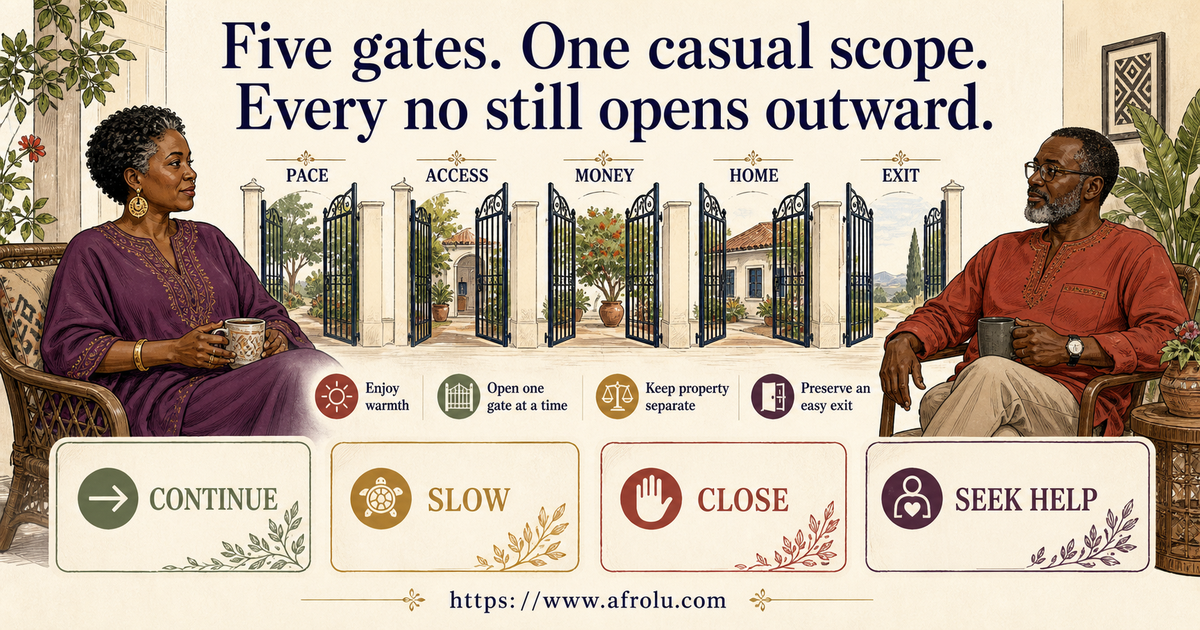
Warmth may arrive quickly; access still moves only through a freely opened gate.
Written and edited by Adwoa Boateng · Dating Safety Editor
Do not diagnose from one enthusiastic date, compliment or gift. Open five gates independently: PACE covers contact and future language; ACCESS covers phone, location, friends and family; MONEY covers gifts, loans and investments; HOME covers keys, codes and visits; EXIT covers cancellation and closure. State the low-pressure casual agreement and watch what happens after one gate remains closed. Respectful adjustment is useful evidence. Renewed intensity, age-based guilt, financial pressure, surprise access or threats supports a smaller scope, closure or appropriate help. Danger bypasses any observation period.
Emotional safety · Late Entrants
How can a later-entry adult receive welcome affection without letting age urgency, gifts or grand language silently unlock access that was never agreed?
Love bombing is a popular, non-clinical label for overwhelming affection that may accompany rapid access, influence or control. It cannot diagnose motive, and intensity alone is insufficient. Low-pressure casual dating is an explicit limited agreement that still requires consent, honesty, sexual-health discussion, property boundaries and a clean exit.
Evelyn, a fictional 53-year-old later-entry dater, enjoys Chike's early warmth but declines daily calls, a spare-key exchange and an investment. His temporary slowdown is followed by age-based trust pressure, so she closes from the repeated access pattern without needing to prove a diagnosis.
The five-gate affection veranda
Let warmth stay welcome while every gate keeps its own lock
Adwoa removes age urgency and reads the cumulative response to no rather than diagnosing from dramatic affection.
Track pace, access, money, home and exit independently across a reader-owned interval, with danger bypassing the clock.
Pace
Keep calls, dates and future language at the rhythm actually agreed.
Access
Share locations, networks and history only through a fresh voluntary yes.
Money and home
Keep gifts, investments, keys, codes and property outside romantic proof.
Exit
Make slowing, cancelling and closing possible without a private hearing.
Separate warmth from entitlement
Later entry does not make quick affection proof, danger or a final chance
Evelyn is 53 and returning to dating because she wants occasional companionship. Later entry is timing, not evidence of desperation, naivety or a shrinking opportunity. She may enjoy Chike's attention without treating it as a rescue, and she may slow a promising connection without wasting a final chance. Age does not change the meaning of consent.
One enthusiastic date, a generous compliment or an early gift does not establish love bombing. Some adults express warmth quickly and accept limits easily. The useful pattern appears across conduct: whether intensity seeks rapid access, whether a no is received without punishment, whether money or home boundaries remain intact and whether exit stays available.
Low-pressure casual dating can be caring and explicit. Evelyn may choose one weekly date, other dating, no home access and no assumption of progression. Chike can prefer a more serious route and leave. Casual scope becomes harmful when it is used to excuse secrecy, sexual pressure or inconsistent rules, not merely because it is limited.
The key question is not whether affection looks large from outside. Ask what the affection asks Evelyn to surrender and what happens after she declines. Warmth that remains respectful after a closed gate supplies different evidence from warmth that turns into guilt, surveillance, repeated calls, money pressure or threats.
Open five gates independently
Pace, access, money, home and exit should never move as one package
PACE covers date frequency, future language and the amount of contact. Evelyn enjoys two lunches but does not agree to daily calls or a holiday together. She can ask for one weekly date. Chike's response matters more than whether his preferred pace is objectively right; both adults remain free to decline the other's rhythm.
ACCESS covers phone, friends, adult children, health history, routines and location. Later life may include rich networks and private responsibilities, but those are not proof-of-trust currency. Evelyn decides when Chike meets a friend. She does not share adult children's addresses, medical records or live location to demonstrate that she is sincere.
MONEY and HOME remain separate even when both adults are financially established. Gifts do not purchase time, exclusivity or gratitude. No one needs account access, investment participation, loans, keys, alarm codes or a convenient overnight arrangement. A gift that cannot survive a no can be declined or returned without debating its giver's motive.
EXIT asks whether Evelyn can pause, cancel or end without retaliation. A disappointed response can still be respectful. Repeated accounts, surprise visits, threats, property interference, image abuse or pressure through family move beyond a pace conversation. She protects access and uses appropriate local support rather than arranging another private meeting.
Watch what follows a closed home gate
Evelyn keeps the warmth she wants and refuses the access she did not offer
During week one, Evelyn and Chike share two lively lunches. Chike sends many compliments, calls each evening and says he has never felt understood so quickly. Evelyn enjoys part of the attention and says she wants casual dating at one date a week. Chike agrees in words but continues to call several times each day.
In week two he sends flowers to her workplace after she had shared only the company name, then suggests exchanging spare keys because both live alone. Evelyn says no to the key and asks him not to send anything to work. She thanks him for the flowers without accepting the access assumptions attached to the gesture.
Chike apologises and follows the one-date rhythm for a week. That respectful interval is useful but does not erase the need to observe. When he later asks Evelyn to join an investment he describes as safe, she refuses and says money will remain outside dating. He responds that trust should not be so difficult at their age.
Evelyn closes the connection because repeated access and money pressure do not fit, not because she can prove a label. She tells a trusted friend, changes a shared building-entry detail and blocks further contact. Had Chike accepted the gates consistently, continuing casual dates would also have been a valid outcome.
Read five gates across three states
Welcome warmth, a redesign point and unsafe conduct should not share one score
PACE stays open when enthusiasm accepts a smaller rhythm. Pause when future language outruns knowledge or calls exceed the stated agreement. Stop relying on affection when urgency invokes age, destiny, health or loneliness to demand commitment. A large feeling can be real while the requested pace still receives no.
ACCESS stays open when friends, routines and personal history are shared gradually. Pause repeated questions about adult children, work or location. Stop surprise visits, monitoring, account intrusion, isolation or demands for proof. Evelyn does not need to disclose more in order to demonstrate that she has nothing to hide.
MONEY and HOME stay open only at the reader's chosen level, which may remain fully closed. Pause an expensive gift or premature practical suggestion. Stop loans, investment pressure, account access, documents, keys, alarm codes, property changes or any claim that affection creates a financial obligation.
EXIT stays open when a slower pace, cancellation or ending is accepted. Pause repeated negotiation after a clear no. Stop threats, harassment, image abuse, property interference, impersonation or family pressure. Immediate danger bypasses the fourteen-day observation period and calls for suitable safety, legal or emergency support.

One grand gesture does not prove a pattern, and one dangerous fact never needs a total score.
Use complete boundaries without a courtroom
Ten lines protect casual scope, privacy, property and a clean exit
For SCOPE + PACE: 'I am enjoying this and want one casual date a week.' 'I am not choosing exclusivity or a holiday plan.' 'I do not answer calls during work or sleep.' These lines preserve warmth while making the actual agreement measurable. Chike can ask for more once and accept the answer or leave.
For ACCESS: 'Please do not send items to my workplace.' 'I introduce friends and family when I choose.' 'My location and health details stay private.' Evelyn does not need to explain every reason. A caring adult can feel disappointed and still stop the requested conduct without recruiting others to persuade her.
For PROPERTY: 'I do not exchange keys, codes, loans or investments while dating.' 'I cannot accept this gift because it comes with an expectation.' Established careers and homes make these boundaries more important, not less romantic. Money and property questions can be verified through independent professional channels when genuinely needed.
For EXIT: 'The repeated access pressure does not fit, so I am closing.' 'Do not come to my home, work or contact family.' A complete ending is not a request for a final argument. If contact continues, Evelyn can preserve records and use relevant platform, building, legal or emergency help.

A low-pressure boundary is information, not an invitation to negotiate harder.
Review delivered access after fourteen days
A reader-owned interval measures response and impact rather than romantic sincerity
Review PACE and ACCESS first. Did contact move toward the one-date rhythm after Evelyn asked? Did workplace deliveries stop? Were family, location and health questions proportionate? One apology can begin repair, but repair becomes useful through later behaviour rather than more praise or a story about good intentions.
Review MONEY and HOME separately. Were gifts freely accepted without obligation? Did investment, loan, key and code requests stop completely? A strong answer elsewhere cannot average away financial pressure. Evelyn may close from the investment request alone without waiting to establish whether it was romance fraud or impulsive overreach.
Review IMPACT and EXIT. Can Evelyn work, sleep, see friends, cancel and disagree without managing Chike's reactions? Does she feel able to end by message or call rather than arranging a private meeting? Persistent impairment may benefit from qualified care; external threats or blocked exit need access-focused support.
Choose continue, reduce the scope, clarify one ambiguity, pause, close or seek support. None is an age verdict. Evelyn chooses closure because three gates were pressed after clear limits. Another adult might continue after respectful adjustment. The framework protects choice rather than manufacturing one required answer.

The review asks what access did, not whether affection felt sincere.
Compare nearby states without diagnosing motive
Healthy enthusiasm, honest casual scope and unsafe pressure require different language
HEALTHY ENTHUSIASM can be intense while accepting boundaries, independent life and uncertainty. LOVE-BOMBING PRESSURE is the popular label for overwhelming affection linked with rapid access, influence or control. The term may help a reader name a pattern, but observable conduct and the response to no are more useful than label certainty.
LOW-PRESSURE CASUAL DATING explicitly limits scope and still requires honesty, consent, health discussion and clean endings. PACE MISMATCH occurs when adults want different contact or progression and accept each other's answer. Neither arrangement makes one adult unserious, damaged or morally superior. Both remain valid adult choices when freely made.
LONELINESS may increase the appeal of intense attention, but it does not make Evelyn responsible for causing pressure or incapable of judgment. Supportive friendships, community and qualified care can widen her options. A new partner should not be assigned to cure isolation or become the only person allowed to help.
UNSAFE CONDUCT includes coercive control, stalking, fraud, threats, property interference or blocked exit. It may appear with or without extravagant affection. Continue welcome warmth, renegotiate a genuine mismatch, close from repeated pressure or use appropriate support. The available action does not depend on proving a hidden psychological motive.
Eight later-entry moments where warmth and access diverge
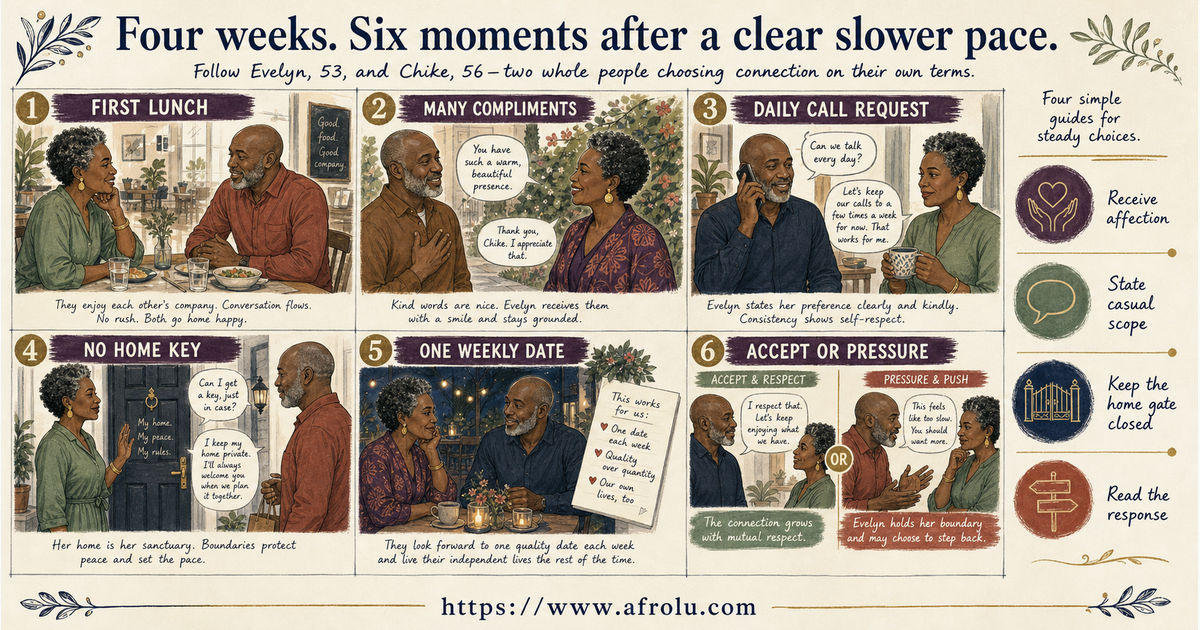
Second-lunch flowers
Daily-call assumption
Workplace delivery
Spare-key idea
Expensive gift
Investment invitation
Respectful slowdown
Surprise home visit
Ten signs across pace, access, property and exit
Future language becoming more certain than the adults' actual knowledge
Age or loneliness being used to accelerate commitment
Calls and messages increasing after a lower rhythm was stated
Gifts arriving at a workplace or home without invited access
Adult children, friends or health history being pursued as proof
A gift feeling difficult to decline because of its price
Loans, investments, documents, accounts, keys or codes entering courtship
A clear no producing guilt, ridicule, withdrawal or renewed intensity
Cancellation or closure producing surprise visits or repeated accounts
Persistent fear or daily impairment that needs qualified support
Review affection through ten independent questions
| Situation | What it may mean | What to do next |
|---|---|---|
| Can affection remain uncertain? | Fits: Warmth does not claim a guaranteed future. Needs review: Future language needs slowing. Stop: Destiny or age is used to demand commitment. | Return to the present casual agreement. |
| Does contact match the stated rhythm? | Fits: One weekly date is respected. Needs review: One excess call is repaired. Stop: Repeated access continues after no. | Reduce or end access rather than explaining further. |
| Are gifts freely chosen? | Fits: Accepting or declining remains easy. Needs review: Cost creates discomfort. Stop: A gift is linked to time, sex, money or loyalty. | Decline or return it and restate the boundary. |
| Is family privacy intact? | Fits: Introductions happen by choice. Needs review: One intrusive question is redirected. Stop: Relatives are contacted or used for pressure. | Seal family access and use suitable support. |
| Do money boundaries hold? | Fits: Finances remain separate. Needs review: An invitation is refused once. Stop: Loans, investments or account access are pressed. | End the transaction route and independently secure accounts. |
| Does the home gate stay closed? | Fits: Keys, codes and visits require a fresh yes. Needs review: A premature suggestion stops. Stop: Surprise entry or property pressure occurs. | Protect physical access and avoid private confrontation. |
| Can Evelyn cancel without punishment? | Fits: Disappointment remains respectful. Needs review: One negotiation needs a final answer. Stop: Guilt, threats or monitoring follows. | Stop access and document dangerous conduct. |
| Is low-pressure casual scope honest? | Fits: Other dating, health and endings are explicit. Needs review: One rule needs naming. Stop: Casual is used to hide coercion or double standards. | Clarify once or close the arrangement. |
| Did behaviour change after the boundary? | Fits: The requested limit holds over time. Needs review: Repair is still being observed. Stop: A new gesture replaces actual change. | Count conduct rather than renewed intensity. |
| Can exit remain complete? | Fits: Closure is accepted. Needs review: One final logistical matter remains. Stop: Repeated contact, threats or property interference appears. | Use access controls and appropriate official help. |
Ten lines for casual warmth with protected gates
“I am enjoying this and want one casual date a week.”
“I am not choosing exclusivity or a holiday plan.”
“I do not answer calls during work or sleep.”
“Please do not send items to my workplace.”
“I introduce friends and family when I choose.”
“I cannot accept this because it creates an expectation for me.”
“I do not exchange keys, codes, loans or investments while dating.”
“If this rhythm is too light, I understand if you leave.”
“The repeated access pressure does not fit, so I am closing.”
“Do not come to my home, work or contact family.”
Know the difference
Healthy enthusiasm, love-bombing pressure and honest casual scope need different responses
Enthusiasm remains compatible with independent life, uncertainty, property boundaries and an easy no.
Pressure, casual scope, loneliness, mismatch or unsafe conduct changes the available next move.
Read what affection requests and how the person responds when one gate stays closed.

The label is less important than the delivered pattern and the next safe action.
Separate eight nearby affection and safety states
| Type or dimension | What it describes | Best next question |
|---|---|---|
| Healthy enthusiasm | Warmth arrives quickly while uncertainty, independence and no remain acceptable. | Enjoy it at the pace both adults freely choose. |
| Love-bombing pressure | Intense affection repeatedly accompanies rapid access, influence or control. | Slow or close from conduct without diagnosing motive. |
| Low-pressure casual dating | Limited scope is explicit about other dating, health, contact and endings. | Keep honesty and safety complete even when commitment is not planned. |
| Pace mismatch | Adults want different contact or progression and accept each other's answer. | Choose one workable rhythm or close respectfully. |
| Loneliness | A need for company can make attention especially meaningful without removing agency. | Widen support and avoid making one match the only route. |
| Ordinary generosity | A gift is freely offered and can be declined without consequence. | Accept only what leaves choice intact. |
| Romance fraud | Trust-building leads toward money, documents, investment or transaction access. | Refuse payment and use appropriate reporting support. |
| Unsafe conduct | Threats, stalking, property interference or blocked exit creates an access problem. | Protect access and seek appropriate local help. |
Use the five-gate veranda in six practical moves
Remove the age clock
Later entry never turns quick access into a final opportunity.
Open one gate at a time
A yes to affection does not unlock phone, money, home or family.
Read the response to no
Accepted limits carry more evidence than another impressive gesture.
Keep casual scope ethical
Limited commitment still needs honesty, consent, health discussion and exit.
Separate property from trust
Keys, investments, loans and codes stay outside romantic proof.
Escalate the actual problem
Distress and dangerous conduct require different support routes.
Questions for pace, access, property and exit
Choose a few prompts that fit the moment. This is a reference library, not a list to complete.
Pace
Keep later entry free of urgency.
- What scope exists now?
- Which contact rhythm fits?
- What future claim outruns knowledge?
- Can no remain easy?
- What would slower look like?
Access
Open one layer at a time.
- Who knows the location?
- Is work contact invited?
- What family detail stays private?
- Are calls chosen?
- Can access be revoked?
Property
Keep affection outside assets.
- Can the gift be declined?
- Are money requests absent?
- Do keys stay separate?
- Is the investment independent?
- What account needs securing?
Exit
Make closure safely complete.
- Can a message end it?
- Who should know?
- What record matters?
- Which access closes?
- What support fits the conduct?
What current love-bombing, coercion and fraud guidance supports
Cleveland Clinic describes intensity, access and boundary response
The psychologist-reviewed overview discusses excessive attention, rushed closeness, isolation and manipulation while encouraging attention to a wider pattern.
Evidence limit: It is not a diagnostic instrument and one gift or compliment cannot establish motive.
The National Domestic Violence Hotline discusses love-bombing signs
The resource frames excessive praise, communication, gifts and early commitment within patterns that may seek influence or control.
Evidence limit: A general resource cannot assess Evelyn's individual danger or legal options.
UK statutory guidance describes controlling or coercive patterns
Jurisdiction-specific guidance explains that monitoring, isolation, economic control and sabotage may accumulate across time rather than appear as one dramatic event.
Evidence limit: Its legal definitions apply in the United Kingdom and are not universal.
CDC distinguishes intimate-partner violence and coercive control
Official material supports separating ordinary incompatibility from stalking, psychological aggression, sexual violence and physical violence.
Evidence limit: It cannot determine whether a specific relationship meets a legal or clinical threshold.
FTC reports examine scams affecting adults over sixty
The official report supports keeping romance, investment and payment access separate while avoiding stereotypes that mature adults lack judgment.
Evidence limit: Reported-loss data are not a personal risk score and do not describe every later-entry dater.
FTC consumer guidance keeps money outside romantic proof
The guidance describes trust building before money requests and advises refusing cash, gift cards, wires and cryptocurrency.
Evidence limit: A U.S. consumer page cannot verify a match or replace local financial and legal channels.
Six ways affection becomes hidden access
Diagnosing from one gift
A gesture becomes a verdict. Repair: read cumulative conduct and response to no.
Treating age as urgency
Later entry becomes forced speed. Repair: let evidence and present capacity set pace.
Merging all five gates
Affection silently unlocks property and family. Repair: require a fresh yes at each gate.
Calling casual careless
Limited scope is moralised. Repair: assess honesty, consent, health and exit.
Waiting for motive certainty
Closure depends on confession. Repair: decide from pattern, impact and fit.
Offering a final private talk
An ending reopens physical access. Repair: use the safest complete channel.
Use a reviewed resource that matches the decision
This guide focuses on the relationship decision, so it does not rank dating apps. Check current prices, safety tools, and local availability before choosing a service.
Explore the guide library
Show more related guides
Continue with Afrolu
Show more Afrolu guides
Clinical overview, safety resources and official fraud guidance
Afrolu reviewed these health, research, safety, or public guidance resources while editing this page. They support the behaviour and safety guidance; they do not diagnose any individual described by a reader.
Later-entry love-bombing and low-pressure casual questions
Does intense affection always mean love bombing?
No. One enthusiastic date, frequent compliment or generous gift cannot establish a harmful pattern or hidden motive. Look across time at what the affection asks for, whether boundaries remain easy, whether independent life stays intact and whether money, home and exit are protected. Decide from conduct rather than label certainty.
Are later-entry daters more vulnerable to love bombing?
Age alone does not establish vulnerability, loneliness or poor judgment. Later-entry adults may bring substantial experience, networks, homes and financial complexity. The useful approach is neither alarm nor dismissal: remove age urgency, open one gate at a time and keep money, property, family information and exit under personal control.
Can low-pressure casual dating include strong feelings?
Yes. Feelings, scope and access are different facts. Adults can enjoy warmth while choosing one weekly date, other dating, no exclusivity and no home access. The arrangement needs honest sexual-health, privacy and ending conversations. If one adult wants more, they may ask once and accept the answer or leave.
What should I notice after I set a slower pace?
Notice the delivered response: do calls reduce, workplace deliveries stop and plans fit the stated rhythm? An apology matters when later conduct supports it. Renewed praise, gifts or future talk that bypasses the boundary is not the same as repair. One clear danger fact can justify immediate access-focused action.
Should I accept expensive gifts early in dating?
Only if you genuinely want the gift and declining would remain easy. Cost can create obligation even without an explicit demand. You may decline or return it and say that gifts will remain small. A gift never purchases time, sex, exclusivity, forgiveness, access to family or a financial opportunity.
When should keys or home codes be shared?
There is no universal relationship timeline, and never sharing may be the right choice. Treat home access as a separate practical decision based on need, trust, safety and revocability—not romance proof or age-based convenience. Surprise visits, pressure after no or property interference require stronger access protection.
What if a date offers an investment opportunity?
Keep romance and transactions separate. Do not send money, provide documents, share account access or follow a match-supplied payment route. If an investment independently interests you, use separately found regulated professional information. Pressure, secrecy, guaranteed returns or emotional proof language are reasons to stop the transaction path.
How long should I observe the response to a boundary?
There is no mandatory period. Evelyn's fourteen days cover two ordinary date cycles and can end immediately if danger appears. Choose only the time you freely want and the evidence you need. You may close after one incompatible request; you do not owe someone a chance to build a clearer pattern.
How can I end without accusing the person?
Name the delivered conduct and your decision: 'The repeated access pressure does not fit, so I am closing.' You need not diagnose love bombing or debate sincerity. Use the safest channel. If contact continues, preserve relevant records, strengthen access controls and seek appropriate platform, legal, building or emergency support.
When should I seek additional help?
Seek qualified health care when fear or distress persists or interferes with daily functioning. Threats, stalking, coercion, sexual violence, image abuse, fraud, property interference or blocked exit require appropriate safety, legal, financial or emergency help. Do not arrange a private final meeting when doing so could increase access or risk.
One thing to do now
Let every new layer of access receive a fresh yes
Continue warmth that accepts casual scope, independent life and every no. Redesign one genuine pace mismatch through a specific rhythm. Close when access, money, home or exit pressure repeats. Use qualified care for persistent distress and appropriate safety, legal, financial or emergency support for stalking, coercion, fraud, threats, property interference or blocked exit.