Diaspora · long distance · boundaries
When warm long-distance calls ask for your whole night
A cross-border connection can be warm without claiming every night. Set a call window, observe the response, and protect sleep, friendships and your own pace.
The response to a calmly stated call window matters more than the intensity of one warm call.
Written and edited by Amina Wanjiru · Senior Dating Apps Editor
If long-distance calls now run past the bedtime you need, propose an hour you can keep: 'I can talk until ten on work nights; Saturday morning works too.' One late request is not a diagnosis. Notice what happens after your limit: a workable counteroffer leaves your choice intact; repeated guilt, monitoring or claims that sleep and friends prove disinterest do not. You can shorten contact or seek trusted help, especially if ending a call feels frightening. Time zones need negotiation, not unlimited access.
Is this early intensity welcome connection, or am I being asked to surrender my own hours?
Love bombing describes overwhelming attention that can be used to rush closeness or override boundaries. Frequent calls by themselves do not establish a person's intent; the response when you set a reasonable limit is more informative for this decision.
Keep the welcome part of the story
The first long call may feel extraordinary because there is finally time to hear the other person's life in detail. Let that pleasure be real. You do not need to apologize for liking attention or treat an interested adult as suspect because they ask for another call. The useful question is whether either person can still choose when the call ends.
Across time zones, somebody may always be tired. Solve that openly rather than silently awarding the same person the inconvenient hour. A rotating weekend slot, shorter weekday call or voice note can be a sincere way to stay close. The agreement is only good if each person can actually live with it outside the excitement of the first week.

Keep your hours your own
Open full-size visual- Call window
- The call was welcome before any limit was tested.
- Ten o'clock end
- A real end time protects sleep.
- Thursday friend
- An existing friend call remains outside this romance.
- Next response
- Observe the next response instead of guessing motive.
Put the call, protected hours and actual response on a clock without scoring anyone's feelings.
Notice whether a request becomes a test
'Can you stay a little longer?' is a request that can be declined. 'If you cared, you would keep the camera on while you sleep' turns the same hour into a loyalty measure. Keep the exact words and what followed in mind. Was your no accepted, negotiated respectfully, or met with repeated calls and accusations? That sequence tells you more than the number of hours spent online.
The Hotline describes communication overload as a possible warning sign of love bombing. Its U.S. resource cannot tell you that this particular match intends abuse. Use it as a reason to pay attention to your autonomy. If a friend call becomes something you must hide, or you are nervous to put your phone down, the cost is already concrete even without an explanation for the other person's motive.
Check whether the intensity is reciprocal or only a rule for you. A match may have a demanding job and need an unusual hour; you can still ask them to share the inconvenience. If they describe every missed call as abandonment, the practical problem is the pressure placed on your ordinary life, whatever name anyone gives it.

What happens when the call ends?
Open full-size visualA welcome cross-border call becomes a request to stay online through sleep.
When the ten o'clock limit is named, is it respected?- Respectedchoose a rhythm both adults can keep.
- Pressure repeatsreduce contact and seek support if afraid.
End at the hour you named; let the next response show whether a shared rhythm is possible.
A call can be welcome and still need an ending
Distance makes a shared hour precious. It also makes it easy to treat one person's sleep or friendships as the flexible part of every plan.
Write a proposed window and its end time before you interpret the other person's reaction. Keep words, behavior and your own next choice separate.
- Offer
A real window
Use an hour that allows work, rest and existing friendships to continue.
- Response
What happened when it ended?
Record whether the call ended, a new time was suggested, or pressure continued.
- Choice
What will you protect?
Continue a workable rhythm, reduce contact or seek help if fear has entered it.
Offer hours, then let the answer matter
Try an ordinary sentence: 'I enjoy this, and I need to sleep after ten on work nights. We can talk on Saturday morning too.' Add the friend or family time you mean to protect if it has become contested. The other adult may dislike the limit and still respect it. They may propose a different shared hour. Neither reaction requires you to prove that ten o'clock is objectively correct.
After that conversation, watch the next few calls. Does the person stop at the agreed time, ask before a change and accept a missed call without retaliation? Or do they call repeatedly, demand proof of where you were or turn each ending into an argument? You do not need a perfect record to leave a pattern that is making you afraid or exhausted.

The ten o'clock sentence
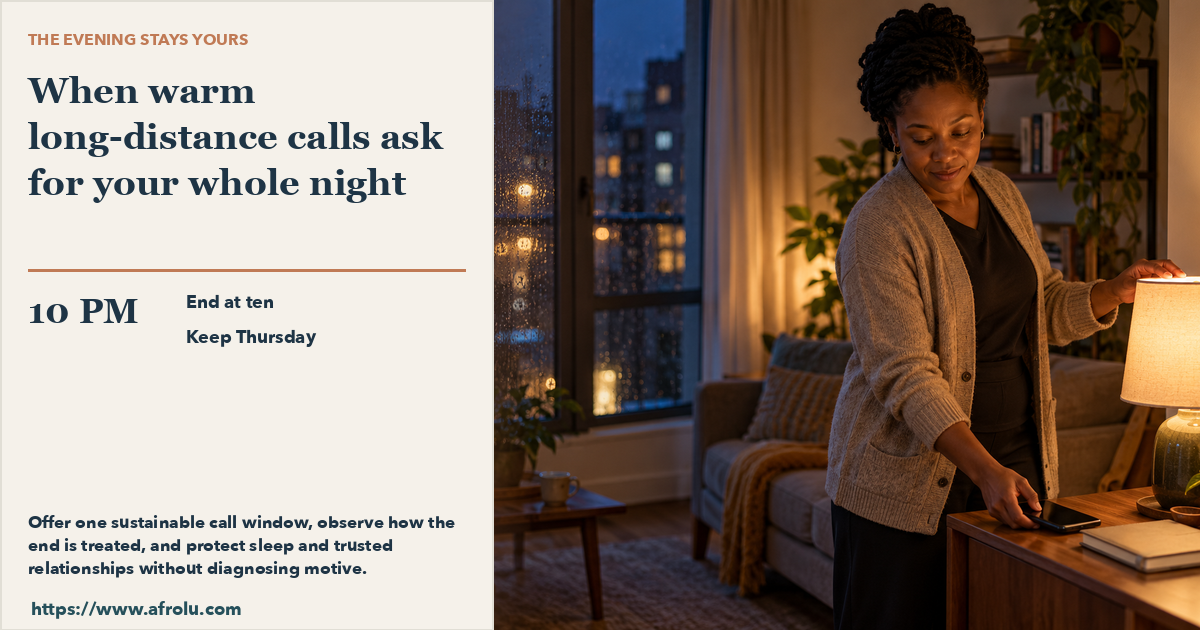
Open full-size visualI like talking with you. On work nights I can call until ten, and I keep my friend call on Thursday; would a weekend morning work for us too?
- Enjoy this
- End at ten
- Keep Thursday
Use a true ending time and offer a shared alternative only if you want one.
A call window you can actually keep
Record an observable response, not a guessed motive.
- Before
I can call until ten on work nights.
Keep sleep and friend time.
- At ten
Can we finish now and try Saturday?
End this call as agreed.
- After
The limit was respected, negotiated or challenged.
Continue, adjust or reduce contact.

Request or loyalty test
Open full-size visualA request
Could we talk later? The other adult can hear a no and suggest another hour.
A loyalty test
If you cared, you would stay online; ending the call becomes an accusation.
- No accepted?
- New hour possible?
- Sleep protected?
- Friend time intact?
A declined request can remain respectful; a punished boundary changes the choice.
Make the next step proportionate to what happened
A respectful mismatch may call for a shorter rhythm or an honest goodbye. If the person repeatedly crosses the stated limit, you can stop answering outside it, mute contact or end the connection. Avoid staging a long argument to secure their agreement with your decision. If digital monitoring or threats appear, seek confidential help from a trusted person or appropriate local service and think about account and location privacy before announcing a change.
Do not let distance persuade you that sleep, friends and work are optional while a new romance is essential. Those parts of life make it possible to choose the relationship freely. Equally, do not assume the new connection is doomed because the first window needs adjustment. What matters is whether two adults can hear a limit and make a rhythm that leaves both with their own lives.

A rhythm you can live with
Open full-size visual- Name windowSay the hour aloud.
- End callLet the call end without a hearing.
- Observe responseNotice what happens at the next boundary.
- Keep supportKeep trusted people and rest in reach.
Offer one sustainable call window, observe how the end is treated, and protect sleep and trusted relationships without diagnosing motive.
Try a call window you can live with
Write the ending hour first. You may offer a second slot, but you do not need to bargain away sleep or an existing friendship.
About these links These information links are not affiliate buttons and are clearly labelled. They do not promise a match or relationship outcome.
What the call-boundary sources can say
U.S. relationship-safety resources describe possible warning patterns; they cannot diagnose a Nairobi match or prescribe one call schedule.
Questions when the calls run late
Are frequent calls automatically love bombing?
No. Frequency alone cannot tell you motive. Consider whether each adult can end a call and keep sleep, work and friendships without guilt or retaliation.
What if our time zones make ten o'clock impossible?
Choose another shared hour or shorter calls. The goal is a sustainable rhythm for both, not a fixed cutoff imposed on every long-distance pair.
Do I have to explain my Thursday friend call?
You may say it is existing time you keep. You do not owe a new match proof of the friendship or a minute-by-minute account.
What if my no is called a lack of love?
You can repeat the limit once and watch conduct. If pressure or fear continues, reduce contact and seek private support from someone you trust.
Does ending a late call end the relationship?
No. It ends that call. The other person's response may help you decide whether the wider connection still feels freely chosen.