Parents dating · two homes · real visits
Before another journey, decide what a visit would cost everyone
Long-distance dating as a parent needs more than calls. Plan visits, protect children's privacy, share travel costs and notice what happens between trips.
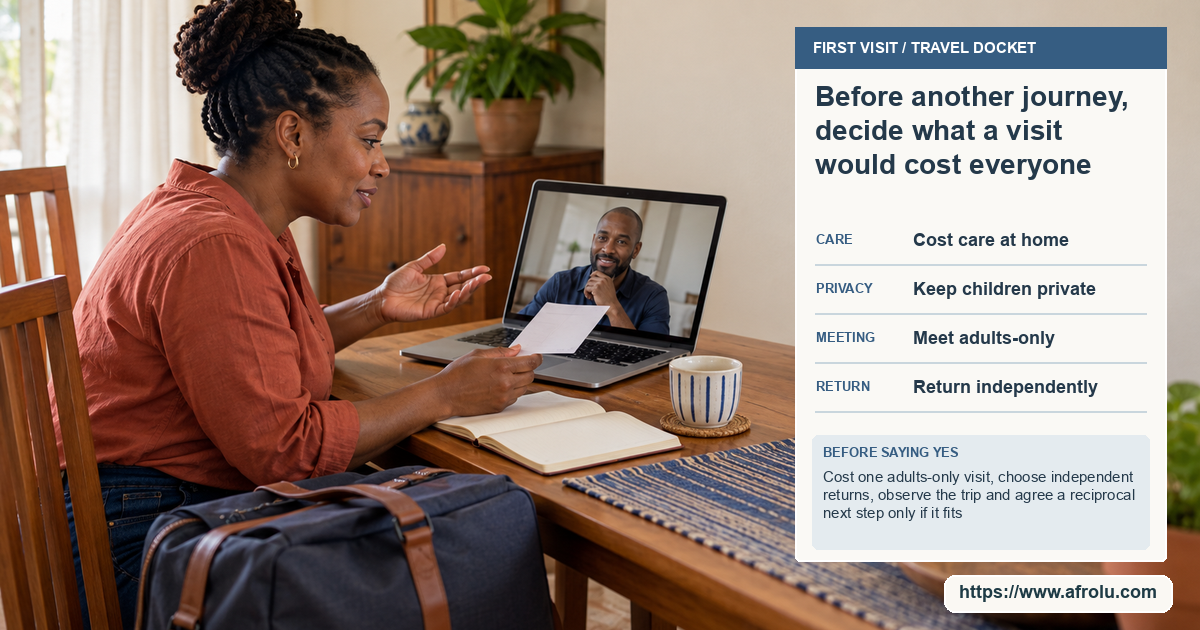
A real visit includes care, money, lodging and a return route; calls cannot settle those details.
Written and edited by Miriam Otieno · Senior Kenya Editor
Start with the next actual journey, not a promise that distance will somehow disappear. Check who can travel, what the trip costs in money and childcare, where each adult would stay, and how either person gets home independently. Keep children's names, school details and photographs out of early dating profiles and conversations. A visit should let two adults learn how they relate in ordinary time; it should not make a child host an introduction or prove that a relationship is serious. If the other adult cannot discuss a reciprocal plan, the feeling on calls may be real while the arrangement is still unworkable.
Distance and diaspora · Parents Returning To Dating
We feel close on calls, but what would make this long-distance connection fair and safe for my family?
Long-distance dating means the adults cannot meet as part of an ordinary week and must deliberately arrange travel or remote contact. For a parent, that plan also touches childcare, privacy, money and the stability of a child's routine.
Illustrative scenario: A parent in Nairobi has enjoyed six weeks of calls with someone in another city. The other adult proposes a full weekend at the parent's home, assuming the children will be there. The parent instead suggests a short daytime meeting during an existing childcare window, with separate accommodation and return transport. That choice tests the adult connection without turning the children into hosts.
Two homes, one decision
A visit must fit the whole life around it
Calls can build familiarity, yet travel reveals whether both adults can make room for one another without borrowing a child's privacy or a parent's entire weekend.
Write the next visit as four concrete choices before discussing a distant future together.
Who covers home?
Name childcare and a trusted backup before tickets are bought.
Who makes the journey?
Include return travel and where each adult sleeps.
Who carries the cost?
A fair plan does not quietly assign all expense to one home.
Who remains outside it?
Do not turn a child's routine or image into proof of trust.
Start on paper
Make one visit possible before imagining a shared future
A ticket is only one line of the cost. A parent may need childcare, time off, a quiet handover, a separate place to sleep and a return journey that still works if the date goes badly. Put those lines beside the other adult's costs. If either person cannot say how the next trip would work, a promise of monthly visits is still a wish rather than a plan.
Ask whose work schedule can move, who has already travelled and whether the same person always takes the overnight bus or flight. Fair does not require identical spending; it requires a conversation in which each adult's constraints are visible. An adult with more money may pay more, while the parent still chooses whether the travel and care arrangement fits. Nobody should buy access to the home by paying for a ticket.
The most useful first plan may be smaller than either person imagined: a daytime meeting in a public place during a known childcare window. It can be enough to learn whether conversation works face to face. You can defer a longer weekend until both adults have seen how one manageable trip feels and whether the effort is returned.
Keep a child out of the test
Protect a child's details before asking them to meet anyone
Australia's eSafety Commissioner and RAINN both advise parents to keep children's identifying details out of dating profiles and early exchanges. That advice concerns online privacy and risk; it does not set a universal age or number of dates for an introduction. You can describe that you are a parent without sending a school uniform photo, sharing the daily pickup route or allowing a new contact to join a family group chat.
If the other adult says meeting your children would prove your seriousness, separate those questions. They may reasonably want to know that parenting is part of your life; they are not entitled to a child's time or information. An introduction should happen only when it serves the family and both adults have a stable enough plan. A first visit can remain adults-only without hiding that children exist.

A call alone cannot complete the worksheet.
What belongs in a real journey?
- Care is arranged
- Childcare and a backup are arranged without making the child host.
- Costs are shared
- Both adults know tickets, lodging and lost work costs.
- Child details stay private
- No school, route or child photograph is sent to a new contact.
- Each has a return
- Each adult can end the visit and travel home independently.
Keep in mind: Check what a trip asks of the family, not how romantic its destination sounds.
Meet in the present
Let the first trip show ordinary conduct
A video call can show attention and humour, but it cannot tell you how someone handles a late train, a changed restaurant or a firm end time. A public daytime visit lets both adults notice those ordinary details. Arrange your own travel to and from the meeting. If the visitor needs accommodation, discuss a separate option rather than assuming the parent's home is a convenient free place to stay.
RAINN's safer-dating guidance recommends public early meetings and independent transport. It is a set of risk-reduction options, not a guarantee that every public meeting is safe. Adapt it to the local route and your circumstances. Share your plan with someone you trust if that helps; you need not share a live location with a new date or tell them the address where your children are staying.
Afterward, compare the trip with what was agreed. Did someone arrive as planned, respect the end time and leave the child boundary intact? Did the travel burden fall where both knew it would? A missed connection or one awkward moment is not a character verdict. Repeated pressure to extend the visit, get the home address or hand over money changes the decision.

The child is not shown or used as proof.
Words before buying tickets
An optional way to say it
I want to see you, but my children will not be part of a first visit. Could we plan a daytime meeting, separate lodging and a return route each of us controls?
What the line does
- Name the wish to meet
- Keep children out
- Choose public daytime
- Own each return
Keep in mind: Invite one adults-only daytime meeting before promising the family home.
What happens at home
The weeks between trips also need a rhythm
Remote contact matters in a long-distance relationship, but it need not be an open line into a parent's household. Try a regular call that both adults can keep, with flexibility when parenting or work interrupts. In a study of 647 Canadian students aged 18 to 25, 36.5% reported a long-distance relationship; within that group, more frequent and responsive texting was linked with higher satisfaction. The survey did not establish a daily quota for parents or show that text volume causes a good relationship.
Pay attention to repair when a call is missed. Does the person let you know, offer another time and accept the same courtesy from you? That is more informative than counting messages in isolation. If the only contact happens at hours that repeatedly displace sleep or care, the plan may feel close on screen while costing one person too much offline.
Decide after evidence
A second trip should be a choice, not a debt
After one visit, name the part that worked and the part that did not. Perhaps the conversation was easy but all the travel landed on the parent. Perhaps the visitor respected the child boundary but cannot make another trip for several months. State the real facts before promising a larger future. A relationship can be meaningful without yet being sustainable for two homes.
If both want to continue, make the next agreement concrete: approximate month, who travels, cost ceiling, childcare arrangements and how plans change. If the other person rejects every practical discussion while requesting more access to your home or children, you can stop. A clear no now is kinder to the family than a series of journeys nobody can safely keep.
The decision is yours even if the other adult has already spent money. A ticket, gift or long call does not create an obligation to host, introduce children or make a romantic promise. Where pressure or fear is present, prioritize safety and trusted support rather than using one more visit to gather proof.

The parent retains a return and a child-privacy boundary.
Review the trip before another
- List the whole costAdd travel, care, lodging and return costs.
- Agree an adults-only visitMeet in public without a child introduction.
- Notice conduct in personNotice punctuality, privacy and the agreed end time.
- Review another tripOnly then decide whether another trip fits both homes.
Keep in mind: cost one adults-only visit, choose independent returns, observe the trip and agree a reciprocal next step only if it fits
Trips that ask different things of a family
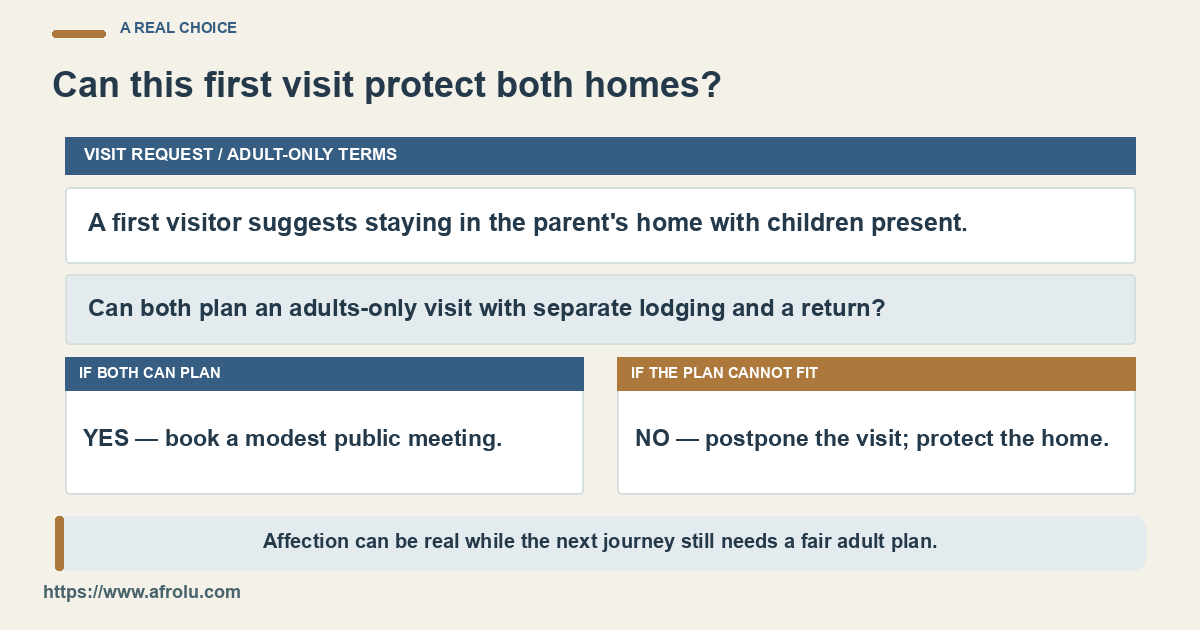
Can this first visit protect both homes?
- What happened
- A first visitor suggests staying in the parent's home with children present.
- Question to ask
- Can both plan an adults-only visit with separate lodging and a return?
- YESbook a modest public meeting.
- NOpostpone the visit; protect the home.
Keep in mind: Affection can be real while the next journey still needs a fair adult plan.
The visitor wants to stay where the children live
Accommodation has become a family and privacy decision, not merely a travel saving.
Suggest separate lodging and an adults-only daytime meeting.One adult has made every trip so far
A pleasant visit can still be financially one-sided.
Put time off, care and ticket costs in the next plan.The last transport leaves before dinner
A longer date could remove an independent way home.
Choose an earlier meeting or separate later travel.A new contact asks to see the family
Curiosity does not require a child's identifying image.
Describe your parenting role without sending a photograph.What a fair first visit contains
Both adults can explain the trip's full cost, including childcare or missed work.
A first meeting can happen without introducing children or entering the family home.
Separate accommodation and independent return remain possible.
A changed travel plan is discussed rather than imposed at the last minute.
The next trip is proposed by mutual choice rather than treated as repayment.
Before a ticket is bought
| Situation | What it may mean | What to do next |
|---|---|---|
| A visitor offers to pay | Help with cost can be welcome without buying home access. | Agree the money and accommodation separately. |
| Childcare falls through | The adult meeting may no longer be possible. | Reschedule; do not make the child host an improvised date. |
| The trip goes well | Enjoyment is evidence about this visit, not an obligation to repeat it. | Ask who can travel next and when. |
| A home address is pressed for | The privacy limit has not been heard. | Stop sharing details and reconsider the visit. |
| One person cannot travel | This may be a real constraint rather than a lack of care. | Decide whether a slower remote connection still fits. |
Words for a child-free first visit
“I want to meet you, and the first visit needs to be adults-only. We can meet in public during my childcare window.”
“I can cover my local travel and care; what part of the journey can you manage without pressure?”
“I enjoyed our afternoon. Before we plan another, can we compare who would travel and where each of us would stay?”
Know the difference
A warm call versus a workable journey
We should meet soon and see how it feels.
A date, fair cost, childcare, separate lodging and independent return are agreed.
Affection can be real while the next journey still needs a fair adult plan.

Neither person is required to travel.
Call promise versus visit plan
On the call
We should meet soon and see how it feels.
In the plan
A date, fair cost, childcare, separate lodging and independent return are agreed.
Questions that clarify the difference
- Care covered?
- Costs named?
- Child details private?
- Return independent?
Keep in mind: Affection can be real while the next journey still needs a fair adult plan.
A promise on screen or a bookable journey
| Type or dimension | What it describes | Best next question |
|---|---|---|
| Warm call | An adult connection forms remotely. | Enjoy it without booking a family visit by assumption. |
| Bookable visit | Care, lodging, costs and return are named. | Confirm the meeting only when each choice is workable. |
| Child introduction | A separate decision that affects a minor. | Keep it out of a first adult visit. |
| Pressure to host | A visitor treats ticket expense as access to your home. | Reassert the limit or postpone. |
Keep the next trip small
The child is not evidence
A new date can know you are a parent without receiving a child's photo or daily route.
Fair is spoken
Ticket prices alone do not include time off, care and return options.
Ordinary time matters
The way a visit ends can tell you as much as the excitement when it starts.
Questions for two homes
Choose a few prompts that fit the moment. This is a reference library, not a list to complete.
Before a ticket
Write the next trip as adults would actually live it.
- Who covers care?
- Where does each adult sleep?
- How does each get home?
After a visit
Use observable details before promising another.
- Was the child boundary respected?
- Did costs land where agreed?
- Would another trip be fair?
Where the travel and privacy evidence stops
Child privacy
eSafety advises against sharing identifying information about children on dating profiles.
Evidence limit: Australian online-safety guidance; no prescribed date for meeting children.
Meeting safety
RAINN suggests public early meetings and independent transport as risk-reduction options.
Evidence limit: U.S. guidance, not a guarantee or a Kenya-specific route.
Remote contact
Among the 36.5% in long-distance relationships in a survey of 647 Canadian students aged 18 to 25, more responsive texting linked to satisfaction.
Evidence limit: Association, not a parent-specific call quota or causal result.
Digital contact
love is respect encourages discussion of texting and social-sharing boundaries.
Evidence limit: It does not decide a family's available hours.
Expectations
love is respect separates discussed expectations from assumed obligations.
Evidence limit: No source can certify one trip as fair for every family.
When romance spends someone else's time
Treating a ticket as trust
Paying to visit does not entitle someone to a child's home.
Giving the child a hosting role
An adult date should not depend on a minor's introduction or approval.
Promising monthly travel after one call
A real cost and care plan has not yet been tested.
Cost the first visit, then ask about the second
A manageable adult meeting can reveal whether the travel and child boundary are respected before another trip is promised.
Explore the guide library
Continue with Afrolu
Child privacy, safer meetings and remote contact sources
Afrolu reviewed these health, research, safety, or public guidance resources while editing this page. They support the behaviour and safety guidance; they do not diagnose any individual described by a reader.
Questions about dating across distance as a parent
Should a first long-distance date meet my children?
A first visit can stay adults-only. An introduction is a separate family choice, not proof that the remote connection is serious.
Is asking for separate lodging rude?
No. It lets both adults meet without assuming access to the family home or giving up an independent exit.
What if only one of us can afford to travel?
Discuss the full costs and whether a slower pace works. A different contribution can be fair if both freely accept it.
Are frequent calls enough to know we fit?
Calls can build closeness; an ordinary visit and a workable plan answer different questions.
What if the visitor already bought a ticket?
You can still keep the child and home boundaries. A purchase does not create an obligation to host or continue dating.
One thing to do now
Only promise a trip both homes can live with
Treat a visit as an adult plan with an independent return, a fair cost and a child-privacy boundary; decide whether to continue after seeing how the plan is handled.