Long-distance dating · Privacy
Your long-distance match asks to record the video call. What now?
A call and a recording are separate choices
You can agree to a video call and still say no to recording it. Ask why a recording is wanted, who could see it and how long it would be kept. If either person is unsure, do not record. You can suggest an unrecorded call or decide not to call. A promise to delete a recording cannot guarantee every copy is gone, and a call can sometimes be captured without your knowledge.
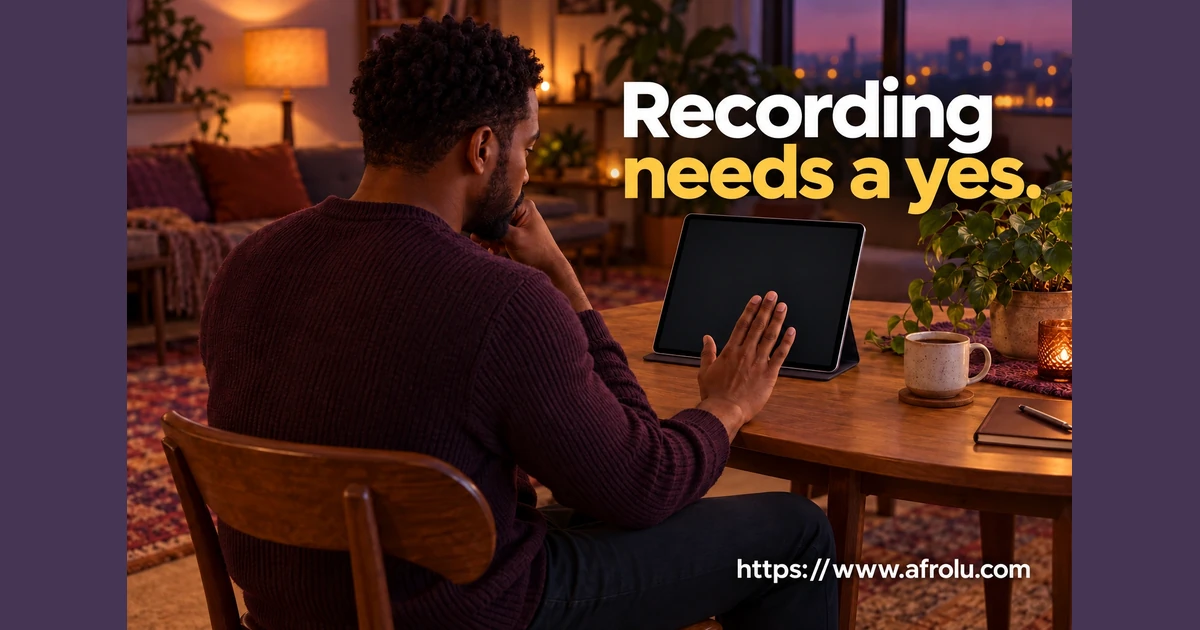
Adult daters Kojo and Thandi live in different places and are beginning a casual connection. Thandi suggests recording their first video date so she can remember it. Kojo likes the idea of a call but does not want a recording. The two choices do not need the same answer.
Ask what the recording is for
If you are interested in the idea, ask what would be recorded, who could view or share it, where it would be stored and when it would be deleted. Both adults need to be comfortable with the answers. If a date changes the purpose later, discuss that change separately. Even if both people want a recording, discuss whether the other can share any part of it and what happens if one changes their mind. Either person can decide the proposed conditions are not comfortable.
Understand the limits of a promise
Someone may make a copy or capture a screen without using the calling app’s record button. eSafety explains that online calls can be recorded or shared without the other person knowing. A warning or setting cannot prove that no copy exists.
Choose what you are comfortable showing and discussing, including background details. A video call can help you talk, but it does not prove identity or guarantee another person’s conduct.
Notice what happens after a no
A respectful response can be “All right, let us talk without recording.” Someone may ask a question, but repeated pressure after a clear no is a reason to pause or end the call. You do not need to give an intimate image, account access or your home address as a substitute.
If a person threatens to share an intimate recording, stop contact, do not pay or send more material, and seek appropriate support. Keep a safe record of the threat if possible. Local reporting choices and laws vary.
If a recording already exists
You can ask the other person not to share it and to delete their copy. Contact the platform about unwanted sharing if needed. Deleting one copy does not guarantee that other copies are gone.
If you feel threatened, a trusted person or local specialist service can help you plan a safer response. Do not attempt to enter another person’s account to remove a file.
Keep reading
More on long-distance dating
Sources and what they can tell us
Kojo and Thandi are invented adults. Recording laws and support options vary; this is not legal advice.
- eSafety Commissioner: Online chat and video chat
It describes recording and sharing risks during online chats, including capture without the other person knowing.
Limit: It does not establish that this particular call will be recorded or explain the law in every country. - eSafety Commissioner: Dealing with sexual extortion
It advises stopping contact and not paying when someone threatens to share intimate material.
Limit: The threat guidance concerns intimate material and its reporting service has Australian eligibility rules. - love is respect: Boundaries and expectations
It supports discussing and respecting personal boundaries.
Limit: It does not set recording laws or guarantee a person will respect a no.
Questions about call recordings
Does agreeing to a call mean agreeing to a recording?
No. Discuss the recording as a separate choice.
Can an app guarantee that nobody records?
No. A screen can be captured in other ways, so no setting can offer a complete guarantee.
Are recording laws the same everywhere?
No. Rules vary by location and situation. Ask a qualified local adviser if you need legal advice.
What if I change my mind?
You can ask for recording to stop and discuss deletion. A past copy may still exist.