Parenting · texting · available time
Find a texting rhythm that leaves room for your real weekend
Dating while parenting? Choose a texting rhythm for care and work, explain quiet hours, repair missed replies and spot pressure without counting texts as love.
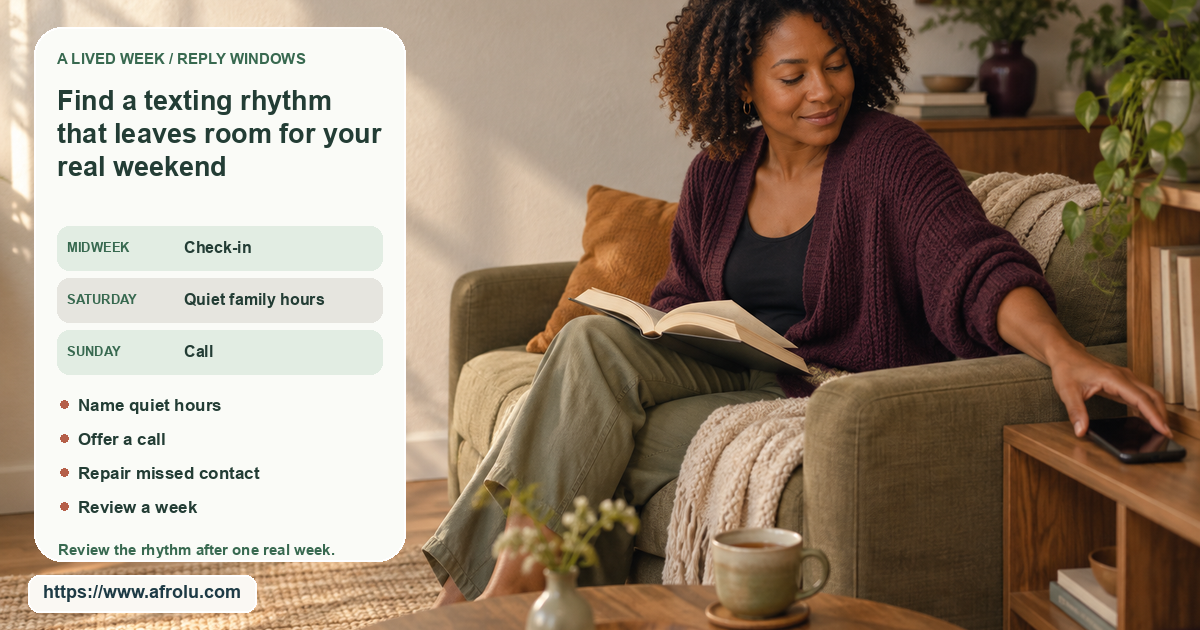
An agreed reply window is more useful than an invisible daily message quota.
Written and edited by Amina Wanjiru · Senior Dating Apps Editor
There is no healthy number of daily texts that proves interest. Tell the other adult when you are usually free, which hours are protected for care or work, and when a call would be easier than a trail of messages. Ask about their preferred rhythm too. A warm note followed by a planned conversation can work better than distracted replies all day. If one person needs more contact than the other can comfortably offer, discuss the mismatch once in concrete terms. Repeated demands for immediate replies, phone access or a child's schedule are different from simply missing someone.
Communication · Parents Returning To Dating
If I cannot text often while caring for my child, how do I show interest without promising access I cannot give?
A texting rhythm is the mutually understood pattern of messages, calls and quiet periods between dates. It is an agreement about access and expectations, not a measure of affection based on a message count.
Illustrative scenario: A parent reads a new date's Saturday message while helping a child with a school project. They reply after bedtime: 'I liked our walk. Saturdays are mostly offline for me; I could call Sunday afternoon.' The date says they prefer a midweek check-in too. Those two preferences can be negotiated without either person proving devotion by hovering over a phone.
An ordinary Saturday
Do not put affection on a timer
The question is not whether a reply arrives before an invisible deadline. It is whether both adults know when conversation is welcome and have a way to return after interruptions.
Describe one typical day, offer a realistic opening and review the other person's response after an actual week.
When can you answer?
Name one time that belongs to conversation rather than care.
Would a call help?
Choose a format for anything too nuanced for short texts.
What if life interrupts?
Agree how to resume without punishment or frantic proof.
What stays offline?
A new date does not need your child's whereabouts to trust you.
A true opening
Start with the hours you actually own
A parent can send a thoughtful message after school pickup and still disappear from the chat during dinner, homework or bedtime. The first useful step is to look at that ordinary pattern, not at the busiest weekend or the most exciting first date. Tell the new person what they can expect on most days and where a call or meeting might fit. An honest hour is more useful than saying 'anytime' and repeatedly apologising.
love is respect distinguishes an unspoken expectation from an agreed boundary. Its relationship education suggests discussing contact preferences rather than expecting a partner to guess them; it gives no rule for messages per day. Your first note can be brief: you liked the date, you are caring for your child today, and you would enjoy a conversation at a named time. That is information, not a defence of parenting.
The right channel
Use messages for contact and calls for questions that need tone
A quick 'thinking of you' can feel good; a twenty-message debate about where the relationship is going may not. Text strips out tone and can invite hurried answers between tasks. If you need to discuss an important change, suggest a call when both adults can listen. If calls are hard, agree that a longer message can wait until a quiet moment. The point is not to rank one medium as inherently more romantic.
love is respect's guidance on respectful texting discusses what feels comfortable to send and how words may be interpreted. Its digital-boundary guidance specifically includes expectations for texting and social media. Neither source says prompt replies equal commitment. Use them to support an explicit conversation about contact, not to score an adult's attachment or to treat a phone notification as a relationship test.
Parenting details deserve a second boundary. You may say 'I am with family' without sending a child's photograph or live location to justify why you did not answer. Australia's eSafety Commissioner warns about sharing identifying information about children in dating spaces. That is a privacy principle, not a demand that you hide being a parent. The adult can know your availability without knowing the child's school or route home.

One kept call can matter more than constant distracted texting.
Four parts of a workable rhythm
- True opening
- The opening is an hour the parent can usually protect.
- Chosen channel
- A call handles nuance that short messages cannot.
- Kind repair
- A missed contact gets a new time without punishment.
- Child details stay private
- No child photograph or live schedule is demanded as proof.
Keep in mind: Four contact choices can fit a parent without making a child visible to a new date.
Read a missed reply
One quiet afternoon and a coercive pattern are different
Suppose the other person expects a Saturday reply and you cannot send one until evening. They may say they felt unsure and ask about a better time to talk. That is a discussion. Repeated accusations, demands for proof of where you were, or requests to inspect your phone after you have explained your rhythm are different actions. Judge the conduct and whether both people can adjust; do not infer intent from one quiet stretch.
You may also discover that the other adult wants daily conversation and you genuinely want much less. Neither preference is automatically wrong. Offer one concrete alternative, such as a Sunday call and one weekday message. If that still feels lonely to them or burdensome to you, name the mismatch kindly instead of pretending you will become constantly available after the next date.

No child's whereabouts appear in the message.
A message with a real opening
An optional way to say it
I enjoy hearing from you. Saturday daytime is usually with my child, so I may reply later. Would a Sunday call and a midweek check-in suit you?
What the line does
- Say you enjoy contact
- Explain Saturday quiet
- Offer two openings
- Invite their answer
Keep in mind: Offer a Sunday call and a midweek check-in, then ask whether that suits them.
After a real week
Keep what worked; release what could not fit
After a week, ask whether you both knew when to expect contact, whether the promised call happened, and whether a change was handled without blame. A rhythm that leaves both people relaxed may have several messages a day or very few. The answer comes from their agreed expectations and lived experience, not from a universal number or a chart of read receipts.
If the other adult says the arrangement is not enough, hear the actual need before offering more. You can try a different time or a better channel if you want to. You can also accept that your lives do not currently fit. A clear, respectful ending protects more goodwill than gradually handing over child time to avoid an honest conversation.

No universal frequency is implied.
Review contact after a week
- Map actual hoursName family and work hours before promising replies.
- Agree contact methodUse text or calls for their best jobs.
- Repair one missAfter a missed contact, offer a real return time.
- Review the weekKeep, adjust or end the arrangement from experience.
Keep in mind: name true reply windows, choose the right channel, repair a missed contact and review one lived week
A Saturday message in real life
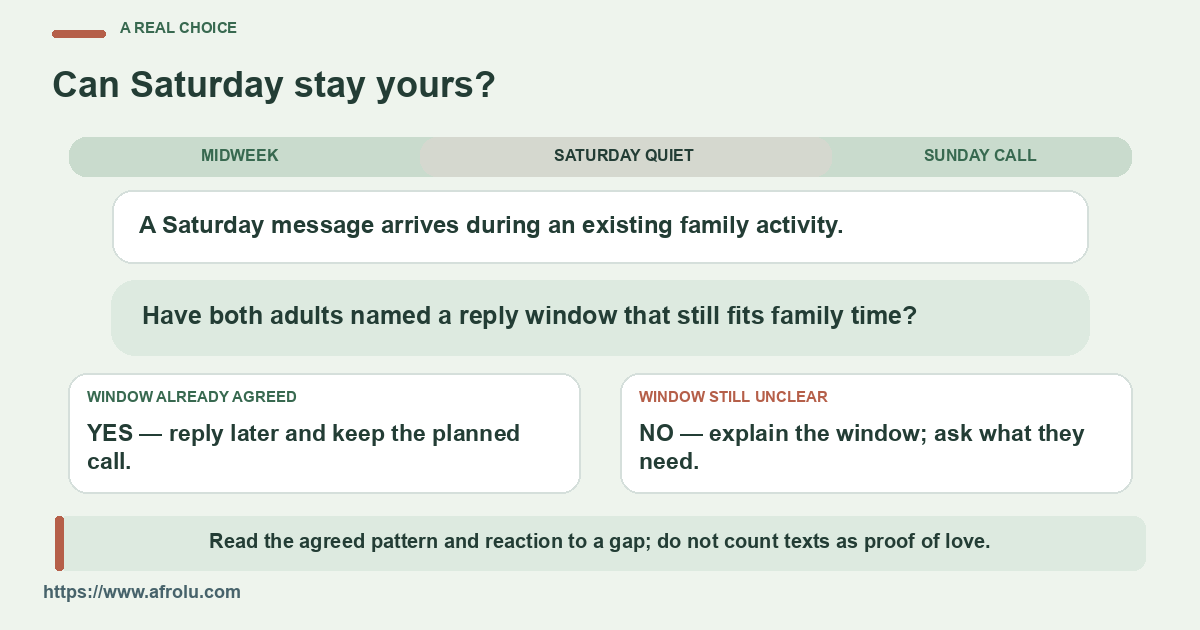
Can Saturday stay yours?
- What happened
- A Saturday message arrives during an existing family activity.
- Question to ask
- Have both adults named a reply window that still fits family time?
- YESreply later and keep the planned call.
- NOexplain the window; ask what they need.
Keep in mind: Read the agreed pattern and reaction to a gap; do not count texts as proof of love.
A text arrives during a child's activity
No reply window was promised during that time.
Answer later and offer a call if you want one.The parent becomes unavailable unexpectedly
A plan changed, and the other adult may need an update.
Apologise briefly and propose one real replacement time.A date demands a child photo to believe the parent is busy
The child has been turned into proof for an adult disagreement.
Keep the child's information private and reconsider contact.Parts of a usable contact rhythm
The promised call or message is usually kept or repaired after a change.
Each adult knows which hours are normally unavailable.
A nuanced issue can move to a better-timed conversation.
Neither adult needs a child's location to tolerate a delayed reply.
A different contact preference can be stated without an accusation.
When a reply cannot come now
| Situation | What it may mean | What to do next |
|---|---|---|
| A morning text can wait | Quiet hours were already explained. | Reply at the named time without a defensive log. |
| The other person wants daily calls | Their preference may be sincere but too much for this home. | Offer a rhythm you can keep and invite their answer. |
| You miss a promised call | The agreement deserves repair. | Name the change and one new time rather than disappearing. |
| Read receipts become a complaint | Message delivery is being used as a test of access. | Discuss the actual contact need; protect device privacy. |
A text that names a true opening
“I like talking with you. Saturday afternoon is family time, and I can answer after bedtime.”
“That feels too important for messages between tasks. Could we speak Sunday when I can listen?”
“I missed the time we agreed. I am sorry; would tomorrow at seven work, or would another time suit you?”
Know the difference
A delayed reply versus a demand for access
A message waits until after family time and is answered as agreed.
One person demands live location, phone proof or immediate replies despite a stated limit.
Read the agreed pattern and reaction to a gap; do not count texts as proof of love.

The difference lies in the demand and response.
Delay or surveillance?
A delay
A message waits until after family time and is answered as agreed.
Monitoring
One person demands live location, phone proof or immediate replies despite a stated limit.
Questions that clarify the difference
- Window named?
- Call kept?
- Miss repaired?
- Privacy intact?
Keep in mind: Read the agreed pattern and reaction to a gap; do not count texts as proof of love.
Waiting versus monitoring
| Type or dimension | What it describes | Best next question |
|---|---|---|
| Delayed reply | A message waits during care or work. | Use the agreed window. |
| Broken promise | A chosen call is missed without notice. | Acknowledge it and offer a new time. |
| Different need | One adult wants more contact than the other. | Discuss fit without making a villain. |
| Monitoring | Proof, location or phone access is demanded. | Keep privacy; seek support if pressure grows. |
Choose contact without a quota
A count hides context
Two thoughtful calls may matter more to these adults than dozens of distracted replies.
A miss needs repair
Quiet time is legitimate, but a specific promise should be updated when it changes.
Parenthood needs no proof
A child should not enter a dating argument as evidence of whereabouts.
Questions after a missed reply
Choose a few prompts that fit the moment. This is a reference library, not a list to complete.
Before offering a rhythm
Choose times that exist most weeks.
- When can I listen?
- What hours are protected?
- Would a call carry this better?
After a gap
Separate a changed plan from a story about motive.
- Was a time promised?
- Was repair offered?
- Did anyone request proof or access?
What digital-boundary sources really support
Text interpretation
love is respect asks readers to consider what they send and how words may be interpreted.
Evidence limit: It offers communication guidance, not a number of messages per day.
Digital boundaries
love is respect includes texting expectations and device privacy in a digital-boundary discussion.
Evidence limit: A delayed reply is not by itself evidence of control or disinterest.
Agreed expectations
love is respect says unspoken standards deserve a conversation.
Evidence limit: One parent-child schedule cannot be inferred from this source.
Child information
eSafety warns against sharing children's identifying details in dating spaces.
Evidence limit: Australian guidance supports privacy; it does not require a parent to conceal parenthood.
Counting instead of communicating
Promising 'anytime'
It gives the other adult an expectation your family week cannot meet.
Turning a delay into motive
A quiet afternoon cannot by itself tell you how someone feels.
Sending child details as proof
A dating preference does not override a minor's privacy.
Name a window you can keep
A real Sunday call and midweek message can be tested for a week; another adult may want a different pattern.
Explore the guide library
Continue with Afrolu
Texting, expectations and child-privacy sources
Afrolu reviewed these health, research, safety, or public guidance resources while editing this page. They support the behaviour and safety guidance; they do not diagnose any individual described by a reader.
Questions about how often parents should text
How many texts a day should parents send while dating?
There is no universal number. Agree on a pattern that fits the actual care and work week, then review whether both adults can live with it.
Is a reply after bedtime too late?
It can be a perfectly honest opening if the other adult knows to expect it and the timing suits both people.
What if my date needs more contact?
Ask what would help, offer only time you have and accept that a respectful mismatch may remain.
Do I have to explain where my child is?
No. You can say you are unavailable without sharing identifying details or a live family schedule.
What if I miss a call we planned?
Acknowledge the change and offer another real time. A care responsibility can be valid while the promise still needs repair.
One thing to do now
Keep a rhythm both people can recognise
Offer a rhythm you can keep, ask for theirs and read how a missed reply is handled before changing your family time.