Later dating · first dates · weekend
Let a first date become a two-person conversation
Returning to first dates later? Use curious questions, your own answers and follow-ups to learn present fit without turning a weekend meeting into an interview.
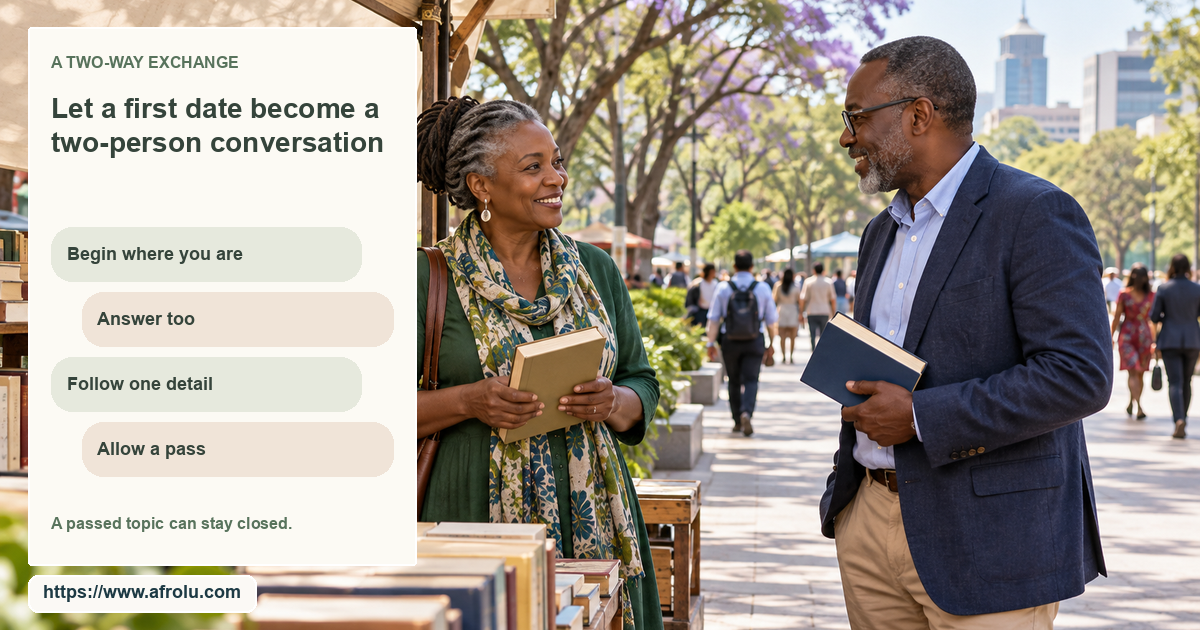
A useful first-date question invites an answer, a return question or a pass.
Written and edited by Liya Bekele · Horn of Africa Editor
Bring two or three questions you genuinely want answered, not a list to complete. Start with the shared setting or how the person spends a free afternoon; offer your own answer and let the next question grow from theirs. You can ask about current dating hopes when conversation has room for it, using present-tense language. Nobody owes a detailed account of former relationships, family plans or finances on a first date. Notice whether both adults can ask, answer, decline and change topic. Clarity includes how the conversation feels, not merely which facts were collected.
What can I ask on a first weekend date to learn whether we fit, without making either of us feel interviewed?
Good first-date questions are invitations to exchange information and curiosity. They are useful when each adult has room to answer in their own way, ask back or pass; they are not a diagnostic test for compatibility.
At the meeting point
Begin with what you can both see
A public bookstall, gallery or garden offers an honest opening: 'What drew you to this book?' or 'What do you usually enjoy on a free Saturday?' You are not trying to hide that the meeting is a date. You are giving both adults an accessible subject before asking for anything intimate. A question with several possible answers lets someone show a preference without performing an autobiography.
If they answer briefly, offer your own thought rather than firing a replacement question. You might say that you stopped at the bookstall because you like finding something unexpected after a busy week. That answer gives the other person something to respond to. A first date can find its rhythm through alternating small disclosures and listening, even when neither person is naturally witty.

A question with your own answer
View full-size imageWhat would an ordinary good weekend look like for you lately? Mine would include a slow morning and time with friends.
- Ask one opener
- Give your answer
- Follow their detail
- Leave room for pass
Ask about an ordinary good weekend and offer your own answer so the exchange can grow.
A walk with pauses
A question should make room for an answer and a return
The date is a meeting between people, not a deadline for discovering every future choice. One question can lead somewhere useful if both adults can answer honestly.
Move from the shared scene to everyday life, then to present hopes only if the conversation welcomes it.
Use what is here
Ask about the place or an easy weekend choice.
Give an answer too
Reciprocity prevents an interview rhythm.
Notice what opens
Ask one genuine follow-up instead of switching lists.
Respect a closed door
A pause or change of topic can be enough.
As the conversation opens
Use follow-ups to learn about a present life
If the other adult says they spend Sundays with friends, a useful follow-up may be 'What do you enjoy about that time together?' rather than a rapid series about occupations, income, marriage and children. Their answer may reveal a value or routine you care about. You can then share yours. The point is to discover how two everyday lives might meet, not to verify a checklist before dessert.
Dating later can bring work, former relationships, family roles or grief into the room. None is a compulsory first-date topic. If a detail matters for near-term planning, ask gently and accept a limited answer. love is respect's boundary guidance supports talking about comfort and limits; it does not require immediate disclosure of a person's full past as proof of seriousness.
If a question lands badly, you can repair it without making the other person explain their discomfort: 'I asked that too quickly. We can leave it there.' Then offer a subject that belongs to the present moment. A respectful shift often teaches more about how you talk together than the private fact you hoped to learn.

The rhythm of a two-person date
View full-size image- Shared setting
- The place offers a low-pressure opener.
- Two-way answer
- The asker offers their own experience too.
- One follow-up
- The next question grows from the answer heard.
- Pass accepted
- A private topic can be declined without pursuit.
Both adults should be able to speak, ask and decline a topic without being scored.

What if the question lands badly?
View full-size image- Notice
- A prepared list reaches a private family question and the other adult pauses.
- Ask
- Can the conversation change topic while both still take part?
- YESreturn to an easier present topic.
- NOstop the list and listen.
The first date can clarify direction without collecting a full life dossier.
When hopes matter
Ask what they want now without asking for a guarantee
If the conversation feels mutual, you can say, 'I am meeting people with the hope of a committed relationship, and I am taking time to learn. How are you approaching dating now?' This tells the truth about your direction and leaves room for a different answer. It is more useful than asking whether they can promise a future before either of you knows the present connection.
A response that differs from yours is valuable information. You may decide another date would clarify things, or that your aims do not fit. Do not try to convert a hesitant answer into certainty by asking the same question five ways. Equally, do not suppress a central hope simply to appear easygoing. Respectful clarity lets both adults choose with the information available.

Exchange or interview?
View full-size imageExchange
What is a good weekend for you? Mine often includes friends and a slow morning.
Interview
Tell me your entire relationship history, family situation and long-term plan now.
- Open question?
- Own answer shared?
- Follow-up genuine?
- Pass respected?
The first date can clarify direction without collecting a full life dossier.
Conversation versus interview
| Dimension | What it describes | Next question |
|---|---|---|
| Open invitation | A question allows several answers or a pass. | Listen to the chosen answer. |
| Interview demand | One topic follows another without exchange. | Offer your own answer and slow down. |
| Present hope | The adult says what they want now. | Compare honestly without extracting a promise. |
| Private history | Past relationships, money or family detail are requested. | Ask whether the topic feels welcome. |
Before you part
What did the exchange make possible?
After the date, recall whether both adults had room to speak and whether a passed topic stayed closed. Did you feel able to answer in your own words, or did you begin editing yourself to pass an invisible test? These impressions are not scientific diagnostics. They are part of your experience of this meeting, alongside practical questions about values and time.
If you want another date, suggest one modest public plan and allow a real no. If you do not, a kind clear ending is enough; you do not owe an assessment report. RAINN's safer-dating advice suggests independent transport and a public place for early meetings, but no setting can guarantee safety. Keep the route home yours while you decide whether a second conversation would be welcome.
Some people will leave a first date with a clear yes or no; others will have one question they would like to ask another time. Neither pace is a sign of being late at dating. If you enjoyed the exchange and the other adult is willing, a second short meeting can answer more naturally than trying to stretch the first one into a decision about a whole future.

Keep one question for next time
View full-size image- Choose three promptsPrepare three possible openings, not a questionnaire.
- Use fewerFollow the conversation and use fewer if it flows.
- Notice mutualityRemember whether both could speak and pass.
- Choose if you meet againOffer a modest next date only if desired.
begin from the shared scene, offer an answer, follow the other person's lead, name present hopes and let a passed subject stay closed
Three questions after you part
Recall the exchange and how freely each person could answer or pass, without scoring a whole life.
After the date
Remember the exchange rather than scoring facts.
- Did we both speak?
- Was a limit respected?
- Would I enjoy another hour?
Next choice
Take three questions, use only what fits
A good date can leave a topic for next time while making both adults feel heard and free to pass.
About these links These information links are not affiliate buttons and are clearly labelled. They do not promise a match or relationship outcome.
Boundaries, readiness and safer-meeting guidance
These sources support the specific advice above. Their scope and location do not establish what any individual date intends.
Questions about first dates later in life
How many questions should I prepare?
Two or three are enough as prompts. Follow the conversation rather than completing a list.
May I ask what someone wants long term?
Yes, when the exchange has room. Share your present hope and invite theirs without demanding a promise.
Must I explain a past marriage or breakup?
No. You can answer at the level that feels comfortable and leave detail for later.
What if the other person never asks me anything?
Offer one answer and notice whether the exchange becomes mutual. You can decide that the rhythm does not suit you.
What if our goals differ on the first date?
Thank them for the answer and choose whether another meeting would be useful. You need not argue either person into a different aim.