Serious dating · work capacity · emotional presence
Make room for a relationship inside a real working life
Busy professionals seeking a serious relationship can assess honest capacity, emotional presence and repair after work changes, then decide if the rhythm fits.

Emotional room is visible in chosen time, listening and repair; a job title cannot measure it.
Written and edited by Ruth Akinyi · Local Dating Editor
Availability is not constant access or a free calendar. Look for a realistic offer of time, willingness to hear a personal truth, and honest repair when work interrupts a chosen plan. Ask what a serious relationship would need from both of you in the present season, not in an imagined quiet future. A date may care and still lack the capacity you need; that mismatch can be acknowledged without assigning an attachment label. Review your own capacity by the same standard.
Emotional readiness · Professionals
How can I tell whether someone is emotionally available when both our careers are demanding?
Emotional availability in this guide means the present capacity and willingness to engage honestly, respond to another person's experience and make workable space for a chosen relationship. It is observable over time, not a diagnosis from reply speed or job title.
Illustrative scenario: Two professionals agree on Thursday dinner. One gets an urgent work request and tells the other early, apologises for the disruption and offers a specific Saturday morning. The other may accept or say that repeated cancellations are too costly. The important evidence is the real explanation and repair across several plans, not the prestige of either job.
Capacity in practice
Look for a place to land, not permanent access
An overloaded week can coexist with affection; a glossy future promise cannot substitute for a present relationship. Use concrete choices as evidence.
Compare the time each adult can reliably offer, what happens when feelings are spoken, and how a missed plan is repaired.
Name a true opening
A protected hour can matter more than an always-open chat.
Hear the difficult thing
Neither adult has to be cheerful to remain welcome.
Respond to a disruption
Early notice and an actual alternative matter.
Count both needs
Care does not erase a real difference in capacity.
Define the present season
A career title tells you less than a real weekly offer
A professional can be deeply interested and still face a demanding project, caregiving or travel. Another can have generous free hours but little wish to share decisions or feelings. Neither job prestige nor message frequency reveals the full picture. Ask what a normal week actually permits: meetings, calls, rest and notice when something changes.
If someone says they want a serious partnership, invite them to describe what serious means in this season. Do they expect to meet most weekends, keep a brief midweek call, or plan around irregular shifts? You can offer your own version without turning it into a contract. The point is to test whether two present lives can overlap, not whether either person can advertise a perfect future.
love is respect's readiness questions include time for a relationship alongside work and other commitments. This is reflection guidance, not a test that classifies a busy adult as unavailable. You may decide you have no room to date now; you may also create a smaller, reliable rhythm and see whether it is enough for both people.
Notice the encounter
Presence can be brief and still be real
When you describe a hard week, does the other adult listen long enough to understand it, ask a useful question or name that they cannot talk well until later? No one is required to process a serious conversation on demand. The more telling choice is whether they make a return possible and then follow through on it.
Emotional boundaries matter here. love is respect describes support for each person's decisions, consistency between words and conduct, and room for time apart as questions that can inform trust. Its U.S. education is not a clinical measure of attachment or a promise that a certain kind of listening leads to marriage. Use the questions to observe, not classify.
Offer the same care yourself. If you routinely ask a date to absorb your job frustrations while rarely hearing their concerns, your own availability may be narrower than your stated intention. A serious connection involves two adults who can speak and listen, even if the pattern grows slowly.

Show repair as action, not an apology icon.
Four signs of present room
- Specific timeA protected hour is more useful than an open-ended promise.
- Attentive returnThe next talk gives room for both adults' needs.
- Early change noticeA changed plan includes notice and a feasible alternative.
- Mutual needs heardNeither career label nor one busy day decides the pattern.
An ordinary month can show whether two people make room without demanding constant access.
Test the repair
A cancelled Thursday can show more than a perfect first month
Work emergencies happen. If Thursday dinner becomes impossible, early notice may save another person's travel, childcare arrangement or evening. A specific alternative is better than a vague promise to make it up someday, but the other adult can still say that Saturday does not work. Neither has to pretend the disruption cost nothing.
One cancellation does not prove a person cannot connect; a repeated pattern without notice or adjustment may mean their present capacity is too small for this arrangement. Name the concrete cost rather than the psychological label: 'I have reserved three evenings and learned too late each time. I need earlier notice and a plan we can keep.' Then observe what changes.
If you are the one repeatedly cancelling, do not promise a rhythm you cannot honour. You can reduce the commitment, offer a later review point or pause dating while work changes. Care becomes credible through choices you can sustain, not through a speech about how much you will be available after the next promotion.

No fantasy of permanent availability is promised.
A realistic month conversation
Optional wording
I would like to build something serious, and my work month is full. I can protect Saturday morning and a midweek call. What kind of time would make dating feel real for you?
Adapt it in four moves
- Name serious hope
- State true capacity
- Ask their need
- Review after a month
Ask for a rhythm that both current calendars can keep.
Make space for difference
Serious intent includes the ability to hear a no
One adult may want shared weekends and a daily check-in; the other may only have one afternoon every two weeks. Both preferences can be sincere. Ask whether either person wants to adjust and what that would cost. If the proposed rhythm leaves one adult chronically waiting or the other chronically apologising, naming that is a respectful result.
A request for more contact is not automatically neediness; a limit around late-night calls is not automatically avoidance. love is respect's boundaries guidance encourages explicit expectations and warns against pressuring a partner to change a boundary. Use a conversation about actual time, rather than assigning a personality explanation to a calendar.
A serious aim does not require an immediate exclusive promise. It does require honesty about what each hopes to build and what is available now. If the answers differ, you can leave with respect rather than treating a busy person's affection as an obligation to wait indefinitely for a calendar that may never open.
Choose the next month
Let a modest rhythm produce evidence
If both want to continue, choose a small plan that fits the coming month: perhaps two protected public dates and a call that can move with notice. Do not make the plan a scorecard. It is a way to learn whether each adult can make room, tell the truth when they cannot, and remain considerate when a week changes.
At the review point, ask what actually happened. Did the dates take place? Did either person share something personal and feel heard? When a plan moved, was the cost acknowledged? Also ask whether this amount of connection feels nourishing enough to you. The evidence is not only whether the other adult performed; your own experience matters.
If the arrangement fits, keep building. If it repeatedly does not, you can end it without pronouncing anyone emotionally unavailable forever. The conclusion may simply be that these two serious intentions do not have enough shared room at this time. That is a practical conclusion, not a verdict on either person's worth.

Use ordinary plans as evidence.
Choose from the month you had
- Describe current monthDescribe the work month you actually have.
- Protect one meetingChoose one meeting that can survive this season.
- Repair changesAcknowledge a change and offer a workable repair.
- Choose whether it fitsAsk whether the resulting rhythm fits both adults.
compare actual openings, attentive conversation, repair after disruption and both adults' present needs
Work-month situations that reveal room
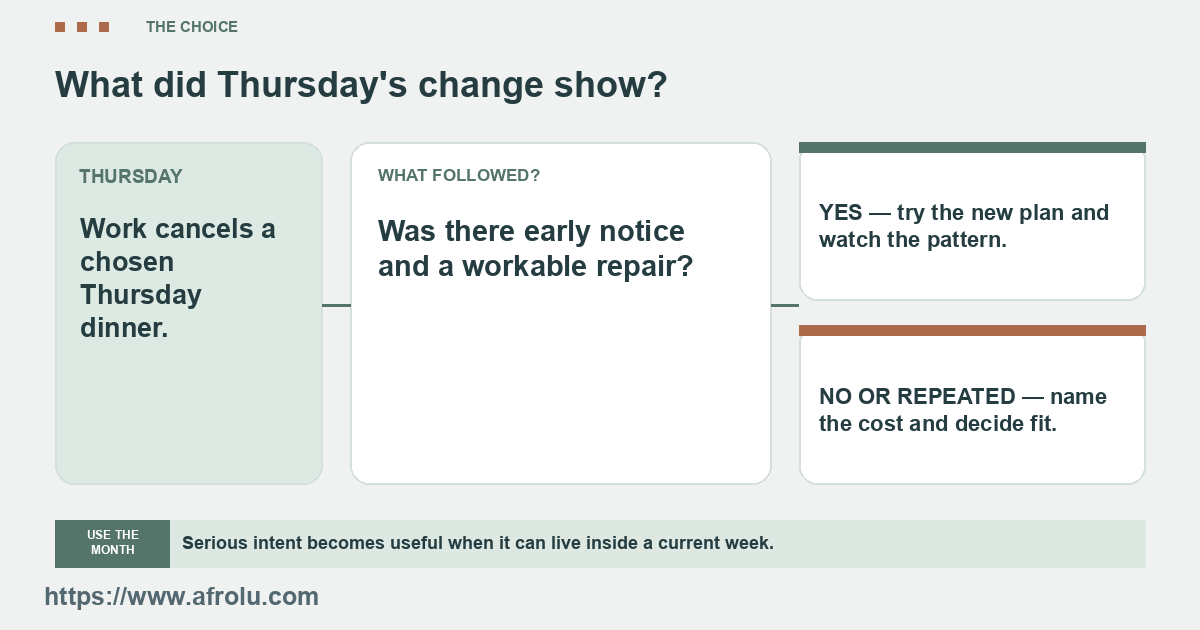
What did Thursday's change show?
- Notice
- Work cancels a chosen Thursday dinner.
- Ask
- Was there early notice and a workable repair?
- YEStry the new plan and watch the pattern.
- NO OR REPEATEDname the cost and decide fit.
Serious intent becomes useful when it can live inside a current week.
One adult protects Saturday morning
A small reliable time can be meaningful.
Choose a date both can keep.Work interrupts a dinner with early notice
Disruption has a cost but may be repaired.
Offer a real alternative and hear the answer.Every meeting waits for a quieter month
There is no present shared rhythm to assess.
Ask what is available now.One adult raises a difficult week
Attention is a choice even when time is short.
Listen now or name when you can return.Evidence of present capacity
Each adult can name time actually available this month.
A difficult feeling is heard or given a real return point.
Changed plans are disclosed before costs accumulate.
Repair addresses the missed time or travel, not only the speaker's image.
Neither adult must erase work, rest or outside ties to appear serious.
A change of plan, then a choice
| Situation | What it may mean | What to do next |
|---|---|---|
| Both want seriousness | A long-term aim still needs present capacity. | Compare two ordinary weekly rhythms. |
| Thursday is cancelled | Work can collide with a chosen plan. | Name impact and offer a feasible alternative. |
| The same miss repeats | The cost keeps landing on one adult. | Ask for a changed practice or decide to stop. |
| Their preferred pace differs | Care and fit are separate questions. | Discuss one adjustment without pressuring a boundary. |
| Your own work overwhelms | You may have less room than you hoped. | Offer a smaller honest plan or pause dating. |
Talk about a realistic month
“I am looking for something serious. This month I can protect Saturday mornings and a midweek call. What would feel real to you?”
“Work changed Thursday, and I know you reserved the evening. I can offer Saturday at 10 if that helps; I understand if it does not.”
“I care about our time, but one meeting every three weeks is not enough for me. Can we find another rhythm, or should we stop?”
Know the difference
Present capacity versus a beautiful future promise
A modest time is protected and a missed plan is acknowledged and repaired.
Every plan waits for a quieter season that has no concrete opening.
Serious intent becomes useful when it can live inside a current week.

No psychological diagnosis is inferred.
Now versus someday
Available now
A modest time is protected and a missed plan is acknowledged and repaired.
Available someday
Every plan waits for a quieter season that has no concrete opening.
Questions that separate them
- Real opening?
- Truth heard?
- Repair offered?
- Enough for both?
Serious intent becomes useful when it can live inside a current week.
Available now versus available someday
| Type or dimension | What it describes | Best next question |
|---|---|---|
| Busy but engaged | A real protected opening and follow-through. | Try the offered rhythm. |
| Busy and changing | A plan moves with notice and repair. | Watch the next actual meeting. |
| Future promise | Care is expressed but no present time appears. | Ask for an opening before waiting. |
| Unmet need | The rhythm exists but is too small for one adult. | Choose another arrangement or part. |
Look at a month you could keep
Capacity is present tense
A serious intention does not create hours that do not exist.
Listening can be scheduled honestly
A later conversation counts when it actually happens.
Fit belongs to two
Your need for time matters alongside the other person's limit.
Questions about each person's capacity
Choose a few prompts that fit the moment. This is a reference library, not a list to complete.
About this month
Ask for the calendar that exists now.
- What time is protected?
- What is likely to change?
- What is enough for me?
After a disruption
Look for action that repairs the real cost.
- Was notice early?
- Was a workable alternative offered?
- Did it happen?
What relationship guidance can and cannot say
Capacity
love is respect invites readers to consider work, school and other commitments before dating.
Evidence limit: A reflection prompt, not a certified availability test.
Emotional trust
love is respect discusses consistency, support and space apart as questions about trust.
Evidence limit: This cannot diagnose an attachment style or guarantee a relationship outcome.
Expectations
love is respect urges specific, mutual discussion of boundaries and expectations.
Evidence limit: It supplies no universal weekly meeting quota.
Respect
love is respect describes mutual dignity and support for independent choices.
Evidence limit: A busy adult may still choose a relationship that does not fit the reader.
Conflict
love is respect distinguishes respectful disagreement from threats or coercion.
Evidence limit: A schedule mismatch is not itself abusive behaviour.
When busyness becomes a label
Diagnosing from a deadline
A late work reply does not establish attachment style.
Spending future time now
After this project may remain permanently vague.
Ignoring your own cost
A modest rhythm can still be too little for you.
Review one actual work month
A protected meeting, honest listening and practical repair can show whether both have enough room now.
Explore the guide library
Continue with Afrolu
Readiness, boundaries and respect sources
Afrolu reviewed these health, research, safety, or public guidance resources while editing this page. They support the behaviour and safety guidance; they do not diagnose any individual described by a reader.
Questions about emotional availability
Is a busy professional emotionally unavailable?
No job or crowded week proves that. Discuss present capacity and observe follow-through over time.
How much contact is enough?
There is no universal quota. Choose a rhythm that both can sustain and that meets your actual needs.
Does one cancelled date settle it?
No. Ask how the change was handled and whether it becomes a repeated costly pattern.
What if they listen but have almost no time?
Care can be real while present capacity is insufficient for the relationship you want.
Should I wait until their career calms down?
Only if the current arrangement is one you freely want. A future promise should not replace a present choice.
One thing to do now
Choose from the life that exists now
Ask what time and attention each of you can choose now; judge repeated follow-through and repair rather than professional busyness alone.