Diaspora · distance · relationship terms
Define the relationship before distance defines it for you
Diaspora daters can discuss exclusivity, contact, visits, costs, privacy and a review point across distance without treating one label as a complete agreement.
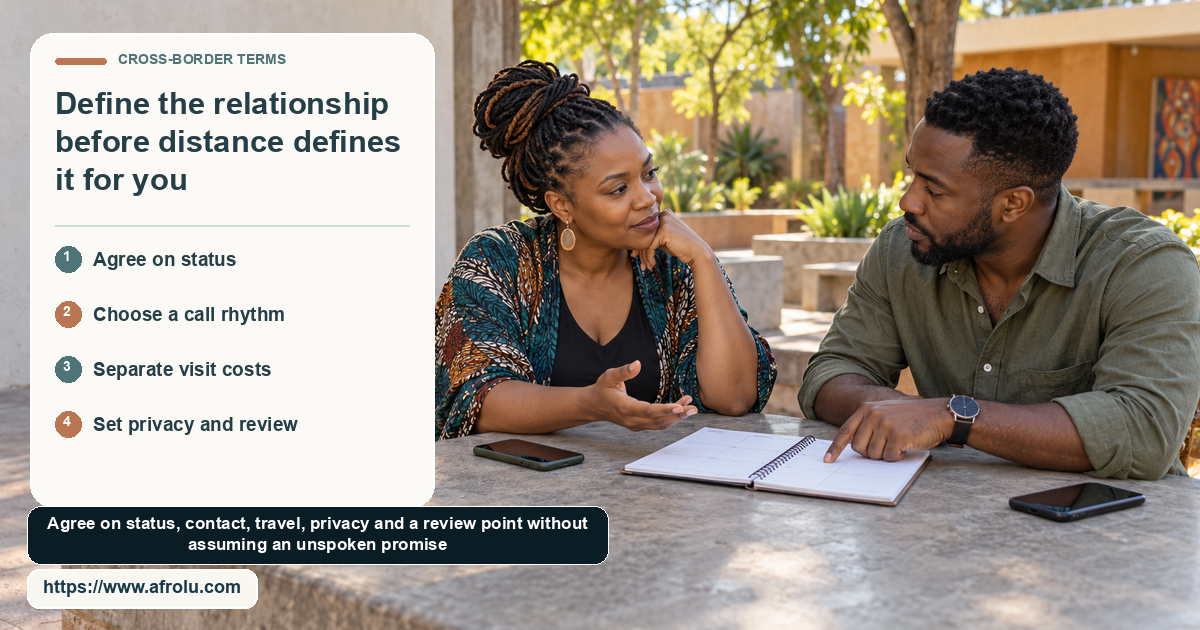
A label is useful when the two adults know what it means for their lives now.
Written and edited by Miriam Otieno · Senior Kenya Editor
Begin with what each person wants now, then make the practical terms visible: whether either is dating others, what contact feels sustainable across time zones, whether another visit is desired and affordable, who controls lodging and transport, what remains private from family or social media, and when to revisit the plan. A label can be meaningful, but it does not answer these questions by itself. If one adult cannot offer a term the other needs, name that difference rather than treating a trip or daily messages as silent consent.
Relationship agreements · Diaspora Daters
What must we actually agree on before calling this a relationship across distance?
Defining a long-distance relationship is a conversation about present expectations and separately chosen commitments. It is not a single status word that automatically grants access to someone's time, travel money, home, devices or family.
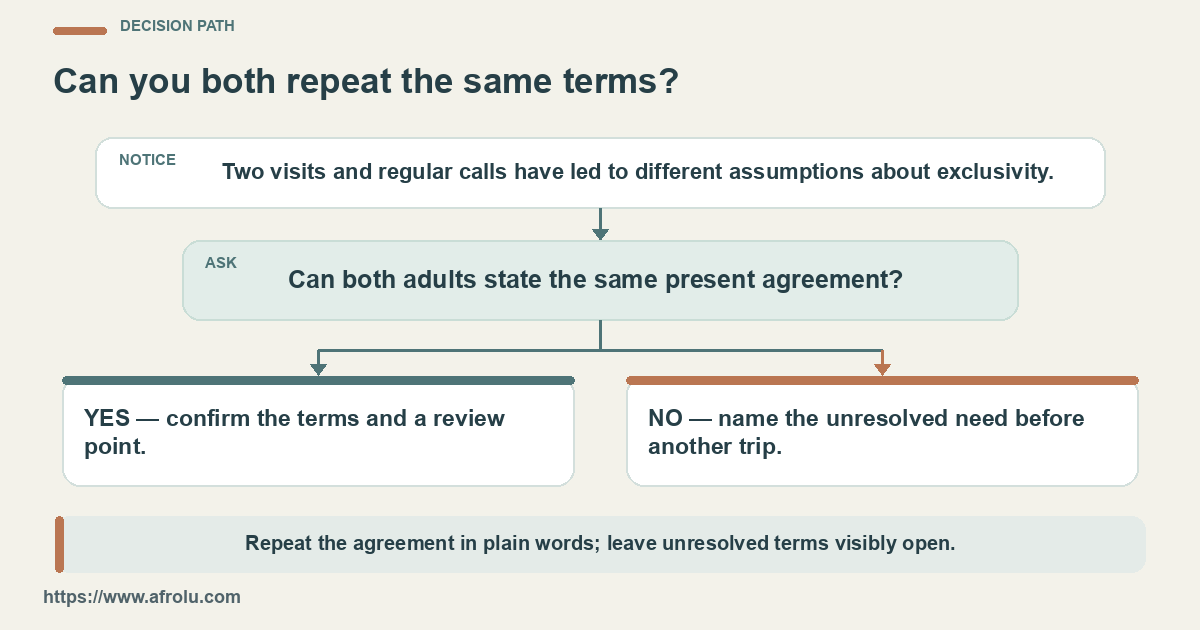
Illustrative scenario: One adult lives in Nairobi and another in London. They have visited twice and speak most evenings. The Nairobi adult assumes exclusivity; the London adult has not agreed to it and is worried about the cost of another visit. In a planned call, they discuss current dating terms, contact windows, a possible next trip and what each is comfortable telling family. They leave the call with an actual agreement or an acknowledged difference.
Six agreements
Turn affection into terms both adults can repeat
Distance magnifies assumptions: messages, visits and public recognition can each mean something different to the two people involved.
Discuss one term at a time, record only what both choose, and leave unresolved points open rather than filling them with hope.
Who else may date?
Ask directly about exclusivity now.
What is sustainable?
Account for time zones, work and rest.
Who chooses and pays?
Separate desire from a booked journey.
What is shared?
Agree before involving family or posting online.
Name the present
A label cannot tell you whether you are exclusive
You may have spent months speaking across time zones and still hold different assumptions about whether either person dates others. Start with your own position: what are you choosing now, and what would you need from the other adult? Ask them without making a warm call or an expensive visit stand in for an answer.
love is respect's dating-definitions guidance says labels alone are less important than agreed ground rules. That is U.S.-based education, not a universal rule for diaspora families or a substitute for the two adults' consent. 'Partner', 'exclusive' and 'serious' may overlap in one person's mind and remain separate in another's.
If both want exclusivity, discuss when that begins and what each believes it includes. If one does not, acknowledge the difference before planning another trip. A person can care deeply while declining an arrangement, and the other person can leave because that arrangement is essential to their present life.
Set a rhythm
Daily contact is only useful when both choose it
A cross-border couple may wake, work and rest at different hours. Instead of promising to be available whenever a phone rings, compare realistic windows for calls and the kind of messages each enjoys between them. Say what you can usually offer and when an urgent practical matter should be handled differently.
love is respect's digital-boundaries resource suggests discussing expectations for texting, social media and privacy. It supplies no daily-message quota and cannot verify anyone's devotion. One adult may like voice calls and another may prefer shorter written updates; the terms are workable when both understand and freely choose them.
If a schedule changes, say so and agree on a replacement window. Avoid turning time-zone arithmetic into surveillance: read receipts, location sharing and password access do not become owed because a relationship is long-distance. Trust is better served by agreements you can keep and honest repair when you cannot.

Do not infer exclusivity from repeated calls.
Count the journey
A visit is an expense and a choice, not a proof of love
The phrase 'come see me soon' can mean enthusiasm without a feasible plan. Before booking, ask whether both want the visit, which dates are possible and how travel fits work, money or care responsibilities. Decide who pays for what without making one person's expenditure a claim on the other's home or body.
Plan accommodation and transport as their own decisions. A visiting partner need not stay in the other person's home, and a local partner need not host to prove commitment. RAINN's U.S. safer-dating advice favors public early meetings and independent transport; those are practical options, not safety guarantees or rules about every established relationship.
If a visit is not possible now, state what remains available: a call, a later planning date or no further long-distance relationship. Do not keep one adult waiting on a vague future fare if regular physical time is a present requirement for them. A practical limit can be sad and still be decisive.

A different answer can end the plan without making either adult wrong.
Define the audience
Family and social media are separate agreements
Being named as a partner to family may matter deeply, particularly when relatives live across countries and news travels quickly. Ask what each person is comfortable sharing now. One adult may want close friends to know while keeping a public profile quiet; another may want a family introduction before using a label. Do not assume that one choice applies to every audience.
Photographs, tags, location check-ins and relationship-status posts can expose details neither person intended to share. Ask before posting or forwarding. Australia's eSafety Commissioner advises caution with identifying details in online dating; that is Australian privacy guidance, not a verdict on a person's motives. Digital boundaries remain relevant after a label changes.
A refusal to post can have many explanations, including work, family safety or a preference for privacy. You can ask what it means in this particular relationship and decide whether the answer fits your needs. You do not need to investigate someone's accounts to settle uncertainty; a direct conversation and their later conduct provide information for your own choice.
Leave with an answer
An unfinished conversation still needs a next point
At the end of the call, reflect the terms back in ordinary words: for example, exclusivity starts now, a Sunday call suits both, no trip is booked and family introductions are undecided. Invite corrections. This is not a legal document or a scorecard; it prevents two people from leaving the same conversation with incompatible impressions.
If a key term is unresolved, choose a review point linked to real information, such as after a work schedule or travel budget is known. Do not set a deadline solely to quiet anxiety. Each adult may decide that the current uncertainty is too costly and step away before the review point.
Return to the discussion when circumstances or preferences change. A new job, move, child-care duty or wish for exclusivity can make an earlier agreement obsolete. Name the change before acting as though the relationship has already adapted. The strength of the conversation is that both adults retain the ability to choose again.

Revisit after a real circumstance changes.
Where distance changes the meaning
Effort is mistaken for exclusivity
One adult assumes the relationship is exclusive while the other has not agreed.
Ask directly before making new dating choices.Night calls become expected
A call rhythm suits one location but disrupts the other's work or sleep.
Agree on repeatable windows in both cities.A visit is talked about but not feasible
Desire has been expressed without a budget or leave from work.
Separate a hope from a bookable journey.One partner wants relatives told
The other wants more time before a family introduction.
Agree on audiences instead of treating privacy as deceit.A photo is tagged without discussion
The post reveals a relationship and location more widely than expected.
Ask before posting or tagging.The call ends without travel agreement
One term remains unresolved while current status is clear.
Set a review point tied to real information.Terms both adults can repeat
Both adults can say whether they are exclusive now.
The agreed call window fits both time zones.
No device password or live location is demanded as proof.
Fare, leave and care commitments are considered before booking.
Lodging is discussed rather than assigned to the local adult.
Family disclosure is chosen by each adult.
An unresolved term is named as unresolved.
A changed preference is discussed before anyone acts on it.
Move from label to agreement
| Situation | What it may mean | What to do next |
|---|---|---|
| The label comes up | It may mean different things in two lives. | Ask what changes now for each adult. |
| Exclusivity is assumed | Visits and affection do not establish it. | State current dating choices directly. |
| A call schedule is proposed | Time zones and work may make it asymmetric. | Compare ordinary windows in both places. |
| A visit is desired | Travel costs and leave remain separate decisions. | Price and schedule before promising. |
| Family asks questions | Disclosure can have different timing and audiences. | Agree on what can be shared now. |
| A term is unresolved | A hope is not yet a shared plan. | Name what information would allow a later answer. |
Open the defining call
“I value us and want to understand what we are choosing now.”
“Are we both choosing exclusivity at this point?”
“Sunday evening in Nairobi and afternoon for you could work; does it?”
“I would like to see you again, but I need to check leave and fare first.”
“I am comfortable telling close friends, but I am not ready for a family introduction.”
“We have not decided on a next trip; can we revisit it after my schedule is confirmed?”
Know the difference
An agreement both can repeat versus a label filled with assumptions
Both can describe exclusivity, contact, a possible visit, privacy and the next review.
Each hears a different promise in the same label and spends time or money accordingly.
Repeat the agreement in plain words; leave unresolved terms visibly open.

Do not convert hope into an agreement.
A shared word is not always a shared plan
| Type or dimension | What it describes | Best next question |
|---|---|---|
| Relationship label | A word two adults may use differently. | Translate it into present terms. |
| Exclusivity | A current agreement about other dating. | Ask whether both choose it. |
| Call rhythm | The contact pattern that ordinary weeks permit. | Check both time zones. |
| Visit hope | A wish to meet again. | Keep it separate from a booked plan. |
| Family sharing | A choice about an audience beyond the couple. | Agree on what each may tell. |
| Review point | A time to revisit an unresolved term. | Tie it to a real change. |
Take these terms into the call
Visits are not votes
Time or fare spent does not automatically establish exclusivity.
Two clocks matter
A comfortable call hour for one adult may be work or sleep for the other.
Distance can hide costs
A warm travel idea still needs leave, fare, lodging and return decisions.
Open is a valid status
An unresolved term can be named instead of smuggled into the label.
Questions for both locations
Choose a few prompts that fit the moment. This is a reference library, not a list to complete.
Before the label
Clarify status.
- Are either of us dating others?
- What would exclusivity include?
- Is it a need for either now?
Across the week
Build contact both can keep.
- Which hours overlap?
- What messages feel welcome?
- How will a missed call be repaired?
Before a visit
Turn desire into a feasible plan.
- Can each arrange leave?
- Who pays what?
- Where will the traveller stay and return from?
Where relationship guidance stops short
Words and terms
love is respect distinguishes labels from mutually understood ground rules.
Evidence limit: U.S. education cannot define one diaspora couple's terms.
Boundaries
love is respect recommends specific expectations rather than mind-reading.
Evidence limit: It cannot enforce or verify the resulting agreement.
Digital contact
love is respect discusses text, tagging and device privacy.
Evidence limit: It prescribes no cross-border call frequency.
Visits
RAINN suggests public early meetings and control of transport.
Evidence limit: U.S. options, not a promise of safety for any trip.
Online privacy
eSafety advises care with identity, location and social-account linkage.
Evidence limit: Australian guidance, not a reason to presume deception.
Assumptions hidden in a label
Treating a label as a contract
It may conceal different expectations about the same word.
Inferring exclusivity from travel
A fare is not an agreement about other dating.
Booking before discussing money
The trip may impose cost or hosting pressure.
Posting first
A tag can disclose a relationship or location without consent.
Leave the call with terms you can both repeat
Use these guides to clarify distance, boundaries and what was actually agreed.
Explore the guide library
Show more related guides
Relationship, digital and travel sources
Afrolu reviewed these health, research, safety, or public guidance resources while editing this page. They support the behaviour and safety guidance; they do not diagnose any individual described by a reader.
Questions about exclusivity and visits
Are we exclusive if we call every day?
Only if both have agreed to exclusivity; call frequency alone does not set it.
Does paying for a visit prove commitment?
It shows a travel choice, not every relationship term or a right to someone's home.
How often should we speak across time zones?
Choose a pattern that both can repeat around work, sleep and other duties.
Can I keep my family uninformed for now?
You can state that preference and hear whether the other adult can accept it.
Who pays for the next trip?
Discuss fare, lodging and return before booking; no adult is automatically obliged to fund or host.
Can some terms remain open?
Yes, if both know what is unresolved and freely choose whether to continue meanwhile.
When do we talk again?
Choose a review point linked to real information or a changed preference, not a vague endless wait.
One thing to do now
Repeat what was actually chosen
Translate the label into six present choices, then set a time to revisit what remains unresolved.