Dating safety · Work life
Your job details and money can wait
Start here
Do not send money, passwords, office access details or private client information to someone you know only through dating. If a match makes an urgent request, stop replying for a moment and tell a trusted person what happened. Save the messages if you may need to report them. A warm conversation does not make an emergency request your job to solve.
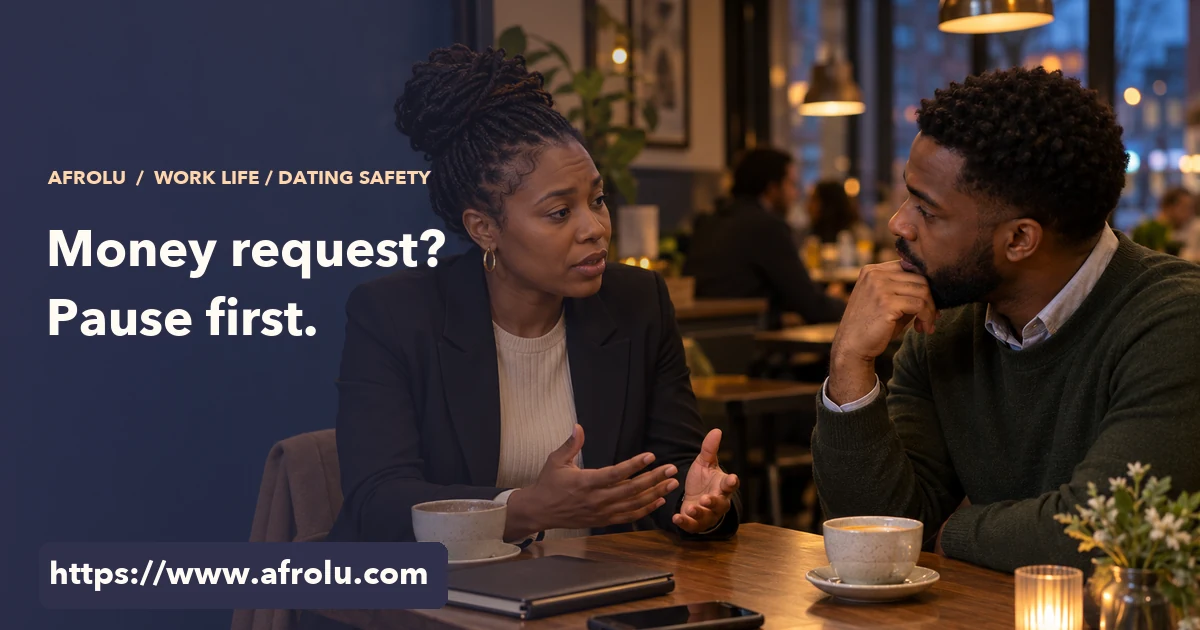
A match you met last week says they admire your career. Tonight they ask for help with a sudden bill and say the payment must happen before morning. They also want to know exactly where you work. You can pause without solving the story or proving whether it is true.
Separate romance from a request
A compliment can feel personal. A request for money is a different action. The US Federal Trade Commission warns that romance scammers may build a connection and then ask for money, often through hard-to-recover payment methods. Do not use a new match's warmth as evidence that a payment is safe.
You do not need to investigate a person's identity yourself. Say no to the transfer and stop if they keep pressing. If you already paid, contact your bank or payment provider promptly and report through the service you used.
Example conversation
A request that crosses two lines
Invented example: Dara works in consulting. A match called Ben has chatted warmly for six days.
This is an invented example.
- Ben
- “I need a transfer tonight. You have a good job, so you can help. Send your work email too.”
- Dara
- “I do not send money or private work details to a new match. I am ending this chat.”
- Dara to a trusted friend
- “This is what the message said. Could you sit with me while I report it?”
Dara does not have to prove Ben is a scammer before protecting her money, work and peace of mind.
Give your job a privacy boundary
You can talk about work in broad terms: ‘I work in healthcare’ or ‘I am in finance.’ A new match does not need your employer's internal systems, client names, travel schedule or building access. eSafety recommends limiting personal information that can be used to find or track you.
A person may ask where you work out of ordinary curiosity. The useful test is how they respond when you say, ‘I keep work details private until I know someone better.’ Respect for that answer matters more than a clever explanation for asking.
Never send a work document to make a dating story sound credible. Ask your workplace security or privacy contact for help if you have already shared protected information.
Watch what happens after a no
A person can be disappointed without punishing you. Repeated calls, guilt about your income, demands for a password or claims that your care must be proved with money are behaviors you can act on. The Hotline includes control and threats among signs of an unhealthy relationship.
This page cannot label a stranger from one message. It can help you decide not to meet a request that crosses your limit. If you feel threatened, leave the chat, use block and report tools, and seek local help.
Choose from the answer
Choose the next safe action
- They ask for money or account access
Do not send it. Preserve the message and use the app's report tools.
- You already sent a payment or work data
Contact the payment provider or your workplace security contact promptly and report the account.
- They accept a plain privacy boundary
You may continue slowly if you want. Keep judging actions over time, not promises alone.
Talk to someone outside the chat
Tell a trusted friend exactly what was asked. Read the message aloud without adding your guess about the person's motives. Hearing the request in plain words can make it easier to see what you are being asked to risk.
Take screenshots if you may report the contact. eSafety advises keeping a record of a profile and messages because a match may disappear or unmatch. Keep that record private and follow the reporting options available to you.
A short answer is enough
You can write, ‘I do not send money or work information to people I meet online. I am ending this conversation.’ You may also stop replying and block. A long debate can keep you in the very chat you want to leave.
If you want to keep dating, choose other connections at your own pace. One bad request does not require you to justify your limits to every new person.
Keep reading
A related question
Sources and what they can tell us
Dara and Ben are invented. The sample reply, work boundary and trusted-friend step are Afrolu guidance. The FTC supports the money-risk warning; eSafety supports careful data sharing and reporting; the Hotline supports attention to pressure and control. None proves who Ben is.
- US Federal Trade Commission: What to know about romance scams
The FTC describes scammers using fake dating profiles, building a relationship and then asking for money through transfers, gift cards or cryptocurrency.
Limit: It cannot prove Ben's identity from one request; Dara can refuse payment without such proof. - eSafety Commissioner: Online dating: How to stay safe
eSafety advises limiting personal details online, recording a profile and messages before meeting, and using a dating app's block or report tools.
Limit: These steps cannot guarantee that a match is genuine or recover a payment already sent. - National Domestic Violence Hotline: Healthy relationships
The Hotline contrasts respectful communication and privacy with controlling conduct, threats and pressure in unhealthy relationships.
Limit: Its general signs do not diagnose this particular match or decide a legal case about fraud or abuse.
Questions you may still have
Can a real person have a real emergency?
Yes. You still do not have to send money to a person you know only through dating.
Should I confront them with proof?
No. You can decline, save the message and report it without running your own investigation.
May I say what I do for work?
You can share broad facts you choose. Keep internal documents, client data, passwords and exact routines private.
What if I have already paid?
Contact the bank or payment provider promptly, report the dating account and use your local fraud reporting channel.