Parenting · distance · safety
When distance dating asks too much of a parent
A parent dating across towns can spot pressure around child details, travel and money, separate a mismatch from unsafe conduct, and choose a safer next step.
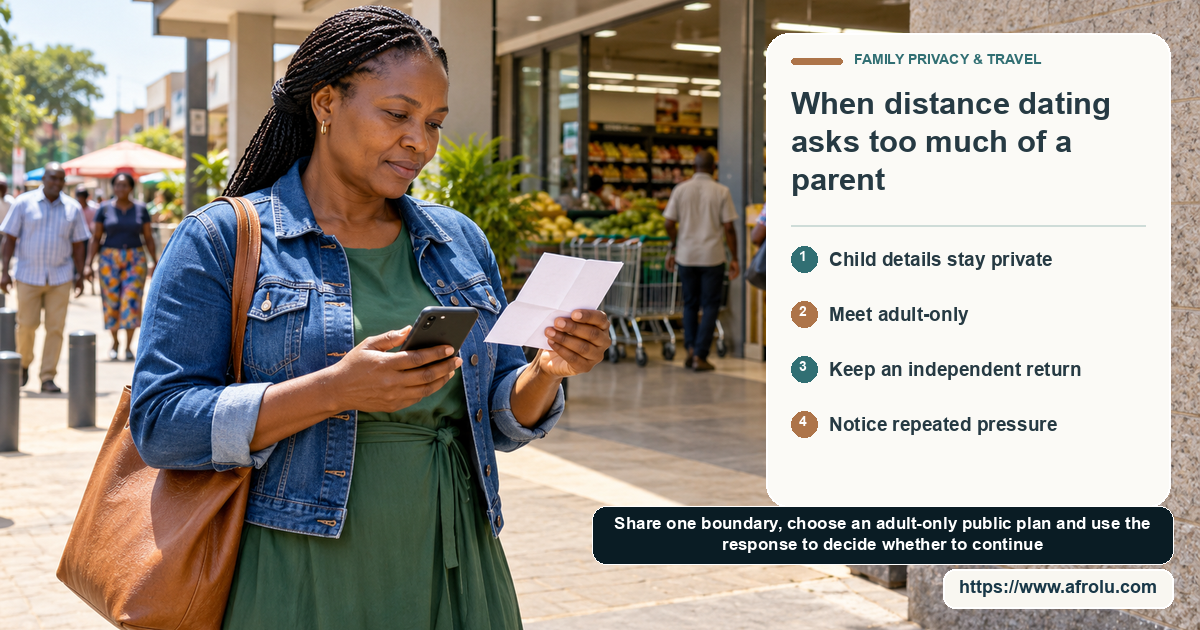
A practical limit is enough; the next response shows whether the plan can respect it.
Written and edited by Amina Wanjiru · Senior Dating Apps Editor
Look at what happens after you give a clear limit. A wish for more calls or a nearer date may be a mismatch; repeated demands for your child's school, live location, money or a visit after you decline are different information. Keep child details out of early dating, pay and arrange travel independently where possible, and choose a public adult-only meeting. If someone pressures, threatens or tracks you, stop negotiating the date and seek support from someone you trust or local emergency services if you are in immediate danger.
Dating safety · Parents Returning To Dating
Is this an awkward long-distance mismatch, or is the other person pushing past a boundary that matters for my family?
A red flag here is an observable action that makes an adult or child less able to choose freely or keep private information private. It is not a personality diagnosis, and one inconvenient schedule request is not proof of danger.
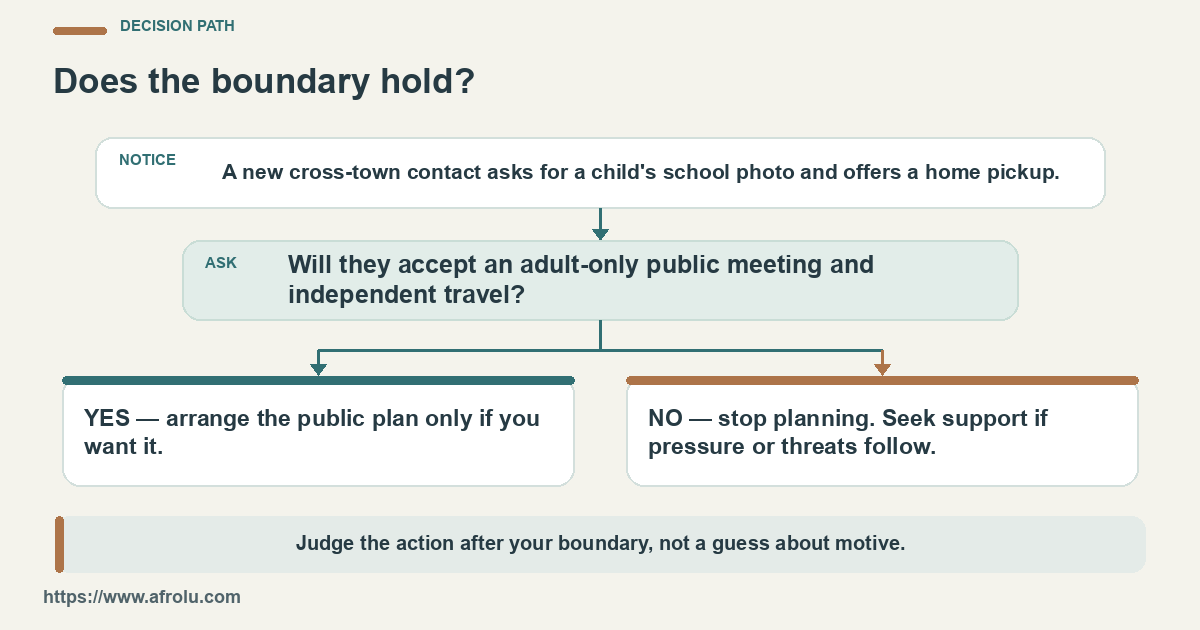
Illustrative scenario: A parent in Kisumu starts talking to someone in Nairobi. A public visit is possible next month, but the new contact asks for a photo of the child in school uniform and offers to collect both of them from home. The parent declines and suggests an adult-only public meeting with independent transport. The response to that boundary, not the person's charming messages, informs whether to continue.
The boundary test
Watch what happens after a clear no
Distance can make care, cost and timing difficult. Those difficulties are different from a person asking for access or information they have been refused.
Name the one condition needed for a meeting, then observe whether the other adult respects it without a demand for proof or a penalty.
Keep identity out
A school, routine or photograph is not dating information.
Own the exit
Choose a public place and a return you control.
Separate help from obligation
A fare or gift does not buy family access.
Use the answer
Respect, negotiation and repeated pressure are different outcomes.
Protect the child
A new date does not need your child's details
It is ordinary to say that you are a parent and that some evenings are unavailable. A new romantic contact does not need a child's full name, school, photograph, uniform, pick-up point or exact care schedule to arrange an adult conversation. Those details can disclose where a child may be found and can travel farther than a private chat suggests.
Australia's eSafety Commissioner explains how photos and details shared online can reveal a child's school or location. Its separate online-dating guidance recommends minimizing information about children on a profile. Applying those principles to a new dating chat is a privacy choice, not Kenyan family-law advice or a claim that everyone who asks a question intends harm.
If a date presses for an introduction before you are ready, you can decline without offering a timetable for when one will occur. A respectful person may be disappointed or ask what adult-only time is possible. Repeated requests for photos, school information or access after a no are useful evidence about whether your boundary will be respected.
Arrange the meeting
Distance should not erase your exit
Across towns, a generous offer to collect you or pay a fare can sound practical. Before accepting, consider whether the offer would leave you dependent on a new person for the journey home, accommodation or a private address. You can suggest a public place, an arrival window and transport you control. If the trip cannot work on those terms, a call or no visit is a valid choice.
RAINN's U.S. safer-dating guidance suggests public early meetings, independent transport and sharing plans with a trusted person. Those are options for reducing exposure, never a guarantee of safety in a particular Kenyan town. Choose a check-in that does not broadcast a child's schedule, and keep enough money or another practical way to leave if the date feels wrong.
A person who cannot travel as often as you hoped may simply have a different budget or care load. The critical distinction is how they respond to your practical limit. A request to compare possible dates is negotiable. Insisting on your home address, demanding a live route or making you feel indebted for an unrequested ticket calls for a firmer response.

A charming reply does not replace an independent return.
Read the response
One awkward request is not the same as repeated pressure
When a question feels intrusive, answer at the level you choose: 'I do not share my child's routine' or 'I will arrange my own return.' You do not have to disclose more to make the boundary persuasive. The next response matters. Someone can accept it, propose an adult-only alternative, ask once for clarification, or keep trying to obtain the same information.
Repeatedly turning your no into a loyalty test, asking you to conceal a visit from family, monitoring your location, or threatening to end contact unless you provide money or child access are observable behaviours. You need not settle a debate about the person's inner motive to decide that contact is no longer workable. Save relevant messages if you may need to report harassment.
Also leave room for an ordinary mismatch. A long-distance partner may want weekly visits that a parent's care duties cannot support. That preference is not itself a red flag. Explain your actual capacity once; if it does not fit, close the romantic plan without promising future child access or more travel to keep the person interested.

No child routine or custody explanation belongs in this script.
Keep expenses clear
A gift is not permission to cross a boundary
Travel and care coverage cost money. A person may offer help kindly, and you can accept, decline or postpone according to what would leave you free to choose. Make the terms explicit before a purchase. A surprise ticket, pressure to reimburse a cancelled visit or a request for money after an online-only conversation should not force a date or a disclosure.
Separate the adult meeting from family logistics. You may say that you need to arrange care privately without sending receipts, a child's location or a custody explanation. If someone says their fare entitles them to your home, a child introduction or physical intimacy, the issue is the claimed entitlement. You can end the meeting and contact a trusted person for practical support.
If you cannot afford to travel and return on your own terms, choose a call or defer the date. That can be disappointing without being a failed relationship. An early long-distance plan should fit the lives of both adults and the interests of anyone in their care, rather than depend on one person surrendering control of transport or money.
Choose a response
You can leave without issuing a verdict on the person
If the other adult respects your limits and the travel plan is feasible, you can continue slowly and check the boundary again as circumstances change. If the two of you want different frequencies or locations, say that the arrangement does not work for you. If pressure persists, stop trying to persuade them; a simple 'I will not continue this' is enough.
For online contact, use platform block and report tools when appropriate and review what identifying information your profile exposes. If someone has threatened you, tracked you or tried to reach a child, contact trusted local support and, when needed, local authorities. Do not rely on a guide to assess an immediate emergency; if you are in immediate danger, use local emergency services.
A later apology is information, but it does not create an obligation to resume dating. Ask whether conduct changed and whether you would freely choose contact now. Protecting a child's privacy can remain a firm boundary even if the person describes the request as affection, cultural custom or a misunderstanding.

A different frequency preference can be a mismatch without being a threat.
Where a parent's line gets tested
A new contact asks for a school-uniform picture
The parent has not introduced their child and the photograph could reveal school details.
Decline the photo; offer an adult-only call if desired.A visitor wants the parent's address
The parent would prefer a public meeting and to arrange their own transport.
Name the public meeting point without sharing the home.A ticket is bought before agreement
The purchase may make the parent feel obliged to meet or host.
Say the purchase did not create a visit agreement.A no about child details is asked again
Persistence after a clear answer matters more than the first question.
Stop sharing and decide whether to end contact.Live location becomes a loyalty condition
Monitoring is being requested instead of a mutually chosen check-in.
Decline tracking and seek support if pressure escalates.Contact becomes intimidating
Threats and attempts to reach a child need more than dating advice.
Use local emergency help if immediate danger; otherwise trusted support and reporting tools.Conduct you can actually see
The other adult accepts an adult-only public meeting.
They do not ask for a child's school, uniform or route after a no.
Each person can arrange a separate return journey.
Money for a fare is discussed before any purchase.
The response to a boundary stays respectful even when disappointed.
Repeated attempts to obtain the same private detail are noticed.
Threatening conduct prompts support rather than another date negotiation.
Choose from the response
| Situation | What it may mean | What to do next |
|---|---|---|
| A photo is requested | The image may reveal school or location clues. | Decline and keep the child out of early chats. |
| They offer pickup | The offer could limit the parent's independent return. | Choose a public meeting and own transport. |
| They pay a fare | Spending does not establish consent or hosting. | Clarify that a visit needs separate agreement. |
| A no is challenged | The person is pushing a stated limit. | Stop explaining and reduce contact. |
| Tracking is demanded | Privacy and choice are being compromised. | Decline and seek trusted help if concerned. |
| Threats appear | This is no longer ordinary dating negotiation. | Prioritize safety and local support. |
Boundary words for the adult plan
“I do not share my child's photos or school details with new dates.”
“I would meet you in a public place, just the two of us.”
“I will arrange my own journey home.”
“I have family responsibilities this weekend and cannot travel.”
“I have answered the question about my child; I will not discuss it again.”
“This arrangement does not work for me, so I am ending contact.”
Know the difference
A workable request versus pressure for access
The other adult accepts no child details and discusses a public time both can leave.
They repeat demands for a child's routine, live location, money or a home visit after a no.
Judge the action after your boundary, not a guess about motive.

If threats or tracking appear, seek local support rather than negotiating.
A request is different from repeated pressure
| Type or dimension | What it describes | Best next question |
|---|---|---|
| Care schedule | A real limit on a parent's time. | Share the available window, not the child's routine. |
| Child details | Private information that an early date does not need. | Withhold photos, school and location clues. |
| Repeated pressure | A boundary is challenged after it was clear. | Reduce or end contact. |
| A public venue | A meeting both adults can reach and leave. | Agree on it before travel. |
| Pace mismatch | Different preferred visit frequency. | Close kindly if no rhythm fits. |
| Threat or stalking | Conduct calling for safety support. | Use local help, not another dating script. |
What matters before a visit
One answer can be enough
A parent need not provide a custody narrative to justify a child-privacy limit.
Courtesy is observable
What a person does after hearing no is more useful than guessing why they asked.
Distance adds dependence
Transport, lodging and return money can change how freely someone can leave.
Mismatch and pressure differ
Incompatible travel wishes can be named without claiming someone is dangerous.
Check the plan, not their supposed motive
Choose a few prompts that fit the moment. This is a reference library, not a list to complete.
Before sharing
Protect the child as a separate person.
- Could this detail identify a school?
- Does a new date need it?
- Can I answer with broad availability instead?
Before travel
Keep the adult meeting independently workable.
- Can I leave on my own?
- Is the venue public?
- Who knows my adult-only plan?
After a boundary
Use what actually happens next.
- Was the no accepted?
- Was another option offered?
- Was the same demand repeated?
What the safety sources do and do not establish
Child privacy
eSafety explains how identifying child details and photographs shared online can expose a school or location.
Evidence limit: Applying that principle to dating chats is our inference, not Kenyan family-law advice or a prediction of motive.
Dating profiles
eSafety describes risks of disclosing family and location details online.
Evidence limit: General platform guidance; it does not assess an individual person.
Early meetings
RAINN suggests public settings, independent transport and a trusted check-in.
Evidence limit: U.S. options to reduce exposure, not a safety guarantee in Kenya.
Respecting limits
love is respect distinguishes a boundary from pressure to change it.
Evidence limit: U.S. relationship education, not a diagnostic test for danger.
Digital privacy
love is respect discusses messaging, social media and device boundaries.
Evidence limit: It sets no rule about how much a parent must disclose.
Where obligation can creep in
Sending a child photo to prove trust
It gives away information the new contact does not need.
Accepting a surprise ticket as an obligation
A purchase does not create consent to meet or host.
Calling every inconvenience a red flag
A schedule difference may simply be a mismatch.
Sharing live location with the date
A trusted check-in does not require monitoring by a new contact.
Keeping a private threat to yourself
Support can help with immediate practical options.
Choose a boundary before arranging the journey
Read about limits and travel only after deciding which detail stays private.
Explore the guide library
Show more related guides
Continue with Afrolu
Privacy and safer-dating sources
Afrolu reviewed these health, research, safety, or public guidance resources while editing this page. They support the behaviour and safety guidance; they do not diagnose any individual described by a reader.
Questions about child details and travel
Is asking about my child always a red flag?
No. Curiosity alone does not reveal motive. You may keep details private and notice whether that limit is respected.
Must I share my child's school to explain availability?
No. A broad adult time window is enough for an early plan.
Should I accept a paid ticket to be polite?
Only if you freely want the trip and understand its terms. The purchase creates no duty to meet or host.
What if they say independent transport means I distrust them?
You can keep that arrangement without debating your character. A public date can still be friendly.
Can we meet if I have not introduced my child?
Yes. An adult-only public meeting keeps the dating choice separate from a family introduction.
When should I stop explaining?
You may stop after a clear no, especially if the same private detail is requested again.
What if I feel threatened?
Seek trusted local support and use local emergency services for immediate danger; this guide cannot assess an emergency.
One thing to do now
Let the response decide the next contact
State one protective boundary; judge the response by conduct, and leave if pressure replaces agreement.