Faith-led dating · weekend rhythm · mutual respect
Make room for a date without giving away your whole weekend
Faith-led adults can name a weekend dating rhythm, protect rest and community time, discuss physical and digital limits, and assess a new date's response.

A boundary names a choice you control; another adult can accept it, offer a different rhythm or decline.
Written and edited by Amina Wanjiru · Senior Dating Apps Editor
Begin with the time, touch, privacy or sharing decision that is actually yours. A new date need not agree with every preference, but they should be able to hear a limit without guilt, ridicule or pressure. Say what you can offer as well as what you cannot: a Saturday walk may fit even when Sunday belongs to worship, family or rest. Ask about their choices rather than assuming shared faith means shared rules. If a boundary does not fit them, you can part respectfully; if it triggers coercion, prioritise distance and support over another explanation.
Healthy communication · Faith-Led Daters
How do I set a boundary with a promising date without making them feel rejected or using faith as a test?
A dating boundary is a personal limit about time, body, privacy, money or emotional disclosure. It says what you choose to do or allow; it is not a device for controlling the other adult's beliefs or calendar.
Illustrative scenario: After a daytime walk along a public park promenade on Saturday, two adults want to meet again. One says Sunday morning is already reserved for their community and a family visit, and offers an early Saturday lunch instead. The other says weekends are limited and asks if a weekday call might work. They can look for a rhythm together without either treating the first refusal as a faith verdict.
A lived-in weekend
Let values guide your calendar without becoming a test
Faith can shape how you spend time and approach intimacy, but the other adult cannot read your practice from a label. Make the present decision explicit.
Choose one real limit, describe the time or contact you can offer, and allow the other person to decide whether the rhythm fits.
Keep an existing commitment
Name the part of the weekend already spoken for.
Choose touch separately
A date or shared belief does not settle physical consent.
Protect your story
Decide when family or community hears about this connection.
Watch the reaction
Respectful disappointment differs from guilt or punishment.
Start with Saturday
A boundary works better when it describes a real weekend
A new date may want Saturday evening while you usually prepare for Sunday community commitments and need a quiet night. You need not produce a theological defence or say that they are wrong to enjoy evenings out. Say which hours you can offer and what you are keeping. A limit becomes easier to understand when paired with an honest option.
If you say yes to a full-day trip because you fear seeming rigid, the cost may surface later as resentment toward the person who never knew your plans. Check travel time, rest, family obligations and any service or gathering you choose to attend before you propose a second meeting. The other person can then accept that window or offer another.
A mismatch may remain after a kind conversation. One adult may only be free on Sundays; the other may reserve that day. Neither needs to become the villain. You can try a different rhythm or decide that the connection cannot fit ordinary life. That decision is more useful than repeatedly cancelling a plan that was never workable.
Separate the choices
Shared faith does not answer questions about touch
People who describe themselves as faith-led can have different views about hand-holding, kissing, sex, overnight travel and how quickly they share a private space. Even within one community, a label cannot tell either person what the other has chosen. If physical closeness might arise, use plain words before the moment and ask what they are comfortable with, without treating an answer as a debate to win.
love is respect explains that physical boundaries can change across a relationship and that consent is needed for each activity, every time. Its guidance is U.S. relationship education, not a statement about a particular faith tradition or Kenyan law. It supports a practical point: accepting lunch or agreeing with a spiritual value is not consent to a kiss, a private visit or intimacy later.
The same care runs both ways. A boundary is not a rule that the other adult must adopt as their own belief; they can say the arrangement does not suit them. If someone tries to make you prove devotion by crossing a physical limit, stop the encounter. You do not owe a prolonged argument to make an already stated no legitimate.

Use the labels without a moral score.
Four limits worth naming
- Time stays yoursKeep your chosen Sunday plan; offer a real alternative.
- Touch is discussedShared belief never presumes agreement about touch.
- Posting needs agreementAsk before sharing a photo, location or introduction.
- A no stays noDisappointment may be spoken; repeated pressure is different.
A respectful response leaves your time, body, privacy and community choices intact.
Choose who knows
Community introduction should be a conversation, not a surprise
A Saturday date might seem simple until a photograph enters a family group or someone introduces the other adult as a future spouse. That can create expectations neither of you has accepted. Ask what may be told to friends, family or faith community, and whether a photo or tag is welcome. Your own openness does not give you permission to tell their story.
love is respect discusses digital boundaries such as online contact, photographs and sharing passwords. Its U.S. relationship education does not mean secrecy is always wise or public acknowledgement always safe. It supports a narrower point: each adult should be able to choose what identifying information leaves a private conversation. You can be honest about the date without posting someone else's location.
If the other adult wants an early introduction and you prefer to wait, explain what wait means in this case: perhaps after several meetings, or after you have both agreed on a relationship label. Avoid an indefinite promise if you already know you do not want a public relationship. A real difference about visibility deserves a real answer.

Do not script a theological debate.
A Saturday invitation
Optional wording
I would enjoy seeing you again. I keep Sunday morning for my community and family; a Saturday lunch could work for me. Would that suit you?
Adapt it in four moves
- Name the commitment
- Offer true time
- Ask about fit
- Allow a no
Offer a real Saturday window without defending an entire faith tradition.
Observe and revisit
The response tells you whether this rhythm can work
A date may feel disappointed that you cannot spend Sunday together. They can say so respectfully and still look for another time. That is different from calling your boundary selfish, accusing you of insufficient faith, repeatedly asking after a no, or arriving at an event you did not invite them to. The observable conduct matters more than a polished explanation of their intentions.
love is respect says unmet expectations are a reason to talk when it is safe, and repeated violations or guilt about boundaries are warning signs. This does not give you a formula to diagnose a stranger after one awkward sentence. It does give you permission to take pressure seriously, make distance, and consult someone you trust if the interaction leaves you uneasy or unsafe.
If the person accepts the limit but their available time never overlaps with yours, that too is useful information. You are allowed to end a pleasant connection for fit. You need not wait for misconduct to justify choosing a relationship that leaves room for your commitments, values and rest.
A boundary can change later because your life or wishes change, not because someone has worn down your earlier answer. You might offer a longer Sunday after months together, or decide nightly calls now cost too much sleep. Say what is different and hear the other person's answer. Neither a past yes nor a past no creates a permanent debt; the weekend still belongs to two choosing adults.

The reader keeps existing supports.
Keep the rhythm chosen
- Choose a real limitChoose one limit you can state plainly today.
- Say what you can offerOffer Saturday only if Saturday is actually open.
- Notice the reactionHear a counteroffer, mismatch or pressure for what it is.
- Revisit if freely wantedChange the rhythm only when both want the new one.
name one real limit, offer only available time, hear the response and revisit by mutual choice
Weekend plans that need different answers
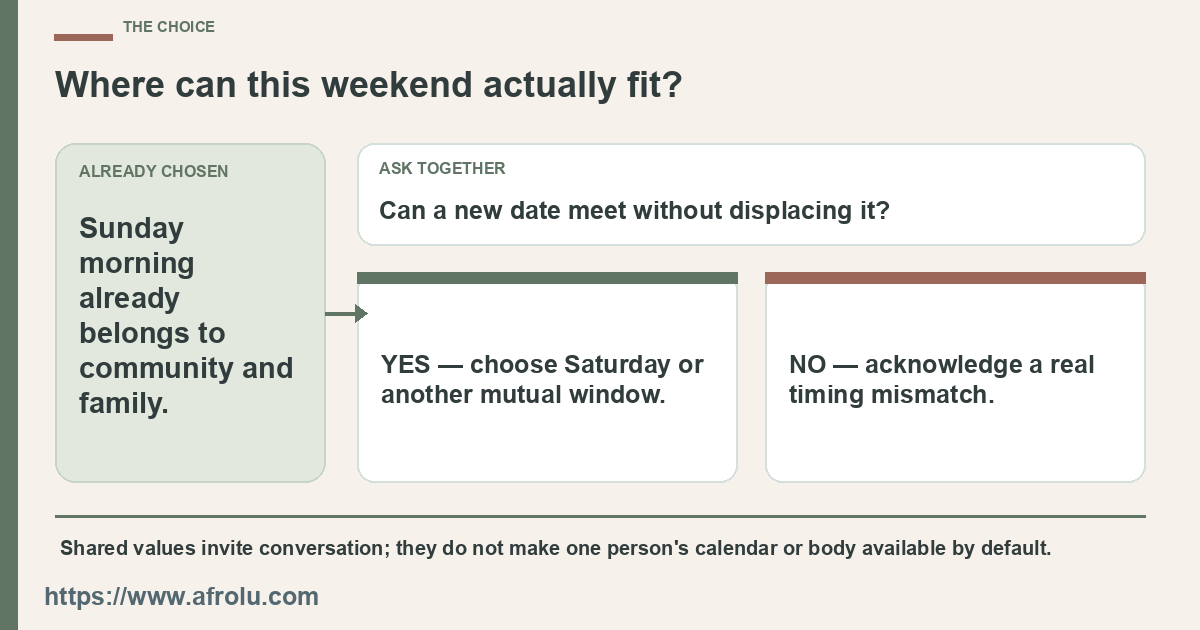
Where can this weekend actually fit?
- Notice
- Sunday morning already belongs to community and family.
- Ask
- Can a new date meet without displacing it?
- YESchoose Saturday or another mutual window.
- NOacknowledge a real timing mismatch.
Shared values invite conversation; they do not make one person's calendar or body available by default.
Community and family already have the morning
A prior commitment is a real part of this adult's life.
Offer Saturday lunch if it is genuinely open.A date wants a kiss after the book exchange
Shared faith does not answer an individual consent question.
Ask and accept the present answer.One adult wants to tag the other immediately
Public sharing involves both adults' information.
Ask before posting and discuss the audience.One adult can meet only when the other is unavailable
A mismatch need not mean disrespect.
Consider another rhythm or part kindly.What respect looks like after a limit
The date hears a Sunday limit without asking for a moral defence.
Both adults can describe their own physical choices without a loyalty test.
Photos, tags and introductions wait for a shared answer.
Disappointment is spoken without repeated pressure or ridicule.
A scheduling mismatch can be acknowledged instead of disguised.
Choose an honest rhythm
| Situation | What it may mean | What to do next |
|---|---|---|
| Sunday is already spoken for | Your existing commitment need not be cancelled to show interest. | Offer a true Saturday or weekday opening. |
| A kiss is suggested | A shared faith label cannot imply consent. | Answer for this moment and hear their answer. |
| Family asks for a label | The connection may not yet have one. | Agree what each adult may disclose. |
| The date says no to your rhythm | They have a different available life. | Discuss one alternative without insisting. |
| A limit draws guilt | Pressure is itself information about the interaction. | Take distance and seek trusted support if needed. |
Words for time, touch and privacy
“I enjoy seeing you. Sunday morning is already for community and family; would Saturday lunch fit you?”
“I am comfortable walking together today, but I do not want to kiss. What feels comfortable for you?”
“I would like us to decide together when family hears about this. Are you comfortable keeping this private for now?”
Know the difference
A personal limit versus a rule imposed on someone else
I keep Sunday morning for community and can offer Saturday lunch.
You must adopt my practice or prove your faith by changing yours.
Shared values invite conversation; they do not make one person's calendar or body available by default.

No faith tradition is depicted as having a single dating rule.
Boundary or control?
My boundary
I keep Sunday morning for community and can offer Saturday lunch.
A control demand
You must adopt my practice or prove your faith by changing yours.
Questions that separate them
- Whose choice?
- What is offered?
- Can they decline?
- Is pressure absent?
Shared values invite conversation; they do not make one person's calendar or body available by default.
Your limit or their instruction?
| Type or dimension | What it describes | Best next question |
|---|---|---|
| Time limit | A chosen Sunday commitment. | Offer another hour if wanted. |
| Belief difference | The other adult practices or prioritises differently. | Ask whether a shared rhythm still fits. |
| Physical boundary | One adult does not want a particular touch now. | Stop; do not bargain for a yes. |
| Control demand | One adult dictates the other's practice or access. | Step back rather than calling it a mutual boundary. |
Keep the next choice small
Clarity is kind
A real Saturday offer is easier to answer than a vague sacrifice.
Labels are incomplete
Faith-led does not settle calendars, consent or public sharing.
Fit can be sad
A respectful no may still reveal incompatible weekends.
Questions about values and fit
Choose a few prompts that fit the moment. This is a reference library, not a list to complete.
Before offering Saturday
Start with the hours that actually exist.
- What is already promised?
- What time can I enjoy freely?
- Which hours are unavailable this week?
After a limit
Read the response, not a faith label.
- Was no respected?
- Was another time proposed?
- Did I feel pressured to prove devotion?
What boundary sources can support
Expectations
love is respect distinguishes discussed expectations from personal limits and says pressure to change a boundary is not okay.
Evidence limit: U.S. education; no universal faith rule or Kenya-specific legal claim.
Touch
love is respect says physical limits may differ or change and must be openly discussed.
Evidence limit: It does not prescribe the physical practice of a faith community.
Consent
love is respect says a previous yes does not imply future consent.
Evidence limit: A meeting or shared belief cannot settle a later physical choice.
Digital audience
love is respect discusses contact and posting boundaries.
Evidence limit: A private relationship is not automatically a hidden or unsafe one.
Response
love is respect distinguishes safe discussion from repeated boundary violations and guilt.
Evidence limit: One awkward response is not a diagnosis, and unsafe pressure need not be discussed again.
Where good intentions become pressure
Using faith as a mind reader
A shared label cannot specify touch or time.
Offering an imaginary window
It stores up cancellation and resentment.
Explaining after coercion
A repeated no need not be argued into legitimacy.
Offer only the weekend you have
A kind invitation can respect both a current commitment and the other adult's freedom to decline.
Explore the guide library
Continue with Afrolu
Boundaries, consent and digital-sharing sources
Afrolu reviewed these health, research, safety, or public guidance resources while editing this page. They support the behaviour and safety guidance; they do not diagnose any individual described by a reader.
Questions about faith and boundaries
Is a boundary selfish if I like this person?
No. Naming a real time or physical limit allows the other adult to choose with accurate information.
Does shared faith mean the same physical pace?
No. Ask about the particular activity and accept that consent remains individual and revisable.
Must I introduce a date to my community soon?
No fixed timeline applies. Discuss what may be shared and whether a private stage fits both adults.
What if they are disappointed about Sunday?
Disappointment can be spoken respectfully. Repeated guilt or pressure after your no is a different concern.
Can my boundary change later?
Yes, if you freely want a different arrangement. A previous yes also does not make the new arrangement permanent.
One thing to do now
Leave room for both people's real weekends
Name the limit, offer only what is real, then judge the response rather than asking the other adult to guess your values.