Casual dating · adult students · safety
A casual label never replaces an adult student's choices
A casual dating label does not decide consent or privacy. Adult students can set a small plan, protect personal details and choose each next step freely.
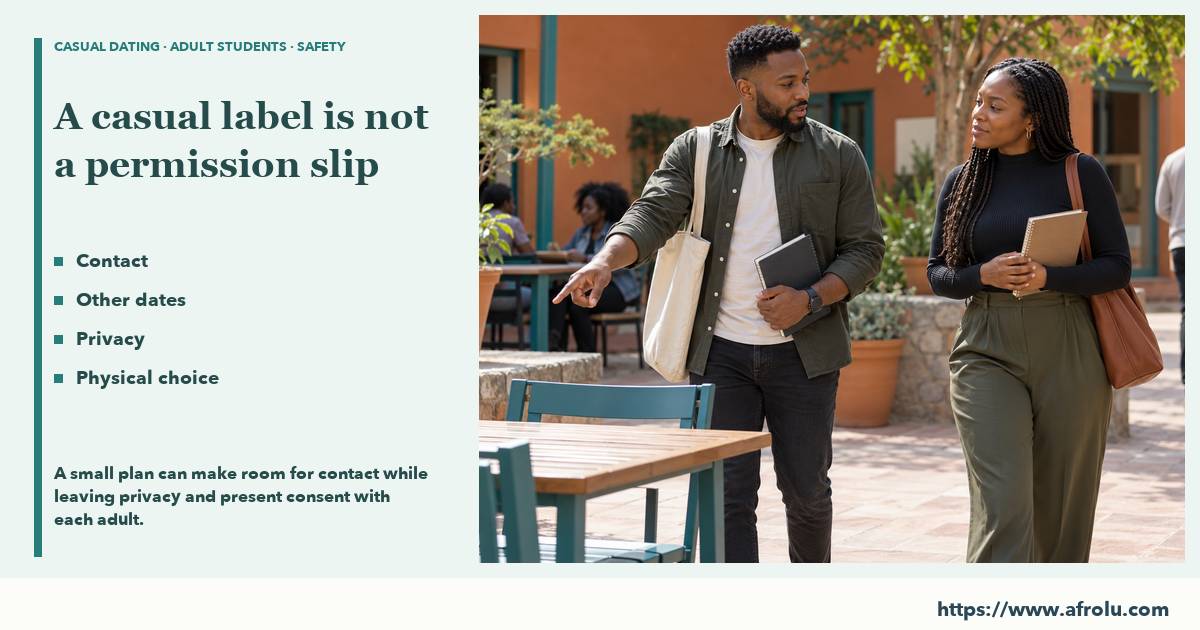
Use a casual label to describe only the arrangement; make contact, privacy, money, physical intimacy and each changed plan separate choices that require a current voluntary answer.
Written and edited by Miriam Otieno · Senior Kenya Editor
Use the casual label for only the relationship-scope question, then answer the live questions separately: what contact fits, whether either person is seeing others, what information stays private, and whether a particular physical choice is wanted now. A short plan can be enough. You do not owe a residence location, timetable, financial information, device access or a change in boundary because you called the connection casual.
How can an adult student keep a casual dating arrangement clear without a label deciding consent, personal details or the next meeting?
Casual dating between adults can mean different degrees of contact or future intention. It does not mean automatic sex, permanent availability, access to a student's routine, or a reduced right to say no. ‘Student’ here describes an adult's learning context, not an age, financial position, campus rule or safety condition.
Let the answer guide the next step
Keep this separate A casual connection does not require a residence, timetable, financial detail, document, account code, device access or live location.
Casual can describe scope, not access
Start by asking what the label is meant to explain. It might mean neither person is promising exclusivity, or it might mean the connection is exploratory. That can be useful information. It does not tell either adult how often to reply, whether to share a location, or whether a particular physical choice is welcome. If the answer matters, ask it plainly and leave room for a different answer.
WHO's sexual-health information describes a respectful, coercion-free approach to sexual relationships. It does not define casual dating, assign a timetable or declare who is compatible. Its focused relevance is simple: a present physical or intimate-image choice needs present voluntary agreement, even when the adults have used the same label for weeks.

Label and current answer are different tools
Open full-size visualLabel
Describes a possible relationship scope or present expectation between adults.
Current answer
Decides this request for time, information, money, touch, images or a changed plan.
- Scope
- Contact
- Privacy
- Consent
Use the comparison to keep a current choice visible.
A study routine can inform availability without becoming evidence
An adult student may have classes, work, caregiving or rest to protect. You can say you are free for a short walk after an evening session without sending a timetable or explaining every gap. If you prefer a daytime plan, independent travel or a public location, state that as your preference. The plan is not a test of whether another adult trusts you; it is the practical shape of the invitation you choose.
eSafety's online-dating material encourages limiting identifying details and using privacy, report and block controls where available. It is Australian guidance, not a Kenyan rule or a promise about an app or person. The modest application here is that an early plan need not disclose a residence, classroom, regular route, document, account or live location.

Four details a casual plan does not decide
Open full-size visual- Residence
- A meeting does not need a home location.
- Study routine
- Availability can be named without a timetable.
- Account or money
- Sensitive requests are separate from romance.
- Physical contact
- Consent is asked in the present.
Keep each decision attached to the request it actually answers.
A label is not permission
Casual can be clear when the questions underneath it are answered one at a time.
Make a small contact plan, then distinguish relationship scope, personal information and current consent.
- Contact
Choose one realistic window
An hour you can leave freely is more useful than a vague late plan.
- Other dates
Say only what affects your choice
You can ask about dating others without demanding a complete history.
- Privacy
Keep study and home details optional
A conversation does not need a schedule, residence or device to continue.
- Physical choice
Ask in the present
No past label or yes supplies a standing answer for touch, sex or images.
A pressure moment can be answered without a motive diagnosis
It can be tempting to argue about whether someone is genuinely interested, especially when the connection began warmly. That argument often hides the usable question: am I comfortable with this request? A reader can decline a financial request, refuse to send identification, or keep a residence private even if the request is framed as proof of trust. An adult student is not required to trade personal access for attention.
ODPC's data-subject information concerns organizations that process personal data; it does not govern a casual date or create a right to a student's messages, devices or documents. KE-CIRT's warning about personally identifiable information and SIM-swap risks supports a narrow caution around OTPs, PINs, credentials and financial requests. It does not identify a particular dater as a scammer.

When a label is used to answer a new request
Open full-size visualA short meeting invitation becomes a question about staying over.
Do I freely want to stay over tonight?- Yesagree only to staying over; keep transport and every later physical choice separate.
- Nodecline the overnight plan and keep or end the public meeting on your own terms.
A casual label cannot decide where you stay or what you consent to.

A calm adult-student boundary line
Open full-size visualI am open to a short casual date after class, but I keep my home and study details private and I decide any physical plans separately.
- State the plan
- Keep details private
- Separate physical choices
Direct language can be warm without turning a boundary into an apology.
A respectful outcome may be another date, a changed pace or a stop
Review what actually happened: did you have space to name a preference, did the plan fit the time you offered, and do you want more contact? You may want to continue and still keep the same privacy boundary. You may decide the pace or response to a boundary does not fit. That is a decision about the arrangement, not an obligation to grade the other person's character.
A casual connection does not cancel a reader's ability to say no. If a plan changes to include a ride, another venue, alcohol, spending, touch, sex or sharing images, the change needs its own answer. A previous invitation is not a standing permission slip.

Four possible next answers
Open full-size visual- Meet brieflyChoose a plan that fits capacity.
- Change the planA change deserves a new yes.
- Clarify termsSay what affects your decision.
- DeclineNo diagnosis is required.
A casual connection remains voluntary at every step.
Four possible next answers
Use a casual label to describe only the arrangement; make contact, privacy, money, physical intimacy and each changed plan separate choices that require a current voluntary answer.
Editorial next reads These are clearly labelled editorial links, not affiliate buttons, and they do not make a dating decision for you.
WHO supports only current voluntary intimacy choices; eSafety offers Australian privacy guidance; ODPC describes organizational data rights; KE-CIRT supports pausing sensitive requests. None defines a student, predicts intent or guarantees safety.
Does casual dating mean I cannot ask about other dates?
No. You can ask a focused question if it changes your own choice. The answer may reveal a mismatch, but it does not entitle either adult to a complete dating history.
Do I have to share my class or residence location to meet?
No. You can propose a time and a meeting area without disclosing a classroom, home, routine or live location.
Can I say no to a changed plan after agreeing to meet?
Yes. A yes to meet does not settle a ride, another venue, spending, touch, sex, images or staying longer.
What if someone says a casual label means I should be easygoing?
You can repeat your answer or leave the plan. A label does not reduce your ability to decide what information, time or physical contact you want.
Should I send an OTP or ID image to show I am genuine?
Do not share a code or document because someone makes the request urgent. Treat it as separate from dating and verify independently through an official channel if needed.