Five-column evidence ledger · adults 25+
Stop Breadcrumbing from Reserving Your Study and Career Time
An adult-student guide to breadcrumbing, honest limited capacity, concrete plans, follow-through, study protection, safety, scripts and clean closure.
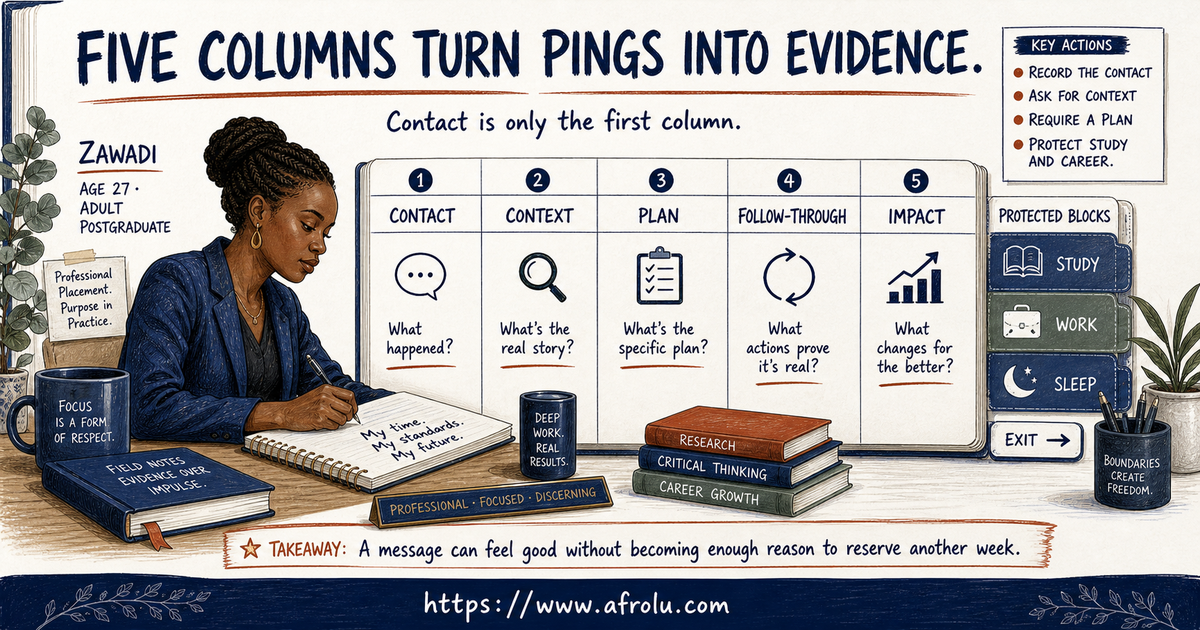
Attention is contact; progression needs a workable next step.
Written and edited by Nia Kato · Profile Advice Editor
Do not diagnose motive or attachment from message frequency. Track five columns: CONTACT records what arrived; CONTEXT names real constraints; PLAN identifies a workable date, call or decision; FOLLOW-THROUGH records action or accountable repair; IMPACT shows what waiting costs study, placement, career, sleep, money and friends. Offer one concrete bridge and one reader-owned confirmation point. If warm contact repeatedly replaces an answer or plan, close without waiting for a confession. Treat money pressure, fraud, stalking or threats as separate safety issues.
Mixed signals · Students
Is this low-frequency connection an honest capacity limit with a workable next step, or an attention loop that keeps study and career time reserved without enough movement?
Breadcrumbing is a popular description for intermittent romantic attention that repeatedly renews possibility without enough clarity or progression for the recipient's needs. It describes observable contact and non-movement; it does not prove intent, diagnose attachment or make every sparse connection unhealthy.
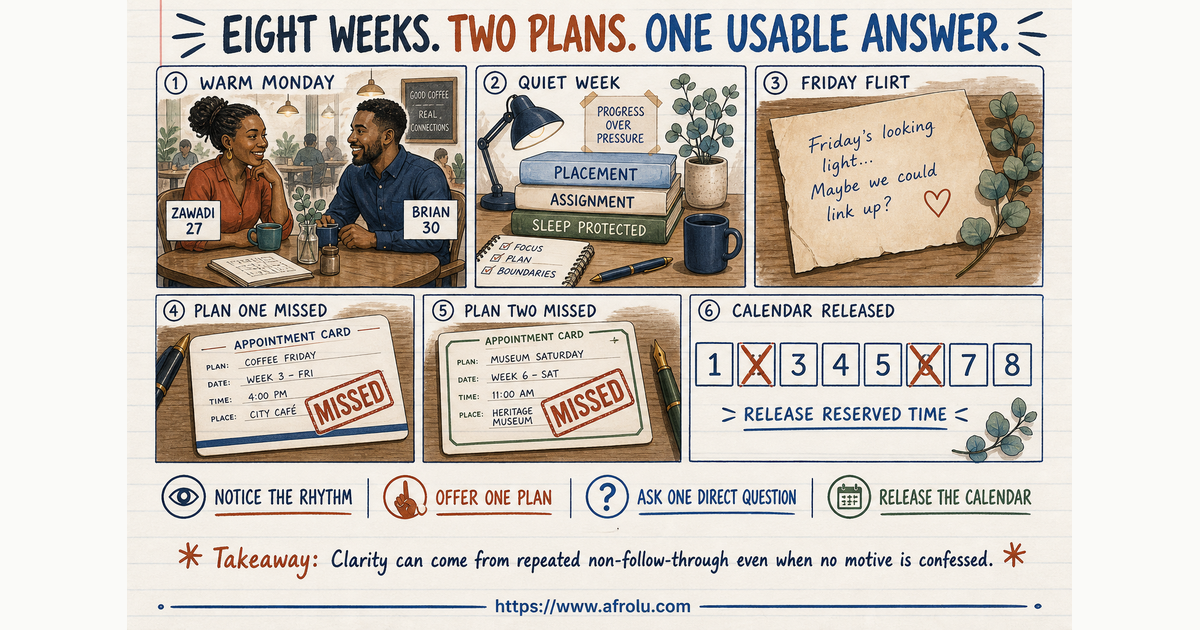
Zawadi, a fictional 27-year-old postgraduate student on professional placement, spends eight weeks receiving Brian's warm Monday voice notes and vague Friday invitations. Two plans do not become dates. Her direct question reveals that he wants occasional open contact. She closes the loop, releases her calendar and protects the adult life already in progress.
The contact-to-action ledger
Let a message earn only the meaning it can support
Nia gives adult students a five-column way to protect study and career while reading a low-frequency connection fairly.
Separate contact, context, plan, follow-through and impact across two relevant cycles, ask once and choose without diagnosing motive.
Contact and context
Record the actual message and the concrete constraint without inventing intent.
Plan and follow-through
Look for one bounded next step, accountable change and completed repair.
Impact
Keep study, placement, work, sleep, money and friends out of indefinite standby.
Close without confession
Repeated non-movement can show that the route does not fit even when motive stays unknown.
Use the term carefully
Breadcrumbing describes a contact pattern; it does not reveal motive or diagnose attachment
Breadcrumbing is commonly used for sporadic signs of romantic attention that keep a connection available without enough progression or clarity. The word can help when it points to evidence: warm reappearances, vague future hints, plans that do not become dates and renewed contact when the recipient begins to step away.
Do not turn the label into mind reading. A person may be uncertain, busy, avoidant, careless, enjoying attention, dating others, dealing with real constraints or deliberately maintaining access. You may never know. The practical question is whether the contact available supports the relationship, safety and use of time that you freely choose.
Studies have reported associations between breadcrumbing experiences and wellbeing or between breadcrumbing engagement and attachment insecurity in specific samples. Those designs do not diagnose either adult and do not establish a universal cause. An adult student should not use an article to label a match's personality, nor use an attachment story to excuse repeated non-follow-through.
One direct question and one workable plan usually provide better evidence than another month of interpretation. If the answer remains vague or the plan is repeatedly unkept, you may release the calendar without proving bad intent. If money pressure, threats, stalking or identity fraud appears, treat that external conduct as a separate safety matter.
Build a contact-to-action ledger
Contact, context, plan, follow-through and impact answer different questions
CONTACT records what actually arrives: a specific question, affectionate reaction, late-night flirt, apology or generic check-in. Frequency matters less than function. Does the message create knowledge, repair a missed step or only revive emotion? Do not copy private conversations into public spaces or ask friends to monitor another adult's accounts.
CONTEXT records what has been said about availability, study, work, health, faith, family or other dating. A postgraduate placement and a demanding job can produce sparse contact. Honest limited capacity sounds like a concrete constraint, a realistic next point and freedom for the other adult to decline. Vague busyness repeated after every question supplies less usable information.
PLAN records a date, call or decision with a time and conditions. FOLLOW-THROUGH records whether it happened, was responsibly changed or simply dissolved. A missed plan is not automatically breadcrumbing. Repair matters: early notice, accountability and a replacement that both adults can choose. Repeated future hints without a calendar remain contact, not progression.
IMPACT records what the pattern costs Zawadi's study, placement, sleep, money, friendships and self-respect. The point is not to blame Brian for every emotion. It is to decide whether reserving attention for this route is workable. When the impact grows while the other columns remain empty, closing can be proportionate even without a final diagnosis.
Follow two real schedule cycles
Zawadi stops reserving every Friday for a plan that never becomes firm
Zawadi, 27, is finishing a postgraduate course while completing a professional placement. Brian, 30, works unpredictable client hours. Their first two dates are enjoyable. Over the next eight weeks he sends warm Monday voice notes, becomes quiet through the week and returns with flirtatious Friday messages about seeing her 'soon.' Zawadi begins keeping weekends open without a confirmed plan.
She uses the ledger. CONTACT is warm. CONTEXT contains a real claim about client work but no usable availability. PLAN contains two suggestions. FOLLOW-THROUGH shows one same-day cancellation and one Friday that passed without confirmation. IMPACT shows a declined study group, poor sleep before an assessment and resentment toward messages she otherwise might have enjoyed.
Zawadi offers one bounded option: public lunch the following Saturday at one, with confirmation by Thursday evening. Brian replies affectionately but does not answer the plan. On Friday he sends a heart and asks whether she is awake. She asks once whether he wants a real date in the next two weeks or only occasional chat. He says he cannot plan and wants to keep things open.
That is a usable answer even though it does not explain motive. Zawadi says occasional romantic contact does not work for her and closes the channel. She does not punish Brian, diagnose attachment or wait for another cycle. Her placement and friendships regain the reserved space. A different adult might accept sporadic chat; informed choice is the standard.
Read the bridge across four evidence rows
Messages, plans, follow-through and impact need separate states
MESSAGE is clear when contact is specific, reciprocal and connected to the present conversation. Review affectionate pings that repeatedly avoid direct questions. Close when contact mainly returns after distance, maintains sexual or emotional access and disappears when a plan is requested. One delayed reply during exams or a deadline is not enough to decide the pattern.
PLAN is clear when an offer has a time, place or next decision that fits both calendars. Review a genuine constraint with a realistic later point. Close when 'soon,' 'one day' or future fantasy repeatedly replaces a plan. Adult students do not need to hold every weekend open so that spontaneity can be mistaken for chemistry.
FOLLOW-THROUGH is clear when the plan occurs or a change is owned early and repaired. Review one missed step with accountable rescheduling. Close when cancellations, silence and reappearances repeat without meaningful change. Do not count affectionate messages as repair when the missed action itself remains unnamed.
IMPACT is sustainable when study, placement, career, sleep, money, friends and safety remain intact. Review temporary disappointment without giving it every free hour. Close when waiting repeatedly displaces important work or creates an indefinite emotional queue. Stop and seek appropriate help for threats, stalking, money extraction, image abuse or unsafe meeting pressure.

Judge the repeated bridge from contact to action.
Ask one answerable question
A useful script connects present contact to a real next step
For TIME: 'My placement is heavy, so I date on Saturday afternoons.' 'I do not keep unconfirmed weekends open.' Those lines expose a real constraint and boundary without turning academic work into a competition for affection. The other adult may not fit the schedule, and that mismatch can end cleanly.
For PLAN: 'Would public lunch Saturday at one work?' 'If Thursday passes without confirmation, I will make other plans.' 'If you cancel, please offer the alternative you can keep.' A deadline controls Zawadi's calendar rather than punishing Brian. It should be long enough for the actual context, not copied from a viral rule.
For SCOPE: 'Are you looking for occasional chat or dates that progress?' 'Are you currently dating other people?' 'I enjoy you, and undefined romantic contact does not work for me.' The answer may be casual, uncertain or no. Clarity does not guarantee the preferred route; it lets both adults choose from reality.
For CLOSE and safety: 'This pattern does not fit me, so I am ending contact.' 'I do not send money or use match-sent verification links.' 'You contacted me again after my no, so I will not respond.' Use access controls and suitable support when pressure escalates. Do not keep a conversation open merely to document more disappointment.

Ask once in a form that can receive a usable answer.
Choose a reader-owned review point
Two relevant cycles can reveal movement without becoming a universal deadline
CYCLE ONE establishes the actual constraint. If Brian says a client deadline ends Friday, the next relevant point may be Saturday. Record the contact, proposed plan and result. Do not invent a test or withhold a reply to manipulate his behaviour. Simply make the requested movement clear and preserve other commitments until confirmation.
CYCLE TWO checks repair or consistency. A changed plan can become reliable when the reason is named, notice is reasonable and a workable alternative appears. If the same vague re-entry happens again, Zawadi has repeated evidence about the route available. She still does not know motive, but she knows what reserving time produces.
CONTINUE when contact, a plan and follow-through fit the impact. REDESIGN when both adults want the connection but the channel or timing is wrong. CLOSE when intermittent attention repeatedly replaces movement or the available arrangement does not fit. SUPPORT applies when distress persists or external safety concerns require trusted, professional, platform, legal or emergency help.
Release saved weekends, archived chats and imagined future plans after closure. Do not monitor whether the other person dates someone else more consistently; that information cannot repair this agreement. Return attention to the term, placement, work, friends and rest that were already part of Zawadi's adult life.

Protect the term, the placement and the right to stop waiting.
Separate sparse contact from unsupported waiting
Agreement and follow-through distinguish five nearby communication routes
BREADCRUMBING is a descriptive pattern of intermittent romantic signals without enough progression or clarity for the recipient's needs. HONEST LIMITED CAPACITY may look sparse, but the constraint, next point and freedom to decline are explicit. SLOW DATING can also have low frequency while still creating planned, mutual and reviewable movement.
FRIENDSHIP may include warmth and sporadic contact without a romantic agreement. It becomes confusing when one adult interprets every affectionate message as pending romance. Ask what the contact means and accept the answer. GHOSTING is a stop in communication without a direct ending; breadcrumbing differs because contact keeps returning and renewing possibility.
One route is not morally superior in every case. Occasional contact may suit two adults who agree to it. A busy season can require patience. A slow connection can be deeply intentional. The problem is the mismatch between what the contact appears to promise, what it repeatedly delivers and what the recipient keeps sacrificing while waiting.
Choose by fit. Continue a sparse but honest route, redesign the schedule, move a friendship out of romantic ambiguity, close a breadcrumbing loop or stop chasing a ghosted contact. Maintain money, identity, sexual-health and public-meeting safeguards across every label. A heart emoji never verifies a person or creates consent.
Eight adult-study moments where a message and a plan diverge
A detailed voice note arrives after silence
The message feels intimate but does not answer the pending Saturday plan.
Acknowledge it only if desired, then return to the unanswered question.Zawadi genuinely has little time
Her limited capacity is specific and includes a realistic Saturday option.
State the constraint and let Brian freely accept or decline.A holiday is imagined without a next date
Long-range fantasy creates emotion while the nearest practical step stays empty.
Ask for the next workable action before reserving the future.A client emergency disrupts lunch
One change can be ordinary when it is named early and responsibly repaired.
Look for an offered alternative rather than punishing the event.Thursday passes without confirmation
The repeated non-answer now supplies evidence about planning capacity.
Release Saturday and stop treating later affection as confirmation.Brian says he wants occasional contact
The answer may disappoint but makes his available arrangement visible.
Choose whether that route genuinely fits instead of negotiating against it.A course emergency requires a transfer
Romantic ambiguity is now connected to financial pressure and unverifiable urgency.
Send nothing and verify any institution independently through official channels.A heart arrives after Zawadi ends contact
The message does not erase the boundary or require another explanation.
Do not restart the loop; use access controls if contact continues.Ten signals across contact, context, plan, follow-through and impact
Warm contact repeatedly avoids the one direct question already asked
Future plans sound vivid while the nearest date stays unconfirmed
Messages return when attention is withdrawn but fade after reciprocity
Cancellations are not named, repaired or replaced with workable alternatives
Busy-season context remains vague and has no honest review point
Study, placement, work, sleep or friends are repeatedly kept on standby
The recipient feels required to perform distance to receive attention
Money, verification links or private meetings appear inside the uncertainty
A clear closure is followed through new accounts or repeated unwanted contact
Sparse contact still includes honest context, a plan, repair and free choice
Review the contact through ten answerable questions
| Situation | What it may mean | What to do next |
|---|---|---|
| Does contact answer the present conversation? | Fits: Messages are specific and reciprocal. Needs review: One question needs redirecting. Stop: Warmth repeatedly replaces the answer. | Return once to the direct question, then decide from the response. |
| Is limited capacity explained? | Fits: The constraint and next point are concrete. Needs review: A short busy period needs review. Stop: Busyness is indefinite whenever a plan appears. | Set a reader-owned review point and release time after it. |
| Is there a workable plan? | Fits: Time, place and confirmation are clear. Needs review: One detail remains open. Stop: Only 'soon' or fantasy is offered. | Offer one bounded option rather than carrying every possibility. |
| What follows a cancellation? | Fits: Notice, accountability and an alternative appear. Needs review: One repair needs confirmation. Stop: Silence is followed by unrelated affection. | Count repair only when the missed step itself is addressed. |
| Can the calendar remain active? | Fits: Unconfirmed time is used normally. Needs review: One slot was held too long. Stop: Study and work repeatedly wait for a possible date. | Add a confirmation point and reclaim the slot automatically. |
| Is the present scope named? | Fits: Both adults understand the contact similarly. Needs review: Uncertainty is admitted honestly. Stop: A scope question is repeatedly evaded. | Choose whether undefined contact fits; do not infer commitment. |
| Does directness remain safe? | Fits: A question or no is accepted. Needs review: Disappointment is repaired once. Stop: Threats, ridicule or repeated access follows. | End contact and use appropriate support rather than debating. |
| Are money and identity separate? | Fits: No romantic proof requires payment or documents. Needs review: An unusual request is independently checked. Stop: Urgent funds or verification links are demanded. | Send nothing, secure information and report through official routes. |
| What is the pattern doing to daily life? | Fits: Study, work, sleep and friends remain intact. Needs review: Disappointment needs a boundary. Stop: Functioning is persistently crowded or distressed. | Close the loop and seek qualified support if impairment persists. |
| Is another cycle likely to add new evidence? | Fits: A real changed condition is approaching. Needs review: One final plan can be tested. Stop: The same vague loop is simply repeating. | Stop extending the review and choose from evidence already present. |
Ten lines for time, plans, scope, money and closure
“My placement is heavy, so I date Saturday afternoons.”
“I do not keep unconfirmed weekends open.”
“Would public lunch Saturday at one work?”
“If Thursday passes, I will make other plans.”
“If you cancel, please offer what you can keep.”
“Do you want occasional chat or dates that progress?”
“Are you currently dating other people?”
“Undefined romantic contact does not work for me.”
“I do not send money or use match-sent links.”
“This pattern does not fit me, so contact ends.”
Know the difference
Low-frequency contact can mean five different agreements
Limited capacity or slow dating is named, planned, mutually chosen and repaired when a step changes.
Warm signals repeatedly renew possibility while plans, scope and follow-through remain unavailable for the reader's needs.
A slow route can be healthy; an indefinitely reserved calendar does not have to be accepted.

A slow connection still needs honest terms and observable movement.
Separate five low-frequency contact routes
| Type or dimension | What it describes | Best next question |
|---|---|---|
| Breadcrumbing | Intermittent romantic attention renews possibility without enough clarity or progression for the recipient. | Ask once, set a review point and close if the loop repeats. |
| Honest limited capacity | A real constraint, next available point and freedom to decline are explicit. | Choose whether the sparse rhythm genuinely fits. |
| Slow dating | Low pace is mutual and still produces planned, observable movement. | Keep reviewing effort, consent and compatibility. |
| Casual dating | Romantic contact may stay non-committed while scope, health and endings remain discussed. | Name what casual includes and excludes. |
| Friendship | Warm contact has no agreed romantic trajectory or reserved access. | Stop treating every ping as a pending relationship. |
| Ghosting | Contact stops without a direct ending rather than intermittently renewing possibility. | Use one proportionate check, then stop chasing silence. |
| One missed plan | A disruption is owned and repaired rather than repeated as the rhythm. | Judge the alternative and later follow-through. |
| Unsafe contact | Money, threats, stalking, deception or coercion creates a separate risk issue. | Protect access and use appropriate official support. |
Use the five-column evidence ledger in six moves
Do not diagnose motive
Use the term for an observable contact pattern and decide from what is available.
Separate five columns
Contact, context, plan, follow-through and impact cannot substitute for one another.
Protect adult-study time
Course, placement, work, sleep and friends stay active until a plan is confirmed.
Offer one real bridge
A bounded date or call can receive a usable yes, no or alternative.
Count repair accurately
Affection after a missed plan is not repair unless the missed step is addressed.
Close without a confession
Repeated non-movement can be enough evidence that the available route does not fit.
Questions for the ledger, calendar, clarity and closure
Choose a few prompts that fit the moment. This is a reference library, not a list to complete.
Ledger questions
Keep the columns separate.
- What contact arrived?
- What context was named?
- What plan exists?
- What followed through?
- What was the impact?
Calendar questions
Protect the adult term and career.
- Which work is immovable?
- Which window is real?
- When is confirmation due?
- What happens if it passes?
- What will I do instead?
Clarity questions
Make the next answer usable.
- Occasional chat or dates?
- What pace can you keep?
- Are you dating others?
- What would progression mean?
- Does this route fit me?
Closure questions
End without solving motive.
- What repeated twice?
- Which time gets released?
- Which access needs closing?
- What support should know?
- What deserves attention next?
What current breadcrumbing research and safety guidance can support
Cleveland Clinic focuses on intermittent attention and missing plans
The psychologist-reviewed article describes sporadic communication, vague future talk and limited follow-through, and recommends direct communication, boundaries and leaving a harmful cycle when needed.
Evidence limit: The overview is not a diagnostic tool and cannot establish another person's intent.
A 2020 preliminary study reports psychological correlates
The cross-sectional study of 626 adults examined associations between ghosting or breadcrumbing experiences and life satisfaction, loneliness and helplessness, showing why the experience can matter emotionally.
Evidence limit: Cross-sectional associations cannot prove causation or predict one reader's recovery.
A 2023 India-Spain study examines attachment associations
The online survey of adults aged 18 to 40 found associations between attachment insecurity dimensions and self-reported breadcrumbing engagement in both country samples.
Evidence limit: The design cannot diagnose attachment, establish motive or generalise to every culture and adult.
A young-adult study examines online dating behaviour
The University of Malaga journal article explores ghosting, breadcrumbing and online dating behaviour, contributing evidence to a still-developing field rather than establishing one universal definition.
Evidence limit: A sample estimate should not be presented as Kenyan prevalence or an individual forecast.
WHO guidance separates ordinary stress tools from qualified care
WHO public guidance notes that stress can affect mind and body and recommends seeking health care when symptoms make coping or daily functioning difficult, supporting escalation without diagnosing from a dating pattern.
Evidence limit: General stress guidance does not prescribe a breakup, dating or treatment timeline.
FTC guidance keeps money outside romantic ambiguity
FTC consumer guidance describes trust-building romance scams and advises never sending money, gift cards, wire transfers or cryptocurrency to an online love interest.
Evidence limit: The U.S. source does not verify a specific match and must be paired with relevant local channels.
Six ways intermittent contact can distort evidence
Counting messages as movement
Warm contact fills the ledger alone. Repair: require a plan and follow-through.
Diagnosing attachment
A study association becomes a verdict. Repair: state behaviour and limits only.
Holding every weekend
Possibility displaces adult life. Repair: use a confirmation point.
Performing distance for attention
Games replace clarity. Repair: ask directly and accept the available answer.
Treating one cancellation as the pattern
Context and repair are ignored. Repair: observe the next relevant cycle.
Waiting for motive certainty
Closure is postponed until confession. Repair: choose from fit and repeated evidence.
Use a reviewed resource that matches the decision
This guide focuses on the relationship decision, so it does not rank dating apps. Check current prices, safety tools, and local availability before choosing a service.
Explore the guide library
Show more related guides
Continue with Afrolu
Show more Afrolu guides
Clinical overview, primary research, stress and fraud guidance
Afrolu reviewed these health, research, safety, or public guidance resources while editing this page. They support the behaviour and safety guidance; they do not diagnose any individual described by a reader.
Breadcrumbing questions for adult students in career-heavy seasons
What is breadcrumbing in dating?
Breadcrumbing is a popular term for intermittent romantic attention that keeps possibility alive without enough clarity or progression for the recipient's needs. It can include warm reappearances, vague future hints and plans that do not become action. The term describes a pattern; it does not diagnose attachment, prove manipulation or reveal motive.
Can a genuinely busy adult look inconsistent?
Yes. Study, placements, shifts, care, health and deadlines can limit contact. Honest limited capacity usually includes a concrete context, a realistic next point, accountable repair and freedom for the other adult to decline. Indefinite busyness that appears whenever a plan is requested supplies less usable information. Choose by the route delivered, not the preferred explanation.
How long should I wait for a plan?
There is no universal day count. Choose a review point that captures the real constraint: the stated deadline, placement roster, exam period or two agreed planning attempts. Do not hold unconfirmed time open. If the relevant condition passes and the same vague loop returns, decide from that repeated evidence rather than extending automatically.
Should I confront someone and call them a breadcrumber?
Usually a direct, answerable question is more useful than a label: ask whether they want occasional chat or a real date, then offer one bounded option. You do not need agreement about the term. If the pattern does not fit, close it. Skip confrontation and prioritise safety if threats, stalking or coercion is possible.
What if they cancel for a real reason?
One cancellation is not the pattern. Look for notice, accountability and a replacement the person can realistically keep. A warm apology may matter, but repair addresses the missed action. If the replacement also dissolves and unrelated affection returns, you have more evidence about follow-through. You may still leave because the schedule does not fit.
Can breadcrumbing happen in casual dating?
Yes, but casual does not mean undefined by default. Two adults can agree to occasional contact, other dating and no trajectory while still communicating honestly. Breadcrumbing becomes a useful description when romantic signals repeatedly imply possibility while scope and movement remain unavailable for one person's needs. Ask what casual means and choose freely.
How do I protect study and career time?
Keep assignments, placement, work, sleep and friendships active until a date is confirmed. Offer one window you can actually use and state when it will be released. Do not wait online during work or rewrite a message through the night. A compatible connection must fit the adult life you are building, not require it as proof.
What if the person asks for money during an unclear connection?
Do not send funds, gift cards, cryptocurrency, investment payments or verification charges. Romantic warmth does not verify an emergency. Check any institution through an official channel you find independently, secure accounts and use suitable platform, payment and local reporting routes. Money pressure is a safety issue, not merely another breadcrumbing signal.
How do I stop replying after closure?
Use one final line only if safe, then archive, mute or block according to the situation. Remove reminders and release reserved calendar space. Do not monitor the person's profile to see whether they behave differently with someone else. If contact returns through new accounts, document what is useful and seek appropriate support rather than explaining again.
When should I seek emotional support?
Talk with trusted people when the loop is crowding perspective. Seek qualified health support when distress is persistent, overwhelming or interfering with sleep, study, work, eating or ordinary functioning. The relationship label does not diagnose the cause. Threats, stalking, coercion, image abuse or fraud require suitable safety, legal, platform or emergency support instead.
One thing to do now
Release the calendar when contact will not cross into action
Continue sparse contact when the constraint, scope, plan, follow-through and repair are honest and the impact fits. Redesign one practical mismatch. Close when attention repeatedly replaces movement or the arrangement does not meet your needs. Refuse money and match-sent verification links; use appropriate help for repeated unwanted access, threats, fraud or persistent distress.