New dating journey · serious direction
Serious Situationships in a New Dating Journey
For adults starting a new dating journey, turn serious intent into clear choices, balance career capacity, protect consent and privacy, and respond safely.

Serious direction needs present choices.
Written and edited by Jean-Claude Mukendi · Relationship Guides Editor
Treat serious intent as a present direction, not a deadline. Ask what each adult can offer now, make career capacity concrete, discuss other dates and intimacy before assumptions form, and keep access, money, accounts, documents, devices, and social visibility gradual. A mismatch can be an honest ending. If pressure, financial manipulation, monitoring, threats, image abuse, repeated pursuit, coercion, or fear appear, reduce access and use support.
Relationship clarity · New Relationship Starters
Is this intentional serious exploration, a capacity mismatch, a future promise without a present plan, an exclusivity or intimacy question, an access boundary, a financial request, unwanted pursuit, or conduct that makes me feel unsafe?
A serious situationship in a new dating journey is recurring dating, romantic, or intimate contact where one or both adults hope for an intentional relationship but have not reached a shared commitment. It is workable when serious direction, capacity, consent, privacy, and the right to leave are current agreements rather than private guesses.
Amani is dating again with a serious direction but has limited time in a demanding season. Rather than treating every early connection as a test of the future, Amani asks what the other adult can offer now, proposes a realistic rhythm, keeps intimacy and exclusivity separate conversations, and declines a request for financial help. The answers make it possible to choose a slower path, a compatible relationship, or a clear ending.
new dating journey · serious direction
Amani dates with a serious direction while keeping hope, career capacity, consent, privacy, and an exit in the present tense
This guide separates intentional serious exploration, mutual casual dating, capacity mismatch, promise-led ambiguity, current intimacy, gradual privacy, financial manipulation, unwanted pursuit, and fear—without treating career or life stage as a status test.
Translate serious into conduct, make capacity usable, ask the next honest question, keep intimacy and access current, preserve independent systems, let mismatch remain honest, and switch to protection when freedom narrows.
Make it present
Serious intent guides choices now; it does not create an early deadline.
Offer a real rhythm
Career and life commitments need an honest, usable shape.
Keep access current
Intimacy, exclusivity, privacy, and visibility remain separate choices.
Protect independence
Pressure, money requests, monitoring, and fear need a different response.
new dating journey · serious intent
Wanting something serious can guide your choices without turning a new situationship into a race toward proof
Starting a new dating journey can make serious intentions feel urgent. You may have more clarity about what you want, less interest in undefined contact, or a desire to protect your time from connections that cannot grow. Those are useful preferences. They do not require you to convert a promising early connection into a guaranteed relationship before enough information exists.
Translate serious into observable present choices. Perhaps you want direct answers about availability, a rhythm that can become dependable, a conversation about exclusivity before intimacy, respectful handling of changes, or a partner whose plans match their stated interest. These are more useful than a broad promise because they tell both adults how to act now.
Leave room for a different answer. Someone may be kind, attractive, and interested while only able to offer casual dating, an exploratory connection, or less contact than you want. You do not need to persuade them into seriousness or downgrade your own preference to keep access. Compatibility is about what can be freely offered, not who has the better argument.
A serious direction also includes proportion. You can take time to learn, keep your private life gradual, choose a small first plan, and change your mind as evidence arrives. The goal is not to eliminate uncertainty. It is to avoid carrying uncertainty alone while someone else enjoys the benefits of closeness without sharing the terms.
capacity · commitments · real life
Career can shape the time you have, but it cannot replace a clear relationship offer or become a score of another adult's worth
A new situationship may form alongside changing responsibilities, uncertainty, deadlines, shifts, care work, study, health, or a new routine. It is reasonable to have limited availability. The important question is not whether a person is busy enough to explain every gap. It is whether they can make an arrangement that does not require the other adult to wait without information.
Describe your actual capacity in a way that another person can use. You might offer one planned evening, say that a particular period is crowded, name a message window, or explain that you are not available for a relationship that needs daily contact. A clear limit can be generous because it lets the other adult choose whether the rhythm fits.
Look for an alternative that has shape. A person who cannot meet this week may still propose another time, acknowledge a missed plan, or say they cannot offer consistency at present. A repeated story about career pressure that never becomes a usable plan is not solved by admiring the story or guessing its hidden meaning. It is information about the connection available now.
Do not treat career as hierarchy. One adult may have more time, less time, different obligations, or a different relationship to work. None of that makes their boundary more or less legitimate. A situationship stays respectful when capacity is communicated honestly and neither person is asked to shrink their needs, rest, privacy, or existing life to validate another person's ambition.

A real offer has a rhythm you can sustain.
clarity conversation · mutual choice
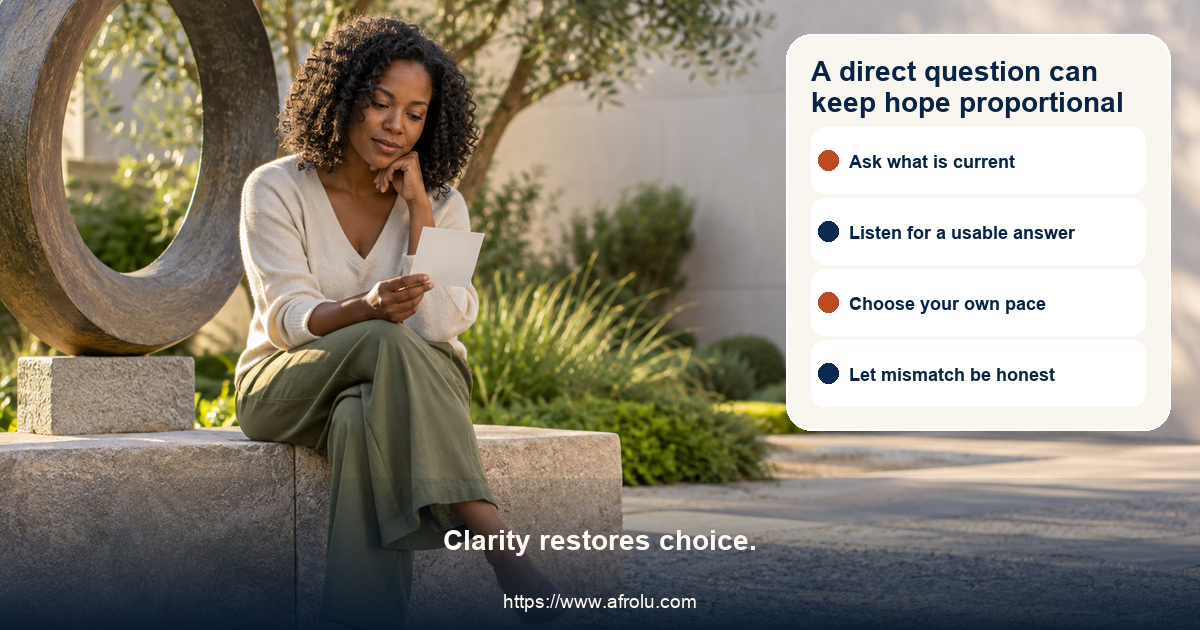
A direct question about seriousness can be modest, current, and useful even when neither adult knows the final outcome
Before you ask, name the decision in front of you. You may want to know whether the person dates multiple people, whether they are open to building a relationship, whether a regular rhythm is realistic, or whether they prefer an occasional casual connection. These questions become less frightening when you do not ask them to settle every future possibility at once.
Use plain language. 'I am dating with a serious direction, and I want to understand what you are open to now' can begin a useful conversation. You can add the boundary that matters: 'I do not need a promise, but I do need to know whether we are both considering something that could grow.' That leaves room for an honest no or not now.
Listen for specific present content. Someone may say they are interested in intentional dating but need a slower pace; they may say they are not looking for exclusivity; or they may say they cannot offer regular contact. Each answer gives you a choice. Words that become more vague whenever you ask for a practical detail may leave you with a label but no usable arrangement.
You do not have to decide in the same conversation. You can take a day, lower the pace, pause physical intimacy, continue casually with explicit limits, or step back. A clarity conversation has worked if it returns your ability to choose. It has not failed merely because another adult cannot offer the outcome you hoped for.
consent · other dates · pace
Serious intention does not make intimacy, images, exclusivity, or access automatic; each needs a present agreement
New beginnings can create a pull to make the connection feel more real through intimacy or exclusivity before either adult has said what those choices mean. One person may assume that a serious direction means they are not dating others; another may treat it as an intention to explore without an agreement yet. The gap can create emotional and sexual-health risks when it remains unspoken.
Name the specific question before a decision needs it. Ask whether either adult is dating other people, what information matters for safer intimacy, whether private images are welcome, and what pace feels voluntary. A person can answer that they are not ready, and you can decide what that means for you without framing the answer as rejection or failure.
Keep your own body and access under your control. You can meet publicly, leave at the time you choose, decline a private setting, stop touch, refuse to send images, or change your mind after planning a date. A serious future does not create a debt in the present, and an adult who respects you will not require you to prove interest by moving faster.
If someone treats a boundary as evidence that you are not serious, repeatedly pushes after you have said no, or asks for secrecy around intimacy, slow down. You may choose less contact, a different setting, a direct close, blocking, or support depending on the pattern. Clarity about serious intent should increase voluntary choice, never narrow it.

Ask for the next honest answer.
privacy · money · independent life
A new serious direction does not require access to your home, routine, accounts, documents, money, contacts, or wider social world
A person who says they want something serious may ask for a kind of access that feels like proof: a home address, live location, an account, a password, a code, personal documents, an image, a financial favour, a shared purchase, or rapid inclusion in your social world. You can keep each category separate. Interest does not make every request proportionate.
Use ordinary independence. Keep your own transport, payment methods, devices, accounts, verification codes, documents, and financial decisions under your control. Do not lend, send, receive, move, or hold money for a situationship. If a claim is consequential, verify it through contacts and institutions you find independently rather than through a link, screenshot, or urgent instruction supplied by the person asking.
Choose disclosure deliberately. You may share parts of your life when it feels right, but a friend, relative, colleague, or community is not evidence you owe someone. A serious connection can develop without turning other people into an audience, a source of approval, or a route for a new date to learn more than you want to reveal.
Watch how a boundary changes the relationship. A person who respects a serious direction can still hear a financial no, accept gradual privacy, and tolerate a slower introduction. If the answer becomes guilt, secrecy, threats, pressure, monitoring, or a search for alternate access, stop treating it as a request for reassurance and move toward safety.
proportion · safety · exit
A serious-direction mismatch may call for an honest ending; coercion, financial manipulation, monitoring, or fear call for protective action
A person may be unavailable, casual, inconsistent, or uncertain in a way that does not fit what you want. It can hurt to learn that the connection will not become serious, but you can respond proportionately: ask once, choose a smaller arrangement, pause, or end it. An honest mismatch can be enough reason to leave without turning it into a safety accusation.
The category changes if someone seeks money, accounts, codes, documents, private images, or secrecy through emotional pressure; follows you, monitors your activity, uses new accounts after a block, threatens exposure, refuses a clear no, or leaves you afraid to change a plan. These patterns are about reducing your ability to choose, not about normal uncertainty in early dating.
Use the action that gives you more control. That may mean reducing access, blocking or reporting, telling someone you trust, securing accounts, saving information only if safe, or reaching out to specialist, platform, legal, or urgent local support. If you fear retaliation, consider safety before announcing a change, and use safer devices where appropriate.
An ending does not require a final conference. A short message may be enough if it is safe; no further engagement may be safer in other circumstances. A guide cannot evaluate immediate danger from a page. Trust your context, prioritise your safety, and seek urgent local help when you believe a person may be in immediate danger.

Keep direction, consent, systems, and exits separate.
future practice · self-trust
A better serious-dating standard lets you stay open to connection without asking hope to override what you can see and choose
Carry forward a small practice: name the direction you are dating in, ask what someone can offer now, choose a plan that fits your actual capacity, discuss exclusivity and intimacy before assuming them, keep personal systems separate, and let a boundary be complete. These are not guarantees. They are ways to learn whether someone can be serious without asking you to abandon independence.
Let evidence be ordinary. A person who communicates a change, offers a realistic alternative, answers a direct question, accepts a boundary, keeps their own systems separate, and does not punish your no is giving you better information than a compelling declaration. You do not need to downgrade the value of such conduct because it looks less dramatic than a promise.
Keep your existing life in view. Work, rest, friends, family, study, care responsibilities, privacy, interests, and solitude are not barriers a serious connection must defeat. They are the conditions that help you recognise whether a relationship actually fits. A compatible person may have different capacity, but neither adult should have to disappear to make seriousness believable.
When you encounter pressure, unwanted pursuit, financial manipulation, threats, monitoring, image abuse, coercion, or fear, make protection the serious choice. Limit access, use report and block tools, preserve information only if safe, and seek local or specialist help. Your right to safety does not depend on being able to explain the whole relationship perfectly.
Eight new-journey situationships where serious direction, capacity, intimacy, access, money, an ending, or safety changes the next move
A label arrives before a plan
One adult says they want something serious but cannot describe availability, exclusivity, or a next meeting.
Ask for the present arrangement rather than a larger promise.Busyness has no alternative
A person repeatedly invokes career pressure but offers no usable rhythm or repair after missed plans.
Treat the current availability as information.An honest answer disappoints
One adult wants a serious direction while the other wants a casual connection for now.
Choose a smaller agreement or an ending without persuasion.Future hope becomes present access
Regular messages lead one adult to assume no one else is dating, while the other has not agreed.
Ask before intimacy or more investment.Seriousness is used as pressure
A person says a private setting, image, or overnight plan proves commitment.
Keep consent current and decline the particular request.Trust becomes access
Someone asks for a home detail, account access, code, document, or financial exception to show the connection is real.
Keep systems separate and verify independently.A close becomes a debate
After a direct ending, the other adult wants repeated explanations about why serious intent changed.
Use a short close and reduce access if needed.Access continues after no
New accounts, threats, monitoring, image pressure, or money requests follow a boundary.
Move from clarity to reporting, blocking, support, and safety planning.Fourteen observable signs that serious situationship exploration remains mutual, vague, pressuring, controlling, or unsafe
Serious intent is described as present behaviour rather than a deadline or dramatic promise.
Both adults can name what level of contact and planning they can realistically sustain.
Career, busyness, income, or status do not replace a usable relationship offer.
A direct question about availability, casual dating, exclusivity, or future direction receives an honest answer.
A changed plan is communicated with a realistic alternative or an honest no.
Intimacy, sexual-health choices, other dates, images, privacy, and a private setting are discussed separately.
Either adult can choose a smaller plan, slower pace, pause, or ending without being shamed.
Home, routine, accounts, documents, codes, money, devices, and social circles remain gradual.
No transfer, financial exception, account access, document share, or secret request enters the connection.
A new serious direction leaves room for rest, work, privacy, friends, and existing responsibilities.
A future story is matched by modest present conduct.
A boundary is accepted without guilt, bargaining, monitoring, or pressure.
An ending is allowed to stay an ending.
Threats, financial manipulation, image pressure, repeated pursuit, coercion, monitoring, or fear require protection.
A proportionate decision map for serious intent, capacity, plans, exclusivity, consent, privacy, money, mismatch, endings, and safety
| Situation | What it may mean | What to do next |
|---|---|---|
| You want serious dating | Your preference needs a present-tense translation. | Name the conduct and information that would make a connection workable. |
| They cite career pressure | Capacity may be real but the offer may still be too small. | Ask what rhythm they can actually sustain. |
| You ask what they want | The answer may be different from your hope. | Treat an honest mismatch as usable information. |
| Plans repeatedly drift | Warmth may be replacing a dependable arrangement. | Request one concrete alternative or reduce investment. |
| You consider intimacy | A current decision needs current terms. | Ask about other dates, consent, health, images, and pace. |
| They call your boundary un-serious | Commitment language may be being used as leverage. | Keep the boundary and slow or end the connection. |
| They request systems or money | The situation has entered a risk category. | Decline, secure access, and verify independently. |
| You want to introduce them widely | Visibility may be moving faster than the relationship. | Choose disclosure in layers and at your own pace. |
| They disagree with your ending | A mismatch may be becoming a negotiation over access. | Use a short close and reduce contact. |
| You feel afraid to change the plan | The relationship question may have become a safety concern. | Prioritise control and local or specialist support. |
Twelve complete lines for serious direction, capacity, a plan, intimacy, privacy, money, a mismatch, and a final boundary
“I am dating with a serious direction, and I want to understand what you are open to now.”
“What rhythm can you honestly sustain in this season?”
“If this week does not work, what specific alternative can you offer?”
“Before we go further, are either of us dating other people?”
“I want to talk about expectations and boundaries before I offer more access.”
“I keep my home, routine, accounts, and social circle private until I choose otherwise.”
“I do not transfer money, share codes, or provide documents in dating connections.”
“I can be open to what grows, but I need a workable arrangement now.”
“That is not the kind of connection I am choosing, even though I respect your answer.”
“I want to think about what fits me before I make another plan.”
“This arrangement is not working for me, so I am stepping back.”
“I asked you not to contact me again. Do not contact me further.”
Know the difference
A serious new dating direction can be intentional and free, or it can become a deadline, status performance, or access pressure
Both adults share present information, build a realistic rhythm, keep consent and access current, and retain the option to revise or leave.
One adult uses a serious label, career story, future hope, or fear of loss to avoid clear terms or seek more access.
Seriousness becomes trustworthy through ordinary conduct that leaves both adults more free, not less.

Seriousness should increase freedom, not access pressure.
Keep intentional serious exploration distinct from promise-led ambiguity, privacy pressure, financial manipulation, unwanted pursuit, and conduct that reduces freedom
| Type or dimension | What it describes | Best next question |
|---|---|---|
| Intentional serious dating | A future direction is paired with direct present communication and realistic plans. | Discuss the next agreement rather than assuming permanence. |
| Early serious exploration | Both adults are learning without a settled commitment. | Ask the question that changes the next decision. |
| Mutual casual connection | Limits, other dates, and current consent are understood without pretending to be serious. | Keep the arrangement explicit as it changes. |
| Capacity mismatch | The amount of connection one adult can offer does not fit the other's need. | Choose a smaller rhythm, pause, or ending. |
| Promise without plan | Serious language appears without practical follow-through. | Return to observable present conduct. |
| Privacy pressure | Home, accounts, documents, money, routine, or social circles are treated as proof. | Layer access and reduce it after pressure. |
| Financial manipulation | Urgency and intimacy seek a transfer, code, document, account, or secret. | Decline and independently verify any claim. |
| Unwanted pursuit | A no, silence, or block is followed by new contact routes or threats. | Report, block, and seek support as needed. |
| Coercion or fear | Monitoring, image pressure, threats, or isolation reduce voluntary choice. | Prioritise safety planning over relationship repair. |
A simple plan you can use today
Serious is a direction
A serious preference guides present choices without requiring an early guarantee.
Capacity needs a shape
Career and other obligations are useful information when they lead to an honest plan, alternative, or no.
Clarity can stay modest
A direct question can ask about current availability without demanding a lifetime promise.
Consent stays separate
A serious future does not decide intimacy, images, exclusivity, privacy, or a private setting today.
Systems remain independent
Money, documents, accounts, codes, devices, and social proof are not prerequisites for a real connection.
Safety outgrows the label
Pressure, coercion, financial manipulation, monitoring, threats, pursuit, and fear need protection.
Questions organised by purpose and depth
Choose a few prompts that fit the moment. This is a reference library, not a list to complete.
Serious direction
Use before hoping an early connection will define itself.
- What does serious change in my choices this week?
- What present offer would fit me?
Capacity and plans
Use when career or other commitments shape the connection.
- What rhythm can each adult sustain honestly?
- What alternative would make a missed plan usable?
Intimacy and access
Use before a connection becomes more physical, exclusive, private, or visible.
- What information changes my next decision?
- What access remains private for now?
Safety and exit
Use when pressure, money, or unwanted contact makes choice harder.
- Would I make this exception outside dating?
- What action returns control to me now?
What deserves a closer look
Turn serious intent into behaviour
Name the plans, communication, boundaries, and information that make serious exploration workable for you.
Evidence limit: No preference can force another adult's future.
Make real life visible
Offer a contact rhythm, alternative, or honest no that fits current obligations.
Evidence limit: Busyness cannot be converted into proof of care.
Ask for the next honest answer
Discuss present availability, other dates, relationship direction, and plans before assuming them.
Evidence limit: A clear answer does not guarantee an outcome.
Keep access and intimacy current
Treat touch, sex, images, exclusivity, a private setting, and timing as separate choices.
Evidence limit: Earlier affection does not settle the next decision.
Preserve independent systems
Layer home, routine, money, accounts, documents, codes, devices, and social visibility.
Evidence limit: Privacy should not become control of another adult.
Respond to reduced freedom
Use platform tools, trusted support, safer-device practice, and urgent help for financial manipulation, pursuit, threats, monitoring, coercion, or fear.
Evidence limit: Do not wait for a complete explanation before protecting yourself.
Shortcuts that turn serious intent or career capacity into deadlines, unwanted access, financial risk, pressure, or fear
Treating serious as a deadline
An early connection cannot responsibly provide certainty it has not had time to earn.
Reading career status as relationship evidence
Busyness, ambition, title, or income cannot replace a clear present offer.
Accepting a promise without a plan
Future language is not a substitute for current availability and repair.
Assuming serious intent settled exclusivity
Other dates, intimacy, health, images, and privacy remain separate conversations.
Giving access to prove commitment
Money, accounts, documents, codes, home details, and social proof can create hard-to-reverse exposure.
Staying in a safety conversation too long
Pressure, threats, pursuit, monitoring, or fear call for protection rather than more explanation.
Explore serious dating, ask a useful first-date question, or protect your dating capacity
Choose the guide that fits your immediate decision. An editorial resource can help you name a preference, but it cannot promise another adult's honesty, availability, or conduct.
Explore the guide library
Show more related guides
Continue with Afrolu
Show more Afrolu guides
Sources used for this guide
Afrolu reviewed these health, research, safety, or public guidance resources while editing this page. They support the behaviour and safety guidance; they do not diagnose any individual described by a reader.
Questions about serious situationships in a new dating journey
Can I want a serious relationship while I am just starting to date again?
Yes. Serious intent can guide your present choices without requiring an early connection to promise an outcome.
How do I explain serious intent without sounding demanding?
State what you are open to now and ask what the other adult can offer. Focus on current plans and boundaries, not a lifetime guarantee.
What if career pressure limits someone's availability?
Ask for the rhythm they can actually sustain. A smaller honest offer may be workable; repeated vagueness is also useful information.
Should I assume exclusivity if we both say we want something serious?
No. Discuss other dates, intimacy, sexual-health choices, images, and exclusivity before a decision that needs the information.
Can I slow down physically even if I want a serious relationship?
Yes. Serious intent does not make intimacy automatic. You can set the pace, change your mind, and keep each step current.
When should I introduce someone to friends or family?
When you choose. Social visibility is not proof of seriousness and does not need to precede trust or a clear agreement.
Should I make a financial exception for someone who says they are serious?
No. Keep transfers, accounts, codes, documents, money, and urgent requests separate from dating, and verify consequential claims independently.
What if someone says my boundary means I am not serious?
A serious connection should respect current consent and privacy. Keep the boundary and reconsider the arrangement if pressure continues.
Can I end a situationship just because it does not match my direction?
Yes. A mismatch in serious intent or capacity is enough reason to step back without proving the other adult did something wrong.
What if they continue contacting me after I end it?
Reduce access, report or block through available tools, preserve information only if safe, and seek trusted or specialist support if pursuit continues or you feel unsafe.
One thing to do now
Choose the next serious connection that preserves your capacity, privacy, and freedom
Choose the smallest next action that protects your time, rest, private life, money, accounts, documents, current consent, independent movement, support network, career capacity, and ability to redesign or end the connection without pressure, monitoring, financial exposure, coercion, threats, or fear.